
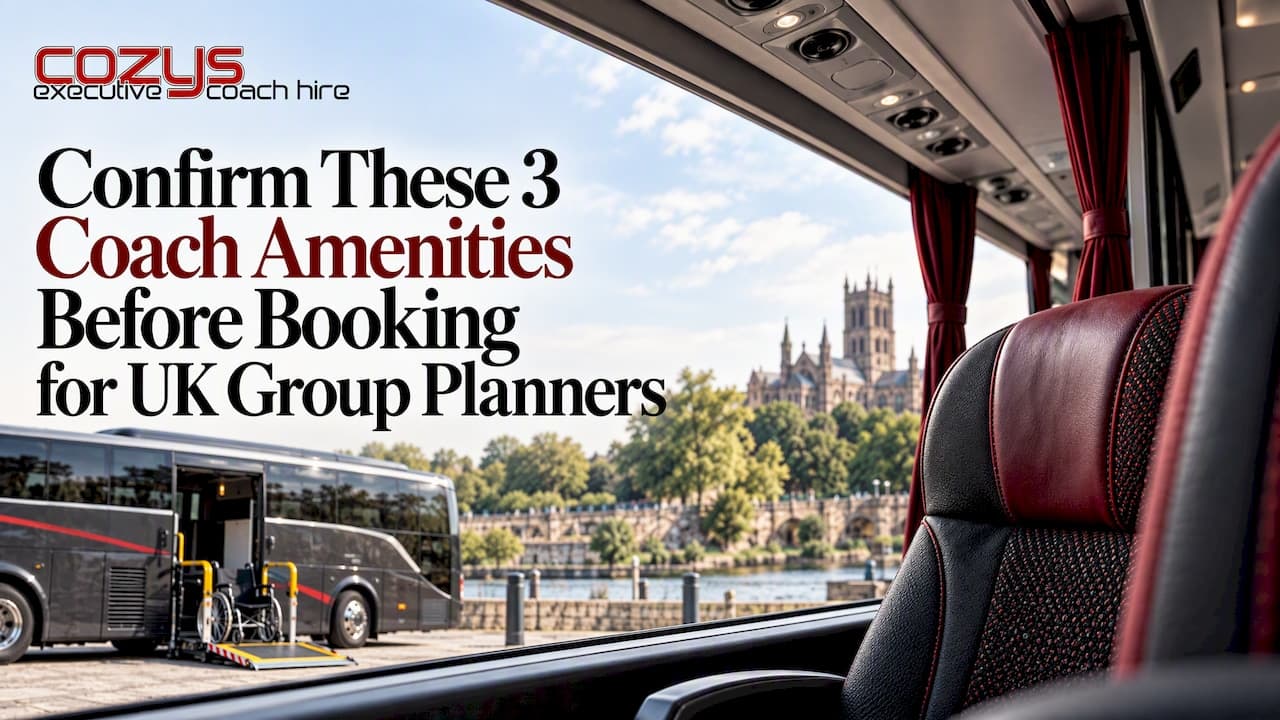
A modern coach should offer comfortable seating, reliable climate control, an onboard toilet, some form of connectivity, secure luggage storage and, where needed, wheelchair accessibility. Before confirming any booking, planners should verify three things: wheelchair compatibility if the group needs it, toilet provision for journeys over three hours, and whether the seat layout matches the passenger list. A modern coach operator sets out these priorities below.
TL;DR:
Verify that the coach has enough seats for all passengers, including any luggage or adaptive equipment, before booking to avoid last-minute issues.
Confirm the HVAC system’s zoned climate control, last service date, and functionality of roof vents and dehumidification for comfort on extreme weather journeys.
Understand Wi-Fi reliability is often limited, and charging points vary; always ask whether they include mains sockets, USB ports, and support presentation equipment.
Check that onboard toilets have sufficient capacity for the trip length, and inquire about cleaning routines, sanitizer availability, and signage for proper use.
Provide detailed wheelchair specifications in advance to ensure securement and accessible toilet availability, as not all accessible coaches include fully equipped facilities.
Table of Contents
-
Accessibility, legal duties and what organisers must confirm
-
Publisher perspective: forty years of practical lessons from operating coaches
Seating and interior comfort
Coach seating generally falls into two categories. Standard seats offer fixed or limited recline with cloth upholstery, while executive or premium seats add deeper recline, leg rests and higher-grade upholstery designed for longer journeys. The difference matters most on trips over two hours, where limited recline becomes noticeable discomfort by the final stretch.
Seat pitch, the distance between rows, determines how much legroom passengers get and how easily they can move to the aisle or toilet. A tighter pitch increases capacity but restricts movement, which matters for groups with older passengers or young children who need frequent access to the aisle.
Organisers should confirm several details before booking:
-
Seat count against passenger numbers, allowing for luggage or equipment that might reduce usable seats.
-
Removable seats or wheelchair bays, if any passengers require wheelchair space rather than a standard seat.
-
Armrest and tray table movement, particularly for passengers with mobility needs who require extra space to transfer.
Confirming these details early avoids last-minute seating changes on the day of travel.
Climate control, ventilation and passenger comfort systems
Coach HVAC systems work differently from building air conditioning. They cool or heat a moving cabin with variable passenger loads and frequent door openings, which means output can lag behind demand on hot days or long idles in traffic. Common failure points include blocked roof vents, uneven airflow between front and rear rows, and condensation build-up on humid journeys.
Ask the operator whether the coach has zoned climate control, when the system was last serviced, and whether roof vents and dehumidification are functional. For journeys in extreme heat or cold, it is worth briefing the group to bring layers or a light blanket, and to have a contingency plan such as a rest stop if the system underperforms.

Connectivity and power: Wi-Fi, USB and AV systems
Onboard Wi-Fi is common on modern coaches but rarely dependable throughout a journey. Coverage gaps on rural or motorway stretches and data caps set by the operator can interrupt streaming or video calls, so tour leaders should treat it as a bonus rather than a guarantee.
Charging provision also varies considerably between vehicles. Before booking, confirm:
-
Whether sockets are USB-only or include 230V mains, since laptops and some medical equipment need mains power.
-
How many charging points exist per seat, as older coaches may only offer shared points along the aisle.
-
Whether the PA and AV system supports a presenter microphone, useful for guides running commentary.
Guides running presentations should carry a portable speaker or battery pack as a fallback, and load any video or audio content locally rather than relying on streaming.
Onboard toilets, water supply and hygiene
Most coach toilets use a chemical system with a fixed tank capacity, which limits use on very long or heavily used journeys. Executive vehicles increasingly fit more advanced systems, but tank limits still apply, so toilets reduce the need for unscheduled stops rather than removing it entirely.
For itinerary planning, this means fewer roadside breaks but a firm cap on how many passengers can use the toilet before it needs emptying. Ask the operator about their cleaning routine between trips, whether hand sanitiser is provided, and whether clear signage explains how to use the system correctly.
Luggage, equipment and onboard storage options
Underfloor luggage bays are specified by weight and volume, and operators set load limits to keep the vehicle within its legal gross weight. Standard suitcases fit easily, but bulkier items such as wheelchairs, bicycles or fragile equipment may need pre-arranged space or a different vehicle configuration.
Internal overhead racks suit smaller bags and coats but are not designed for heavy items. For group trips, label luggage by passenger or subgroup and share a simple manifest with the driver so loading and unloading at multiple stops runs smoothly rather than becoming a scramble at each stop.
Accessibility, legal duties and what organisers must confirm
UK law requires coaches used for accessible services to provide a working lift or ramp, at least one wheelchair space with proper securement, adequate lighting for safe boarding and alighting, and drivers who will assist disabled passengers on request, according to Gov. These are baseline duties, not optional extras, on vehicles offering wheelchair access.
A coach advertised as “wheelchair accessible” does not guarantee an accessible toilet is fitted, since some accessible vehicles lack one even while offering ramps and secured wheelchair bays. Organisers should always supply the wheelchair’s make, model, weight and dimensions when booking, since securement systems vary and not every wheelchair fits every bay.
A short checklist before confirming: wheelchair space reserved and securement confirmed, accessible toilet availability checked if relevant, and driver briefed on assistance needs ahead of the journey.

How to match amenities to trip type and passenger needs
Matching amenities to the trip starts with two questions: how long is the journey, and how much does comfort matter compared with simply moving people from A to B. A three-hour transfer needs a toilet and decent seating; a twenty-minute school run does not.
-
Day trips need comfortable seating and climate control, with a toilet a strong preference over three hours.
-
Overnight tours need executive seating, reliable toilets and charging points for multi-day comfort.
-
Corporate transfers need reliable Wi-Fi and mains power more than reclining seats, since passengers often work en route.
-
School journeys prioritise seat count, safety features and driver familiarity over onboard extras.
Pro Tip: If an operator cannot confirm toilet condition, Wi-Fi reliability or wheelchair securement in writing before booking, treat that as a reason to ask for a different vehicle.
Publisher perspective: forty years of practical lessons from operating coaches
Booking the right amenities is rarely about picking the newest coach. It is about matching a vehicle’s real specification to a group’s actual needs, which is where most planners go wrong: they assume “executive” means fully accessible, or that Wi-Fi means reliable Wi-Fi throughout.
Cozy Travel operates a fleet ranging from 16 to 85 seats, including the UK’s first hybrid coach, and holds a six-star BUSK safety rating alongside Category D driver training for staff assisting passengers with additional needs. Guaranteeing a wheelchair space means confirming it at the point of enquiry, not on the day, and drivers trained to this standard are expected to assist without being asked twice.
— Cozys
How Cozy Travel helps you secure the right amenities
Booking a coach with the right amenities does not have to involve guesswork about what the operator can actually provide. Cozy Travel publishes its fleet specifications and offers wheelchair-accessible coach hire built around confirmed wheelchair compatibility rather than a generic “accessible” label.

Organisers planning group trips can confirm exact seating, toilet provision and accessibility needs directly when enquiring, rather than discovering gaps on the day of travel.
-
Coach Hire services cover general group transport across various vehicle sizes.
-
Accessible transport services confirm wheelchair securement and driver assistance in advance.
-
Corporate and school transport services match vehicle type to journey purpose.
To confirm amenities for your group, start with a coach hire enquiry.
Sources
For legal detail on accessibility duties, see GOV.UK’s accessibility guidance. Planners weighing how amenities affect trip cohesion may also find this piece on convenience in business travel useful background.
FAQ
What amenities are available on National Express coaches?
Amenities vary by route and vehicle, but National Express coaches typically include reclining seats, onboard toilets and Wi-Fi on many services. Specific features such as power sockets or accessible toilets depend on the coach assigned to that route, so it is worth checking directly for a particular journey.
Can passengers use the toilet while the coach is moving?
Yes, coach toilets are designed for use while the vehicle is in motion, though passengers should hold handrails when moving through the aisle. Onboard toilets typically use a chemical system with limited tank capacity, so operators still plan occasional rest stops on longer routes.
How much does hiring a coach cost per hour?
Coach hire pricing depends on the operator, vehicle size and journey length, and is not set as a fixed hourly rate industry-wide. Organisers should request a quote directly from the operator, such as through Cozy Travel’s coach hire page, based on their specific trip details.
What are the drawbacks of travelling by coach?
Coach travel can involve longer journey times than flying or driving directly, and onboard Wi-Fi coverage can be unreliable on rural or coastal routes. Toilet capacity is also limited on chemical systems, which can affect very long or heavily used journeys.
How do I confirm wheelchair accessibility before booking a coach?
Provide the operator with the wheelchair’s make, model, weight and dimensions so they can confirm the vehicle’s lift and securement system will fit, as required under GOV.UK accessibility rules. Always request this confirmation in writing before the day of travel, since not every “wheelchair accessible” coach carries an accessible toilet.