
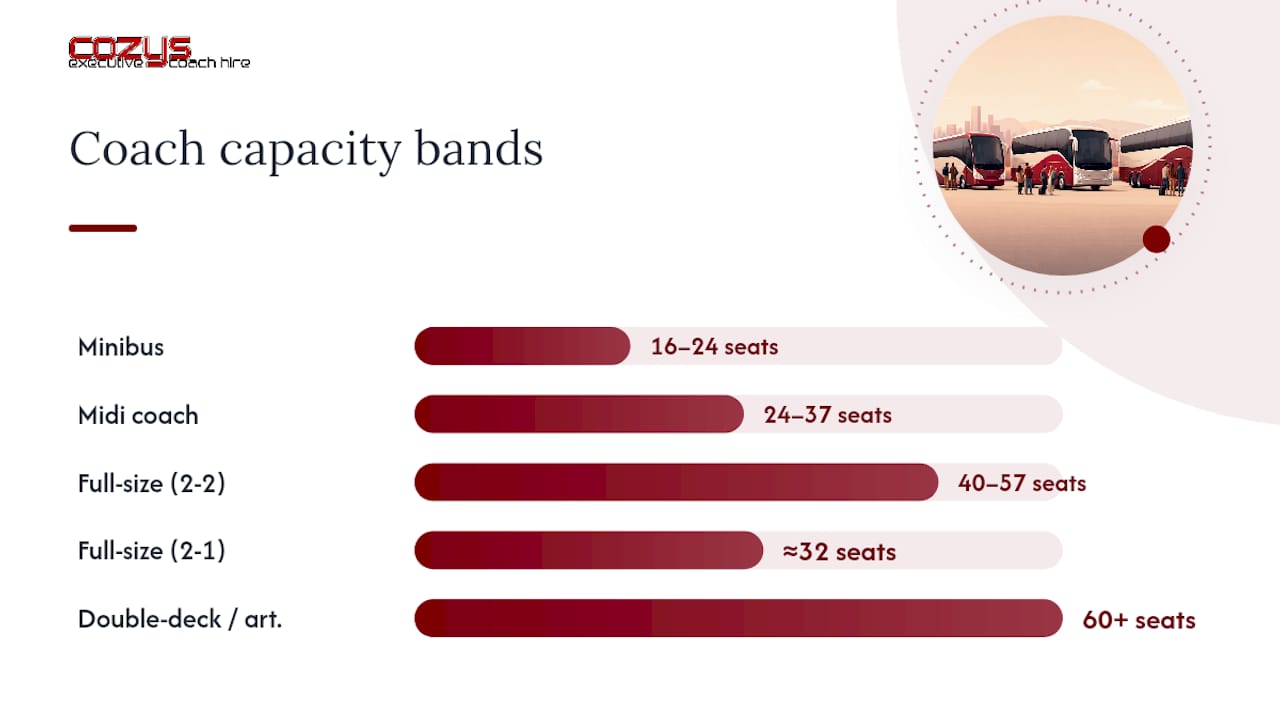
Minibuses seat roughly between 16 and 22 passengers, midi coaches accommodate mid-sized groups, full-size coaches typically have seating capacities in the range 40 to 57, and double-deck coaches seat large groups, often 60 passengers or more. The rule of thumb is simple: add your headcount, luggage volume, and trip length together, then pick the smallest class that comfortably covers all three. Layout and onboard extras shift the exact number, so always confirm the working seat count with the operator before booking.
TL;DR:
- Minibuses usually seat between 16 and 22 passengers, but actual capacity can decrease with features like luggage space or accessibility fittings.
- Full-size coaches typically have a seat range of 40 to 57, with lavatories and layout choices often reducing available seats by two to four.
- Larger groups over 60 passengers generally require double-deck coaches or multiple vehicles, especially for safety and comfort.
- When selecting a coach, consider luggage needs, accessibility, and trip length, as these factors can significantly impact actual seating and storage capacity.
- Booking a larger vehicle than the minimum needed provides extra luggage space and a buffer for late additions, often at a lower cost per person.
Table of Contents
- Coach capacity at a glance
- How coach size and seating layouts really break down
- What actually changes a coach's working seat count
- Luggage, kit, and payload: the space people forget to plan for
- How to choose the right coach or minibus for your group
- Real fleet examples: matching vehicles to common group sizes
- Why booking buffers matter more than the seat count
- Get help matching a vehicle to your group
- Sources
- FAQ
Coach capacity at a glance
Every vehicle class covers a distinct job. Getting this rough match right before you request quotes saves time and stops you overpaying for space you won't use.
- People carrier / minibus: typically seats around 16 to 22 passengers, suitable for short transfers or small groups.
- Midi coach / mini coach: accommodates mid-sized groups, seating is generally in the lower 20s to low 30s.
- Full-size coach: seats usually fall within the 40 to 57 range, often fitted with toilets and legroom for longer trips.
- Double-deck / high-capacity coach: designed for large groups, typically seating 60 passengers or more.
These bands are a starting point, not a guarantee. As detailed background on bus and coach configurations makes clear, single-deck, double-deck, and articulated designs all vary by seating pattern, so treat any published figure as approximate until the operator confirms the actual layout.
How coach size and seating layouts really break down
Seat totals come from a simple sum: rows multiplied by seats per row, minus whatever space fittings like toilets or wheelchair bays take up. A full-size coach typically has 12 to 14 rows in a 2‑2 seating layout, resulting in seat totals commonly seen between roughly 49 and 57 seats on most operator specifications.
Working from smaller to larger, the typical bands run roughly 16–24 seats for minibuses, 24–37 for midi coaches, 40–57 for full-size coaches, and 60 upwards for double-deck or articulated vehicles. Within the full-size band, a coach quoted at 53 seats rather than 57 has almost certainly had a lavatory module fitted, since that one fixture reliably absorbs a row or two of space. Industry seating references confirm that full-size coach capacity is commonly quoted in this 40–57 seat range, with lavatories being the single biggest reason two coaches of identical length carry different passenger totals.
Layout changes have an outsized effect too. Swap a standard 2‑2 arrangement for a 2‑1 executive configuration, and you lose roughly a third of the seats in exchange for wider individual seats and extra aisle space, useful for VIP transfers or long overnight journeys, but rarely worth it for a straightforward day trip where headcount is the priority. If a spec sheet lists an unusually low number for a vehicle's length, ask whether it's running 2‑1 seating before assuming there's been an error.
What actually changes a coach's working seat count
The number printed on a brochure and the number you can actually book are often different figures, and knowing why saves an awkward surprise on the day.
Seat pitch and layout pattern come first. A 2‑2 economy layout packs in the most bodies; executive 2‑1 seating trades headcount for comfort on longer journeys. Lavatory modules are the next big variable: fitting one typically removes two to four seats, a trade-off confirmed across coach seating comparisons and one of the most common reasons a "57-seater" arrives with 53 or 54 usable seats.
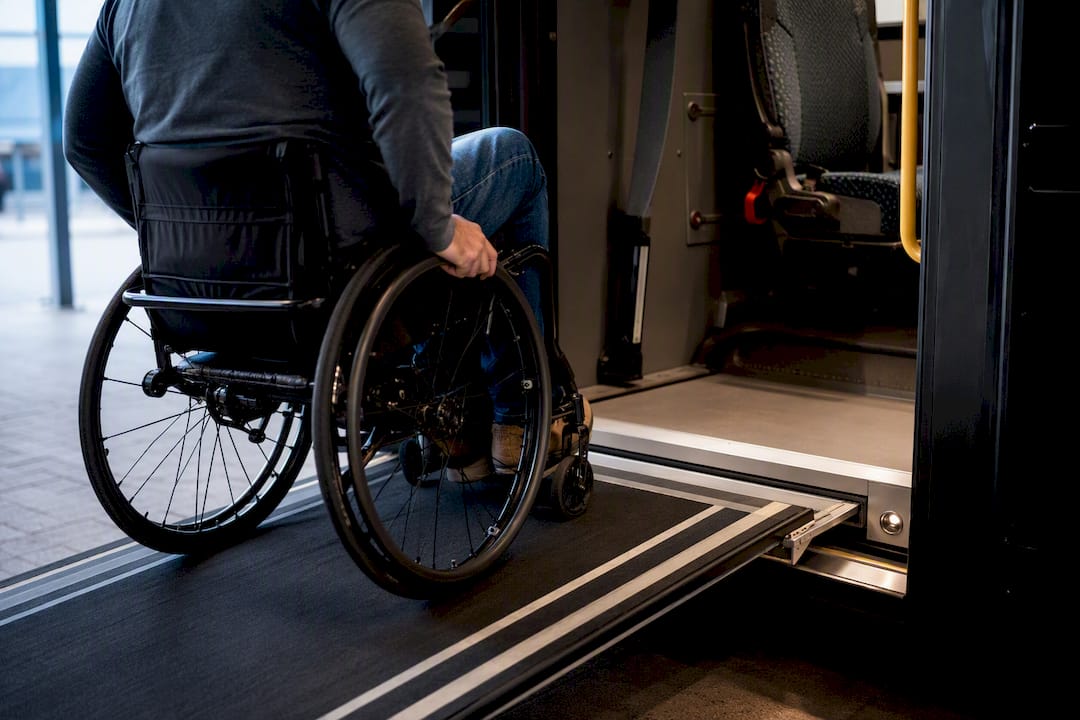
Accessibility fittings matter just as much. Wheelchair bays and foldaway seating reduce the fixed seat count whenever the space is in use, and government guidance on accessible bus and coach features sets out how ramps and designated bays are expected to work in practice. Fitted seats also aren't quite the same thing as legal capacity: an operator may quote a lower working figure than the vehicle's maximum to keep aisles clear or maintain a driver's line of sight, so never assume the brochure number is the bookable number.
Luggage, kit, and payload: the space people forget to plan for
Seat count only tells half the story. A full coach with limited underfloor space is a real problem on multi-day trips, sports tours, or anything involving instrument cases, wheelchairs, or display equipment.
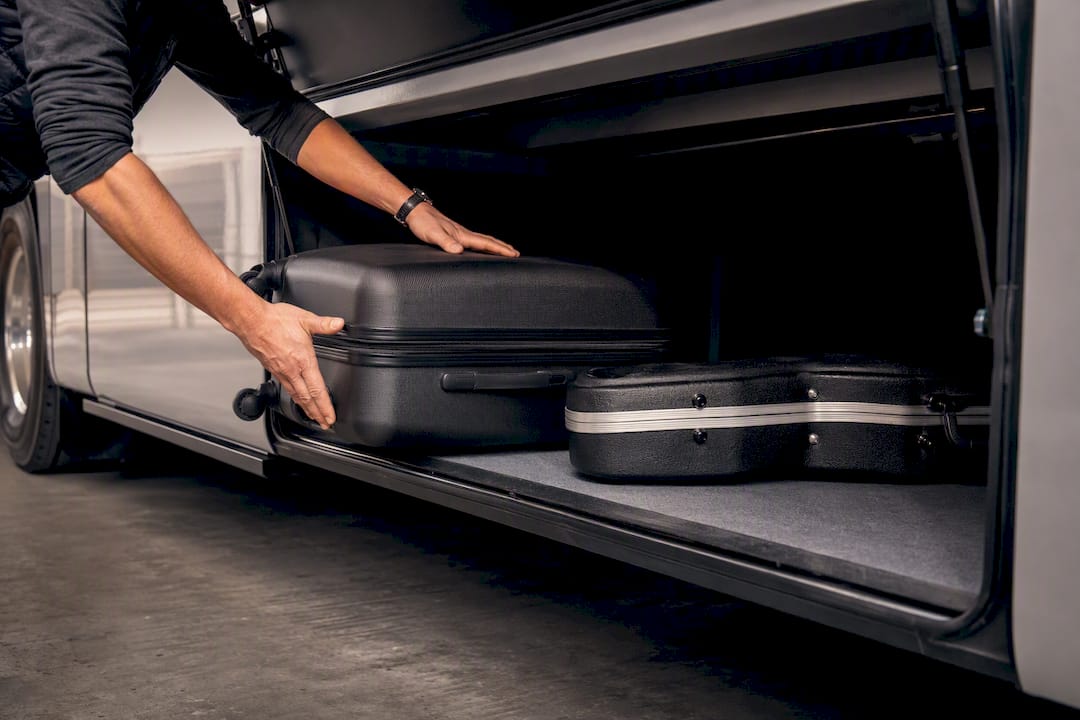
For day trips, one small bag per passenger is standard and rarely stretches a vehicle's hold. Longer trips change the maths considerably: a full suitcase per person on a 50-seat coach can fill underfloor lockers faster than the seats fill up, which is when planners either step up a vehicle class or add a second coach purely for luggage capacity. Operators typically state hold capacity in cubic metres, or in the number of standard large cases the locker will take, so ask for that figure directly rather than guessing from photos. If your group carries anything unusually bulky, get the number in writing before you confirm.
How to choose the right coach or minibus for your group
Work through this checklist before you request a quote, and you'll spend far less time going back and forth with operators:
- Confirm your final passenger count, including any late additions you expect.
- Total your luggage and equipment, not just headcount.
- Flag any accessibility requirements, particularly wheelchair users.
- Decide whether a toilet is essential for the trip length.
- Set a realistic budget per head, not just a vehicle budget.
- Confirm trip duration and whether driver hours affect the schedule.
When you speak to an operator, ask directly: what's the current seat count with this specific layout, how many large cases fit in the hold, is there wheelchair provision, is a toilet fitted, what's the seat pitch, and are there extra driver costs for longer days? Driver scheduling isn't a minor detail either. The national standard for driving buses and coaches sets out the qualifications and hours rules that shape what a long trip will cost and how it needs to be scheduled.
Treat a quote that dodges these specifics as a red flag, and ask for a current layout sheet or vehicle photo rather than relying on a headline seat number. As a rough guide, groups of 15 to 20 usually suit a minibus, 25 to 35 a midi coach, and 40 upwards a full-size coach, though your own luggage and accessibility needs can shift that up a class.
Pro Tip: If your group sits right on the boundary between two size bands, book the larger class. The extra luggage room and buffer for late joiners usually costs less per head than you'd expect, and it saves a stressful reshuffle the week before departure.
Real fleet examples: matching vehicles to common group sizes
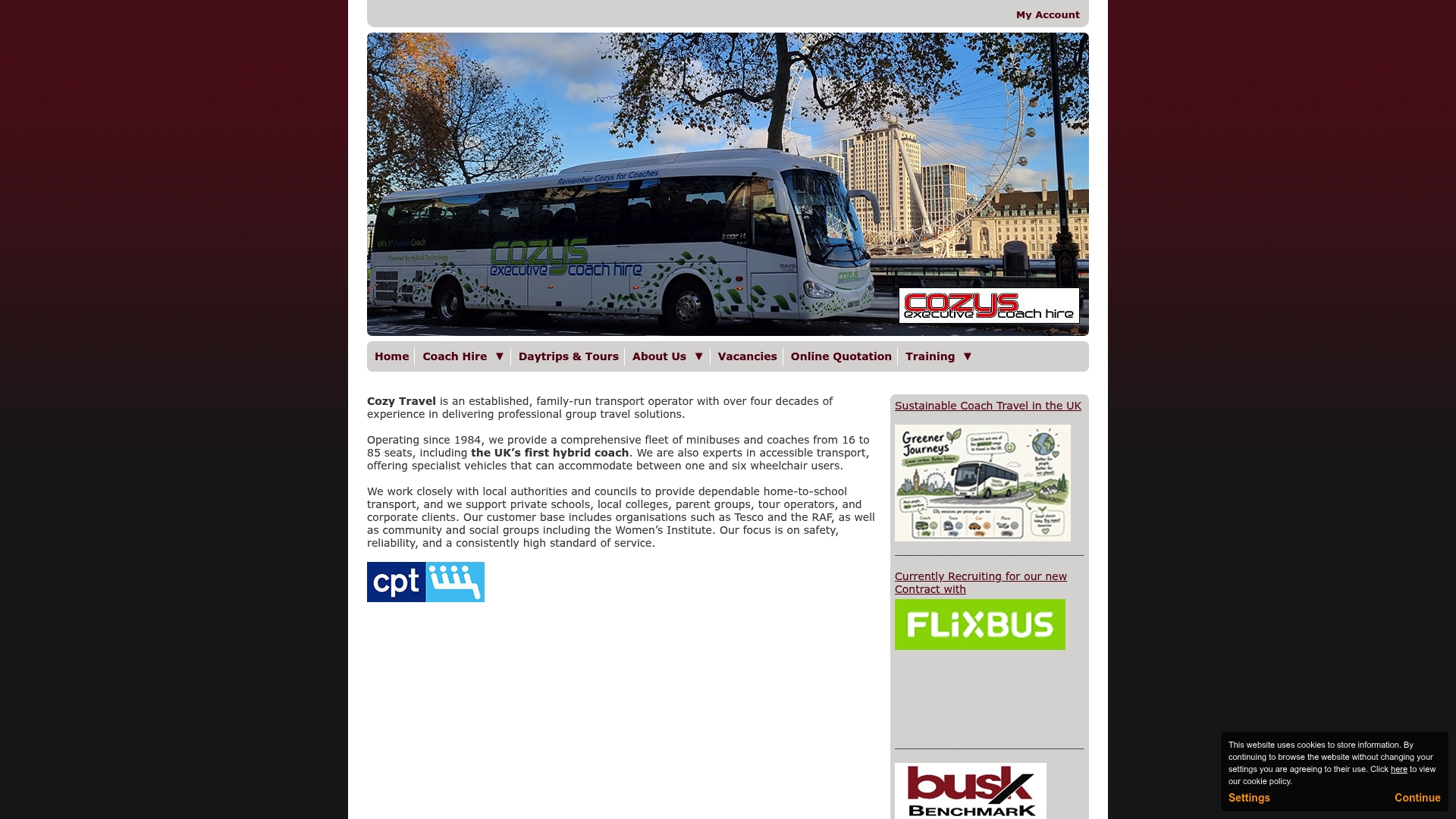
A school trip of 30 pupils plus staff typically suits a midi coach, while a 45-strong corporate away-day fits comfortably on a standard full-size coach. Cozy's coach fleet spans 16 to 85 seats, covering everything from a small community outing to a large double-deck event shuttle on a single booking.
For groups needing wheelchair access, accessible vehicle options remove the guesswork around bay provision. Every vehicle in the fleet holds the highest 6-star BUSK safety rating, and planners weighing sustainability can also ask about the availability of a hybrid coach for lower-emission journeys.
Why booking buffers matter more than the seat count
Standard seat configurations aren't an accident. Operators lean on them because a consistent, well-understood layout keeps safety checks and driver training reliable across the fleet. Build in a small buffer for late additions; it's usually cheaper than a last-minute second vehicle.
— Cozys
Get help matching a vehicle to your group
Working through seat pitch, lavatory space, and luggage capacity is a checklist applied before quoting any trip, and with fleets running from 16 to 85 seats, including accessible vehicles and some with 6-star BUSK safety ratings, matching a vehicle to your group size and duration isn't left to guesswork.
Whether you're booking a school trip, a corporate away-day, or a community event shuttle, the fastest route to the right vehicle is a direct conversation about your numbers. If your group includes wheelchair users, Cozy's accessible transport specialists can talk through bay provision and layout before you commit. For everyone else, get in touch through Cozy's coach hire page with your passenger count, luggage, and dates, and request a bespoke quote built around the layout you actually need.
Sources
FAQ
Can you fit 70 people on a coach?
Yes, but only on a double-deck or high-capacity coach. Standard full-size single-deck coaches typically top out around 57 seats, so groups larger than 60 passengers need a double-decker or two separate vehicles.
How many people can fit on a coach in the UK?
A standard full-size single-deck coach usually seats between 40 and 57 people, while double-deck coaches can carry 60 passengers or more depending on layout.
How long is a 40-seater coach?
Most 40-seat coaches have a length typical for this class, though exact length varies by manufacturer and whether the layout includes a toilet or extra legroom.
What is the capacity of a standard coach?
A standard full-size coach typically carries between 40 and 57 passengers, with the working number often reduced by two to four seats if a lavatory is fitted.
Does Cozy offer coaches for large groups?
Yes. Cozy's fleet runs from 16 to 85 seats, covering everything from small minibus transfers to double-deck coaches for large-scale group events.