
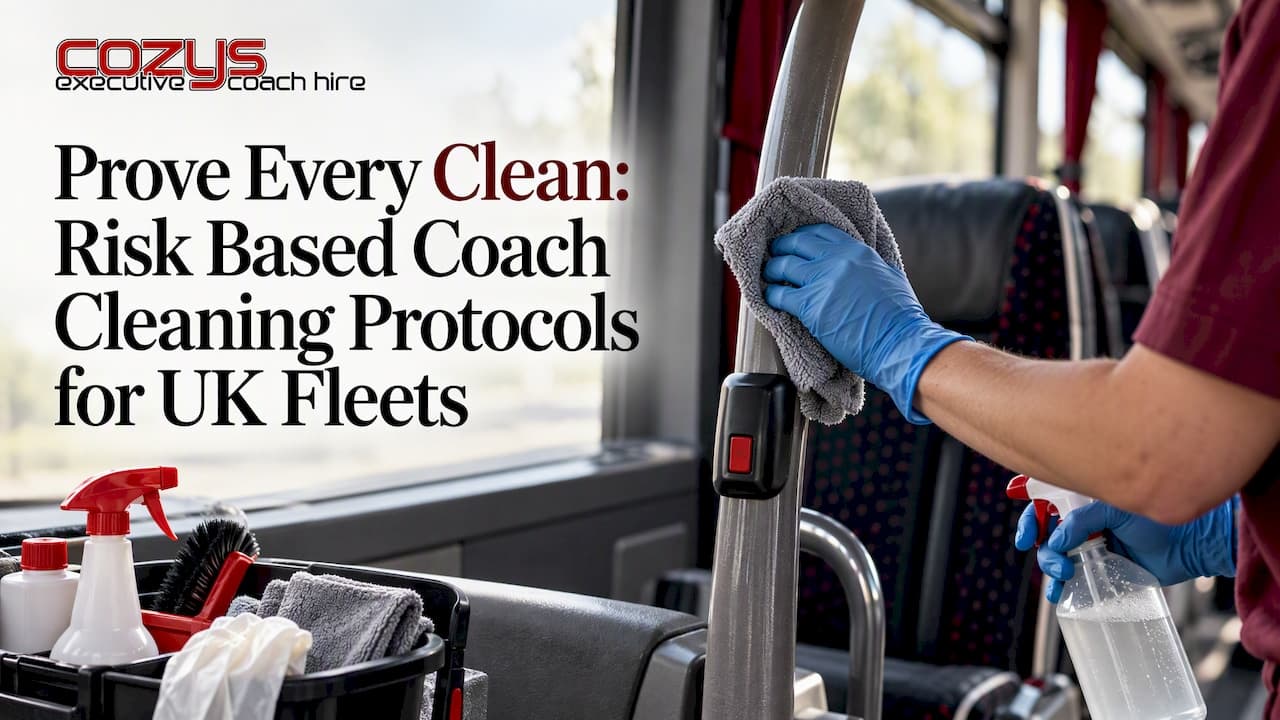
A good coach cleaning protocol prioritises frequent touch sites, ventilation and hand hygiene, and auditable, COSHH-managed procedures that staff can reliably perform. Manual cleaning remains the baseline: disinfecting fogging or UV technologies are supplementary tools, not replacements. The strongest protocols pair a documented schedule with a named responsible person, so every clean can be verified rather than assumed.
TL;DR:
Prioritizing high-frequency touch sites such as handles, rails, and switches improves passenger safety more effectively than cleaning the entire vehicle indiscriminately.
Proper ventilation, including running HVAC systems on fresh air and opening roof vents, enhances disinfection effectiveness and protects staff during cleaning.
Regular cleaning should follow structured schedules like pre-trip inspections, changeover disinfection, and weekly deep cleans, with logs recording all actions for accountability.
Use disinfectants only after conducting a COSHH assessment, and ensure staff training covers surface compatibility, PPE use, spill response, and accurate record-keeping.
Fogging, HPV, and UV disinfection have limited roles, best suited for terminal cleaning or post-infection decontamination, not as routine daily controls.
Table of Contents
-
Frequencies and scheduling: pre-trip, changeover and deep clean cycles
-
Training, records and audit: building a protocol you can prove
-
Practical perspective: risk-based cleaning beats indiscriminate sanitisation
Which areas to prioritise and why
Not every surface on a coach carries the same risk. Passengers and drivers touch a small number of surfaces repeatedly during a journey, and those surfaces deserve the bulk of the cleaning effort:
-
Entrance handles and stepwell grab rails
-
Handrails along the aisle
-
Seat belts, buckles and armrests
-
Tray tables and cup holders
-
Light, air vent and call-bell switches
-
Lavatory handles, taps and flush controls
-
Driver controls, wheel and gear selector
Government transport evidence produced during the assessment of transmission risk on public transport recommends prioritising exactly these high-frequency touch sites, alongside enhanced ventilation, ahead of blanket surface sanitisation across a vehicle interior, as set out in the transport evidence overview. This is a practical instruction as much as a scientific one: a crew with fifteen minutes at a changeover cannot deep-clean an entire coach, but it can cover every rail, handle and switch a passenger has held.
A risk-based touch-site list, cleaned consistently, does more for passenger safety than an occasional full valet. That single principle should drive how a coordinator allocates cleaning time across a shift.
Ventilation is the other half of the equation. HSE’s manual cleaning guidance recommends adequate airflow whenever disinfectants are in use, both to protect staff from inhaling vapours and to help disperse airborne particles generally, detailed in HSE’s SR4 guidance. On a coach, that means running the HVAC system on fresh-air rather than full recirculation where possible, opening roof vents during boarding and at changeover, and checking that vents are not blocked by luggage or debris. Drivers can build a quick pre-trip habit around this: open vents before boarding, check that hand sanitiser dispensers are filled, and give the main touch sites a fast wipe if the schedule has not already covered them that day.
Frequencies and scheduling: pre-trip, changeover and deep clean cycles
A cleaning protocol only works if it specifies when each task happens, not just what the task is. Most coach operations settle into four cadences.
-
Pre-trip: the driver inspects the cabin, checks that touch sites look and feel clean, and signs the log before departure; where time is tight, a fast touchpoint wipe substitutes for a full check.
-
Changeover: between passenger groups, staff clean and disinfect all touch sites and the lavatory, following the contact times printed on the product label.
-
Post-shift: at the end of the day, the vehicle gets a fuller wipe-down of seating areas, windows and floors in addition to the touch-site clean.
-
Periodic deep clean: upholstery, air vents, luggage bays and lavatories get a scheduled deeper treatment, typically weekly or fortnightly depending on use.
School runs and high-turnover event work justify tighter cadences than long-distance touring, simply because more people cycle through the same seats in a shorter window. A coordinator running a home-to-school contract might reasonably double the changeover frequency during a norovirus season at a school, while a corporate day-hire with one group all day may need only the standard pre-trip and post-shift cycle.
Whatever the cadence, the schedule itself needs to flex with demand and the flexing needs to be visible. If passenger numbers rise, a route changes to carry a symptomatic group, or a deep clean gets skipped because of a breakdown, that change belongs in the log, not just in someone’s memory. NHS decontamination guidance for reusable equipment makes the same point in a clinical setting: routine cleaning follows a fixed method, but the record of when and how it happened is what makes the process auditable, as described in Appendix 7 on decontamination.
Products, PPE and legal safety controls
Choosing a disinfectant is not just a question of what kills the most pathogens. HSE guidance on disinfectant use requires employers to run a COSHH assessment before any hazardous cleaning chemical is introduced to a workplace, coach depots included, as confirmed in HSE’s disinfectants guidance. A COSHH assessment for coach cleaning should cover:
-
A list of every chemical in use, with its safety data sheet.
-
The hazards each chemical presents, including inhalation, skin contact and flammability.
-
The control measures in place, from ventilation to PPE to storage.
-
The training staff need before they use the product unsupervised.
-
The emergency procedure for a spill, splash or accidental mixing.
Surface compatibility matters just as much as chemical hazard. NHS decontamination guidance instructs staff to check manufacturer instructions before applying alcohol, chlorine-based products or oxidisers to electronic devices, screens, upholstery or accessibility equipment, since the wrong product can degrade seals, discolour fabric or damage wiring, per Appendix 7. Wheelchair lifts, ramps and anchor points on accessible vehicles are worth a specific check, since these mechanisms often carry their own manufacturer cleaning restrictions.
PPE and respiratory protection should match the product, not a generic assumption. Gloves suited to prolonged chemical contact, skin-care provision to manage the drying effects of frequent handwashing and glove use, and a trigger for health surveillance if staff report skin or respiratory symptoms are all part of the SR4 control framework, referenced above. Respiratory protective equipment becomes relevant only where a product’s data sheet or a fogging procedure specifically calls for it, not as a default for routine wiping.
Safe handling rounds out the picture: never mix chemicals, follow the stated dilution ratio and contact time exactly, and store disinfectants away from heat sources with a spill kit close at hand.
Pro Tip: Keep a laminated copy of each product’s safety data sheet in the cleaning cupboard, not just on a shared drive, so staff can check contact times and PPE requirements without hunting for a login.
Fogging, HPV and UV: when they help and when they don’t
Fogging, hydrogen peroxide vapour (HPV) and UV-C systems have a role on coaches, but it is a narrow one. Government transport evidence notes that UV-C and HPV are effective against pathogens such as SARS-CoV-2 but carry practical and safety limits that make them poorly suited to daily operational cleaning, as set out in the transport evidence overview. HSE guidance reinforces this from a workplace-safety angle: fogging is not a routine shortcut, because airborne persistence, the COSHH controls it demands and the re-entry timing it requires make it a specialist intervention rather than a daily tool, according to HSE’s disinfectants guidance.
-
Use fogging or HPV for terminal or deep-clean situations, such as after a confirmed infectious illness on board, not as a substitute for manual touch-site cleaning.
-
Treat UV-C with the same caution: it can disinfect exposed surfaces effectively but needs full shielding and a controlled, unoccupied space to be used safely.
-
Any application demands a documented COSHH assessment, a defined re-entry time once air has cleared, and staff trained specifically in that method.
-
Manual cleaning with the right disinfectant and correct contact time remains the reliable daily control; fogging supplements it rather than replaces it, but is not suitable for routine daily use.
Before hiring a contractor to fog or UV-treat a vehicle, ask for their validation data showing the method actually achieves the claimed reduction, proof of insurance covering the work, and a written re-entry plan stating how long the vehicle must stand empty before passengers or staff go back on board.
Step-by-step cleaning procedure and incident response
Sequencing determines whether a clean actually reduces risk or just moves contamination around. The order that decontamination guidance and practitioner manuals consistently recommend runs as follows.
-
Remove visible waste, litter and soil first, working with disposable gloves.
-
Pre-clean with a detergent to lift grime before disinfecting; disinfectant applied to a dirty surface works far less effectively.
-
Apply the disinfectant and leave it wet for the full contact time stated on the product label, not wiped dry early.
-
Work from cleaner, higher areas down to dirtier, lower ones, so contamination is not spread upward.
-
Clean the lavatory last, using dedicated equipment kept separate from the rest of the vehicle.
Colour-coded cloths, one colour per zone (seating, lavatory, driver area), stop cross-contamination between areas, and single-use paper or disposable wipes are preferable wherever bare-hand contact with a soiled surface would otherwise be needed.
Body-fluid spills need a specific, faster response. A basic spill kit should hold gloves, an apron, absorbent granules or pads, a scoop, disinfectant suited to the fluid type, and clinical waste bags. The immediate steps are to isolate the area from passengers, put on PPE before touching anything, absorb the spill, disinfect the surface underneath once the bulk material is removed, and double-bag the waste for disposal as contaminated material rather than general rubbish.

Pro Tip: Keep the spill kit in the same labelled locker on every vehicle in the fleet, so any driver or cleaner can find it without searching, even on a coach they do not normally drive.
Every spill response belongs in the cleaning log alongside routine entries, and any incident involving a needle, blood or a risk of staff exposure should be escalated to a supervisor immediately rather than closed out quietly at the end of a shift.
Training, records and audit: building a protocol you can prove
A cleaning schedule earns trust when it can be checked, not just described. Each entry should show the area cleaned, the method and product used, the frequency it was due, and a signature or timestamp from the person who did the work.
-
Log the responsible person by name, not just by shift or team.
-
Record the method and product so a manager can trace back if a complaint arises.
-
Note the due frequency against the actual time completed, to flag drift.
-
Capture exceptions, such as a skipped deep clean, with the reason recorded.
Training should cover COSHH awareness, correct PPE and RPE use, spill response, surface compatibility for different vehicle materials, and how to complete the record itself, since a well-run protocol is only as good as the paperwork behind it. Independent accreditation adds a further layer of assurance: the BUSK Benchmark audits operators against safety and management criteria to award a star rating, and schools and institutional clients increasingly ask for that rating before signing a contract. Records built this way do double duty: they prove compliance to a commissioner, and they give a manager the evidence needed to adjust frequency when passenger numbers or risk change.
Practical examples and lessons from an experienced operator
A good cleaning protocol assigns pre-trip checks to drivers and a deeper depot clean to dedicated cleaning staff, splitting responsibility so nothing falls between two roles. Vehicle size affects the schedule directly: larger coaches on school contracts need a tighter changeover cadence than smaller minibuses doing single transfers, and accessible vehicles carrying wheelchair lifts get an additional check on the lift mechanism itself. Accreditation and driver training records are kept on file and produced during tendering, as part of the evidence requested by clients before awarding a contract. A simple log entry, area, product, contact time, cleaner’s name and time, adapts easily to almost any fleet size.
Practical perspective: risk-based cleaning beats indiscriminate sanitisation
Cleaning every surface equally wastes time that touch sites need more. A risk-based protocol, targeted, ventilated, logged, gets more protection from the same labour hour than a blanket wipe-down ever will. The trade-off is discipline: schedules must be reviewed as conditions change, and any commissioner should ask a supplier for its COSHH paperwork and verification records before assuming the cleaning happens at all.
— Cozys
How compliant operators support cleaning protocols
A compliant transport operator runs a fleet sized to different group needs, possibly including hybrid coaches and vehicles with high safety ratings and trained drivers, giving commissioners a documented basis for the cleaning and safety standards behind each journey. Accessible vehicles for wheelchair users are handled with the same recorded, auditable approach as the rest of the fleet.

Before booking with any operator, ask three questions: can they show a signed cleaning schedule for the vehicle you would use, do they hold a current COSHH assessment for their disinfectants, and can they produce audit or accreditation evidence such as a cleaning schedule management solution on request. If the answers check out, coach hire built on that kind of record is worth requesting a quote for, and Cozy Travel’s BUSK safety rating is available to review before you commit.
Sources
-
Transmission and control of SARS-CoV-2 on public transport (EMG transport overview)
-
Appendix 7: Decontamination of reusable non-invasive care equipment - NHS England
FAQ
How often should a coach be disinfected between passengers?
Touch sites and the lavatory should be cleaned and disinfected at every changeover, with a fuller wipe-down at the end of each shift. Deep cleaning of upholstery, vents and luggage bays typically follows a weekly or fortnightly cycle, tightened for high-turnover school or event work.
What should a COSHH assessment for coach cleaning include?
It should list every chemical in use with its hazards, the control measures such as ventilation and PPE, the training staff receive, and the emergency procedure for spills or exposure, as required under HSE’s guidance. Without this documentation, a cleaning protocol cannot be verified as compliant.
Is fogging or UV disinfection necessary for routine coach cleaning?
No, manual cleaning with the correct disinfectant and contact time remains the reliable daily method. Fogging, HPV and UV-C are better reserved for terminal or deep-clean situations because of the airborne persistence and re-entry timing they require, per government transport evidence.
Can I use rubbing alcohol to clean my coach purse?
Rubbing alcohol is only suitable for materials confirmed to tolerate it, since alcohol is flammable and can damage certain fabrics, finishes or coated surfaces, as noted in NHS supply chain safety data on alcohol-based products. Spot-test an inconspicuous area first and check the manufacturer’s own care instructions before applying it more widely.
What accreditation shows a coach operator follows proper cleaning standards?
The BUSK Benchmark is an independent audit framework that reviews an operator’s safety and management systems, including cleaning and maintenance practices, to award a star rating. Asking to see a current BUSK rating is a practical way for schools and commissioners to verify a supplier’s standards before contracting.