
Six fuel families cover the coach market today: Euro 6 diesel, renewable diesel (HVO and B100 biodiesel), hybrid, battery-electric, CNG, and hydrogen. Diesel and HVO suit long-distance and interurban work where range matters; hybrid and battery-electric fit shorter urban duties with predictable depot charging; CNG and hydrogen remain niche until refuelling networks mature. ACEA figures put diesel at 67.3% of new EU bus registrations against 12.7% electric, and chassis such as the Volvo B13R already run on HVO and B100 without modification.
TL;DR:
Diesel remains the dominant coach fuel, with Euro 6 engines significantly reducing NOx and particulate emissions through advanced after-treatment systems.
Renewable diesel like HVO offers a practical alternative for existing engines, substantially lowering CO2 emissions if the engine is compatible and the supply is secure.
Battery-electric coaches suit short routes with predictable depot charging, but infrastructure upgrades and safety protocols are critical for deployment.
Fuel choice should be dictated by route duty cycles, depot capabilities, and vehicle compatibility, with thorough testing recommended before fleet-wide adoption.
Infrastructure costs, maintenance differences, and residual value uncertainties vary widely across fuel types, influencing total cost of ownership strategies.
Table of Contents
-
Operational implications: maintenance, safety and depot changes
-
Publisher perspective: lessons from Cozy Travel’s mixed fleet
What are the main coach fuel types?
Diesel still dominates coach fleets, and Euro 6 has changed what that word means in practice. Selective catalytic reduction, AdBlue dosing, and particulate filters have cut emissions dramatically compared with older generations. While Volvo’s engine datasheets report NOx reductions of around 89% and particulate matter reductions near 50% against previous engine generations. It remains the default because the refuelling network is universal and range is never a constraint.
Renewable diesel changes the fuel, not the engine. HVO (hydrotreated vegetable oil) and B100 biodiesel can run in many existing diesel engines, though warranty terms vary by manufacturer and engine output.
Hybrid coaches pair a diesel engine with an electric motor and battery pack. Mild hybrids recover braking energy to cut idling fuel use; strong hybrids can run short stretches on electric power alone, which helps most on stop-start urban routes.
Battery-electric coaches remove tailpipe emissions entirely but bring range and charging-time limits that suit defined, shorter duty cycles better than open-ended touring work.
CNG and hydrogen occupy smaller niches:
-
CNG suits operators with access to gas refuelling infrastructure and predictable local routes.
-
Hydrogen offers diesel-like refuelling speed but remains constrained by scarce hydrogen refuelling stations in the UK.
Operational implications: maintenance, safety and depot changes
Each fuel type demands a different maintenance rhythm. Diesel and HVO vehicles need routine oil analysis, AdBlue top-ups, and after-treatment checks; battery-electric coaches shift that workload towards battery thermal management and high-voltage system inspections. CNG vehicles require periodic tank and cylinder inspections under separate pressure-vessel rules, while hydrogen systems carry their own leak-detection and ventilation protocols.
Technician training has to match the fuel mix on your yard. Diesel and HVO technicians need standard fuel-handling and AdBlue procedures; battery-electric fleets require staff with high-voltage safety qualifications before they touch a charging connector or open a battery enclosure. CNG and hydrogen add gas-handling competencies that most conventional workshops simply don’t have yet. A DVSA-approved driver training provider can extend Driver CPC modules to cover new-fuel handling, but maintenance-side competency has to be built separately.
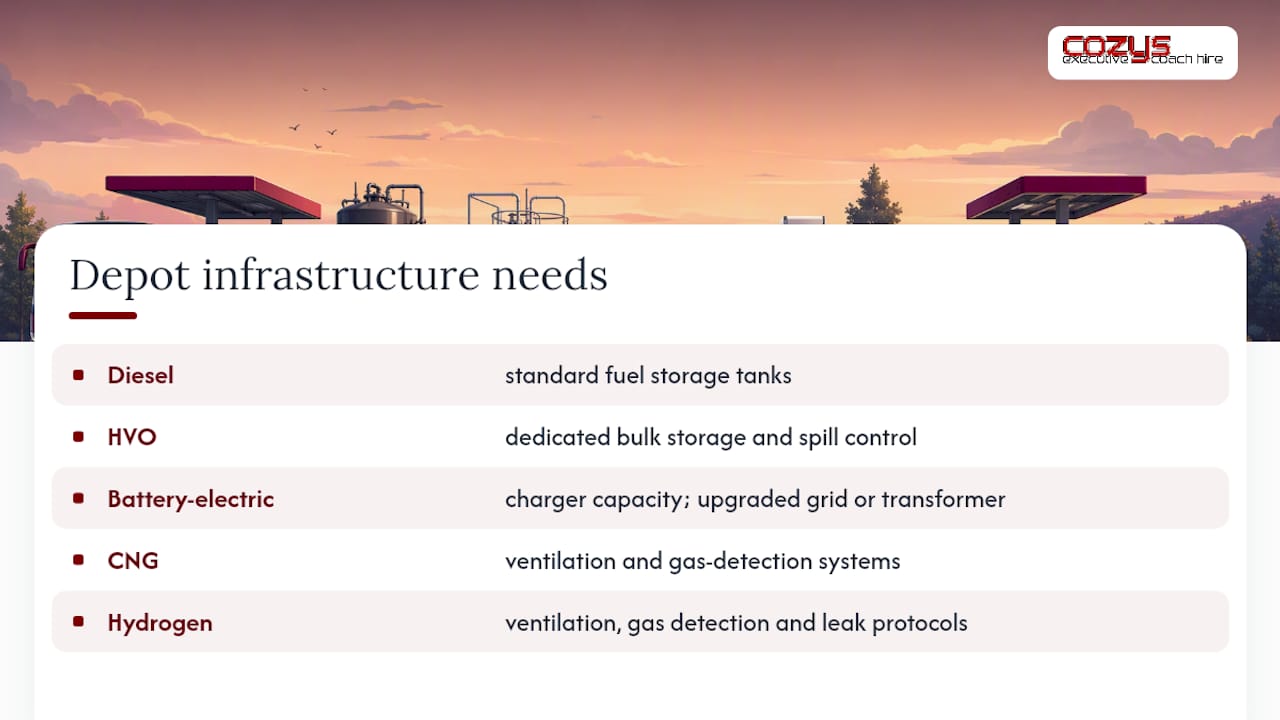
Depot infrastructure often becomes the real constraint. Battery-electric operation depends on charger power capacity and, frequently, an upgraded grid connection or on-site transformer. HVO needs dedicated bulk storage and spill-control measures if it’s stored separately from standard diesel. CNG and hydrogen both require ventilation and gas-detection systems that most conventional coach depots were never built to house.
Safety governance differs too. High-voltage incidents, gas leaks, and fuel spills each need their own emergency response plan, and mixing fuel types on one site means writing several protocols, not one.
Emissions and practical decarbonisation options
Battery-electric coaches produce zero tailpipe emissions, but that’s not the only meaningful decarbonisation route available today. Renewable diesel narrows the gap for fleets that can’t yet electrify a route.
Volvo states its B13R chassis (460 and 500 hp variants) is compatible with both HVO and B100, and the manufacturer’s own figures are striking.
-
HVO is reported by Volvo to substantially reduce CO2 impact compared with fossil diesel.
-
B100 biodiesel is also reported to reduce CO2 emissions.
Those are supplier-stated figures rather than independently audited results, but they show why HVO in particular has become the default “bridge fuel” for operators not ready to invest in charging infrastructure. The practical checks before switching: confirm the specific engine variant’s compatibility, secure a stable HVO supply contract, and verify the fuel doesn’t void your engine warranty.
Pro Tip: Ask your chassis manufacturer for written HVO/B100 compatibility confirmation by engine code, not just model name. Compatibility can vary between power outputs on the same chassis.
A realistic timeline for most fleets looks like this: switch compatible vehicles to HVO now, apply Euro 6 efficiency gains across the fleet, then electrify specific routes as depot power and vehicle range allow.
Cost and total cost of ownership drivers
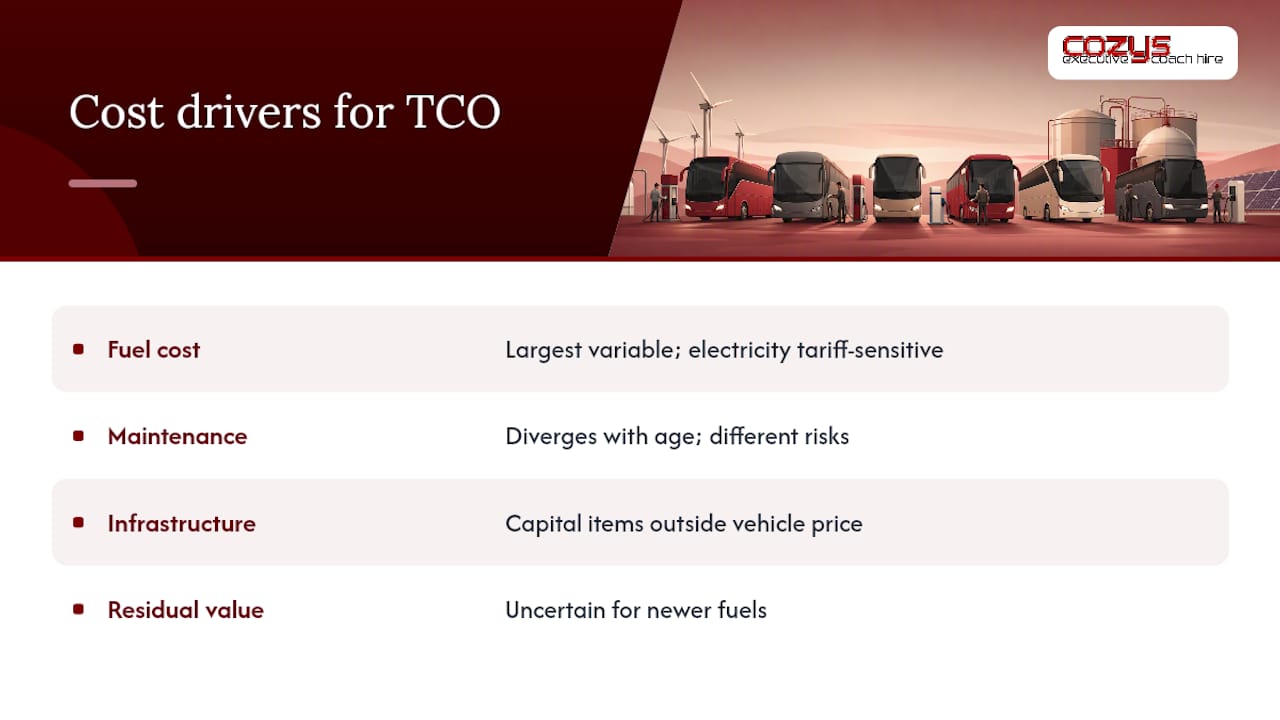
Fuel or energy cost per kilometre is the single biggest variable in coach total cost of ownership, and it moves differently by fuel type. Diesel and HVO pricing tracks the wholesale fuel market and is broadly predictable; electricity cost depends heavily on your depot tariff and whether charging happens off-peak.
Maintenance costs diverge over the vehicle’s life rather than month to month. Diesel after-treatment systems need periodic servicing and occasional component replacement, while battery-electric coaches carry a different risk profile centred on eventual battery degradation and replacement cost.
Infrastructure capital is where budgets get surprised. Chargers, transformer upgrades, CNG compression equipment, or HVO bulk storage all sit outside the vehicle price and rarely appear in a like-for-like quote comparison.
Residual value is still unsettled for newer fuel types. Diesel and HVO-compatible coaches have a known second-hand market; battery-electric and hydrogen coaches are priced on thinner resale data, which adds uncertainty to any lease-versus-buy comparison.
How to choose the right fuel type for your fleet and routes
Matching fuel type to operational profile matters more than chasing the newest technology. Work through this in order:
-
Map duty cycles and range needs across every route the vehicle will actually run, not just the typical one.
-
Audit depot capacity including electrical supply, gas infrastructure, and fuel storage space.
-
Get manufacturer compatibility and warranty terms in writing for HVO, B100, or battery specifications before committing.
-
Run a 3 to 7-year total cost of ownership scenario that includes infrastructure spend, not just fuel price.
Watch for red flags before you sign anything: patchy charging or refuelling access along your actual routes, a thin resale market for the fuel type you’re considering, or a technician team without the qualifications the new fuel demands.
Pro Tip: Trial one vehicle on the target route for a full duty cycle before committing fleet-wide. Real consumption on your specific routes almost always differs from published figures.
Publisher perspective: lessons from Cozy Travel’s mixed fleet
Introducing the UK’s first hybrid coach taught Cozy something the spec sheets don’t: fuel-type suitability is a route question before it’s a technology question. The hybrid earns its keep on stop-start, shorter-hop work, not on long motorway legs where a strong Euro 6 diesel remains the more efficient choice.
Driver and maintenance training needed real investment before the vehicle ever left the depot, and that groundwork paid off against Cozy’s 6-star BUSK safety benchmark rather than against it. The clearest lesson: match the vehicle to the route first, then let the fuel type follow.
— Cozys
Trial hire and fleet consultancy from Cozy Travel
A hybrid coach is available for hire, which gives fleet managers a way to test hybrid performance on their own routes before committing capital to a new fuel type. Rather than relying on manufacturer brochures alone, you can book time behind a real vehicle and measure consumption, range, and depot impact on your own duty cycle.

An experienced team, supported by a high BUSK safety rating, can also discuss what a mixed-fuel fleet demands in training and depot changes. If you’re weighing up whether hybrid technology fits your operation, book a hybrid coach hire to trial it on a real route, or get in touch about wider coach hire and fleet options to discuss your procurement plans.
FAQ
What are the four main types of coach fuel?
The four most commonly cited fuel types are diesel, hybrid, battery-electric, and CNG, though renewable diesel (HVO and B100) and hydrogen are increasingly counted alongside them. Most coach fleets today run predominantly on Euro 6 diesel, with ACEA reporting diesel at 67.3% of new EU bus registrations against 12.7% electric.
What fuel do most coaches run on?
Most coaches run on Euro 6 diesel, which remains the standard choice for long-distance and interurban work because of its range and universal refuelling access. A growing number of compatible chassis, including the Volvo B13R, can also run on HVO or B100 biodiesel without engine modification.
Do coaches run on diesel or electricity?
The majority of coaches still run on diesel, though battery-electric and hybrid coaches are increasingly used on shorter, urban, or fixed-route duties where charging infrastructure is available. Cozy Travel operates the UK’s first hybrid coach alongside its diesel fleet, reflecting this mixed-fuel approach.
Is HVO a good alternative to diesel for coaches?
HVO is a practical bridge fuel for compatible engines, with Volvo stating it can cut CO2 impact by up to 85% compared with fossil diesel. Compatibility and warranty terms vary by engine and manufacturer, so written confirmation is essential before switching.
How do I know if my coach can run on HVO or B100?
Check the engine variant against the manufacturer’s published compatibility list, as approval can differ even between power outputs on the same chassis. The Volvo B13R’s 460 and 500 hp variants, for example, are explicitly approved for HVO and B100 use.