
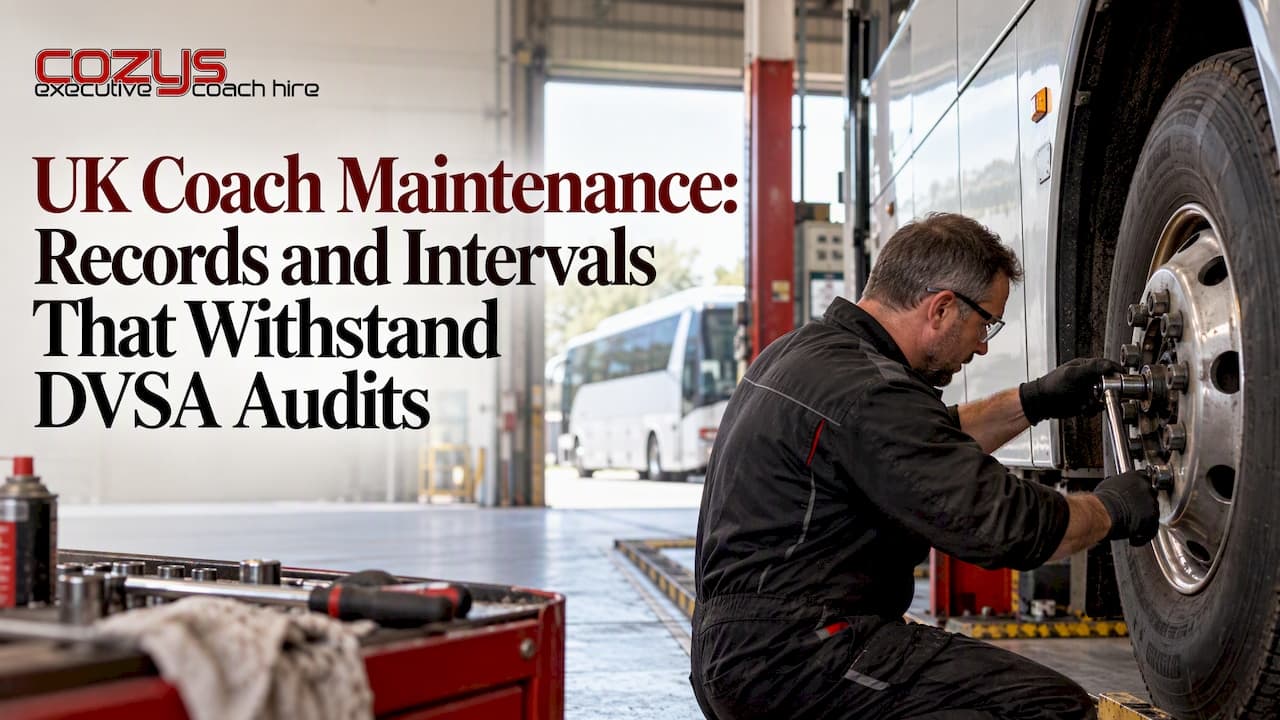
UK coach operators must run a documented preventive-maintenance system, enforce daily walkaround checks, and keep records that demonstrate continuous roadworthiness rather than relying on the annual PSV test alone. The three actions to take this week: confirm your inspection intervals are risk-based and documented, make sure every driver reports defects in writing before each journey, and audit whether your records could withstand a Traffic Commissioner review today.
TL;DR:
Routine inspections should be risk-based and documented, with shorter intervals required for vehicles used in arduous or intensive duties.
Daily walkaround checks must be performed and defect reports properly documented before each journey, with dangerous defects fixed prior to departure.
Maintenance records, odometer readings, and repair evidence must be retained for at least 15 months to support regulatory scrutiny and monitor fleet safety.
Outsourced maintenance does not exempt operators from responsibility; comprehensive contracts and regular audits of contractor paperwork are essential.
Use of onboard diagnostics and telematics can improve inspection accuracy and timing but must supplement, not replace, physical safety checks.
Table of Contents
-
Statutory framework and operator duties under DVSA and operator licensing
-
Managing outsourced maintenance while keeping operator responsibility
-
Practical checklist and sample inspection schedule operators can adopt
-
Standards and best practices for maintenance personnel training and qualifications
-
Detailed procedures for identifying and categorizing defects beyond dangerous ones
-
Use of diagnostic tools and technology in maintenance checks
-
Environmental and sustainability standards related to coach maintenance
-
Emergency maintenance protocols and roadside repair standards
-
Impact of maintenance standards on passenger safety and comfort
-
Publisher perspective: lessons from operating a compliant fleet
-
How we support operators with training, audits and fleet practice
Statutory framework and operator duties under DVSA and operator licensing
The Guide to Maintaining Roadworthiness sets the benchmark that DVSA and Traffic Commissioners use to judge whether an operator is managing a fleet properly. It requires a documented system covering safety inspections, inspection intervals, record keeping, maintenance facilities, defect reporting and periodic management review, not simply a folder of old MOT certificates.
A Traffic Commissioner reviewing your operator licence will ask to see the maintenance system itself: inspection forms, a defect-reporting trail, maintenance contracts where work is outsourced, and evidence that problems actually get fixed. Paperwork that only proves a vehicle passed its annual test will not satisfy that review.
The annual PSV MOT is a snapshot. It confirms the vehicle met the required standard on the day of testing, but operator licensing conditions assume continuous roadworthiness between tests. Treating the MOT as the main compliance milestone, rather than one checkpoint in an ongoing system, is one of the most common gaps Traffic Commissioners flag during public inquiries.
Planned inspections: setting intervals and what to inspect
Inspection intervals should reflect how hard a vehicle actually works, not a single fleet-wide default. DVSA’s own guidance gives a working range that most operators can adapt:
Inspection intervals should be risk-based, with DVSA guidance providing example ranges depending on operating conditions and vehicle age; lightly loaded vehicles on easy duty may have longer intervals, while vehicles in arduous or off-road use and those 12 years or older generally require shorter intervals.
These examples come directly from the Guide to Maintaining Roadworthiness, and whichever interval you choose, write down the reasoning. The inspection itself should follow the scope set out in the PSV inspection manual, covering chassis condition, braking performance, tyres and wheels, doors and emergency exits, and electrical systems.
Shorten the interval whenever a vehicle shows repeated defects, enters a season of heavier use, or takes on a more demanding contract such as daily school transport.
Pro Tip: Review inspection intervals every time a vehicle changes duty type, not just at its annual renewal date.
Daily walkaround checks and defect reporting workflow
Every bus or coach needs a walkaround check before each journey, carried out by the driver or another responsible person. DVSA’s walkaround check guidance confirms this is a legal duty, not a courtesy, and that defects must be reported in writing rather than mentioned in passing.
A thorough check runs through these items in sequence:
-
Visibility, wipers and warning lamps.
-
Steering, horn, and brake and air build-up.
-
Doors, emergency exits and accessibility equipment.
-
Seats, seatbelts and emergency hammers.
-
Fire extinguisher and first-aid kit.
-
Tyres, wheels, lights and any visible leaks or exhaust smoke.
-
AdBlue level, battery condition and ancillary equipment.
Dangerous defects found during a walkaround check must be repaired before the vehicle continues its journey, under the duty set out in the same DVSA guidance. Build a simple defect-report form that separates “reported by driver” from “actioned by the organisation”, with a clear sign-off field so nobody can put a vehicle back into service without named authorisation. DVSA’s guidance on carrying out daily walkaround checks draws exactly this distinction between the driver’s reporting role and the organisation’s management role.
Records, OCRS and how regulators use defect data
Your paperwork needs to survive scrutiny long after the vehicle has moved on. The Guide to Maintaining Roadworthiness requires safety inspection and repair records to be retained for at least 15 months, alongside:
-
Completed inspection forms for every scheduled check.
-
Repair invoices and evidence of parts provenance.
-
Odometer readings at each inspection, to confirm mileage-based intervals are being followed.
Base score calculated over a three-year rolling period; roadworthiness banding sits at green for 10 points or below, amber between 10.01 and 25, and red above 25. Use the operator compliance risk score (OCRS) system
DVSA’s Operator Compliance Risk Score uses that rolling data to decide which operators get targeted for roadside or site inspections. A green band is a useful signal, not a reason to relax: repeated serious defects will push the score up quickly. You can monitor your own standing, MOT pass rates and test-failure patterns through the vehicle operator safety and risk reports service, which is worth checking quarterly rather than only when a letter arrives.
Managing outsourced maintenance while keeping operator responsibility
Outsourcing maintenance to a third-party workshop does not transfer legal responsibility away from the operator. Operator licensing still requires you to demonstrate that vehicles are kept fit and serviceable, which means retaining the maintenance agreement and every inspection form the contractor produces, even when the work itself happens off-site.
A solid maintenance contract should specify:
-
The exact scope of work and which inspection standard it follows.
-
Agreed response times for both scheduled inspections and defect repairs.
-
A requirement for certified or traceable parts.
-
Documentation obligations that match what DVSA expects to see.
-
KPIs and an explicit right to audit the contractor’s records.
Pro Tip: Spot-check a sample of contractor paperwork each quarter, including parts receipts and return-to-service authorisations, rather than waiting for an annual contract review.
Practical checklist and sample inspection schedule operators can adopt
A working system groups checks by frequency and puts safety-critical items first. Daily: lights, brakes, tyres, doors, accessibility equipment, fire extinguisher and first-aid kit. Weekly: fluid levels, battery condition, underbody inspection for leaks, and a check of emergency exits and hammers. Monthly: a fuller review of brake wear, suspension components and electrical wiring, cross-referenced against the vehicle’s inspection history.
| Operating pattern | Example interval |
|---|---|
| Light duty, easy routes | 10 to 13 weeks |
| General coach work | 6 to 10 weeks |
| Arduous or intensive school-run duty | 4 to 6 weeks |
| Off-road or especially harsh use | Every 4 weeks |
| Vehicles 12 years or older | At least every 6 weeks |
These bands follow the examples set out in the Guide to Maintaining Roadworthiness.
The paperwork flow that supports this is straightforward: a driver files a written report, the workshop triages and actions the defect, a named person signs off the repair, and the completed form moves into the archive alongside odometer readings and parts receipts.
Pro Tip: Keep one continuous file per vehicle rather than per year, so an inspector can trace its full maintenance history in one place.
Standards and best practices for maintenance personnel training and qualifications
Vehicle condition is only as reliable as the people assessing it. Technicians carrying out safety inspections should hold a recognised vehicle maintenance qualification relevant to heavy passenger vehicles, and transport managers overseeing the system need to understand both the mechanical standards and the record-keeping obligations attached to them.
Transport managers typically hold the Certificate of Professional Competence for passenger transport, and many operators build in periodic refresher training to keep pace with changes to DVSA guidance and inspection manuals. Drivers also need proper instruction, not just a form to sign: understanding what counts as a dangerous defect, how to describe it accurately in writing and when a vehicle must be withdrawn from service is a trained skill, not common sense that arrives automatically with a PCV licence.
Workshop staff, whether in-house or contracted, should be assessed against the same inspection manual DVSA examiners use, so that an internal inspection and the annual PSV test are judging the vehicle by the same standard. Mismatched standards between in-house checks and the official test are a frequent reason vehicles fail annual inspection despite passing internal reviews all year.
Ongoing competence matters as much as initial qualification. Brake systems, emissions controls and accessibility equipment change across vehicle generations, and a technician trained on an older fleet may need updating before working confidently on a newer hybrid or low-floor accessible vehicle.

Detailed procedures for identifying and categorizing defects beyond dangerous ones
Not every defect demands an immediate roadside stop, but every defect needs a clear category and a timeline. A practical system sorts findings into three tiers: dangerous defects that require immediate repair or withdrawal from service, major defects that need fixing before the vehicle’s next journey or within a short, defined window, and minor defects that can be scheduled into the next planned inspection without taking the vehicle off the road.
The distinction matters because treating every fault as equally urgent either grounds vehicles unnecessarily or, worse, trains staff to underreact to genuinely dangerous conditions. A slow oil weep and a failing brake line are both defects, but they do not belong in the same response category.
Each defect record should capture what was found, where on the vehicle, who found it, the severity tier assigned, and the date it was resolved. That audit trail is what distinguishes a functioning defect-management process from a pile of tick-sheets, and it is exactly the kind of evidence a Traffic Commissioner will ask to see during a licence review.
Recurring minor defects on the same vehicle are worth flagging separately. A door mechanism that keeps needing minor adjustment, for instance, may be signalling a developing major fault, and a defect log that only records isolated incidents rather than patterns will miss that signal until it becomes a bigger problem.
Use of diagnostic tools and technology in maintenance checks
Modern coaches carry onboard diagnostic systems that flag faults in braking, emissions and engine management before they become visible during a manual check. Reading these systems as part of a scheduled inspection, rather than only when a warning light appears, catches developing issues earlier and gives technicians a documented starting point for further investigation.

Telematics and fleet-management software have also become practical tools for scheduling: tracking mileage and engine hours automatically makes it easier to trigger inspections at the right interval rather than relying on a wall calendar, particularly across a mixed fleet where vehicles accumulate mileage at different rates.
None of this replaces the physical walkaround check or the hands-on safety inspection required under the PSV inspection manual. Diagnostic data supplements a trained inspector’s judgement; it does not substitute for someone physically checking tyres, brake components and emergency exits. Technology earns its place in a maintenance system by making the documented process more accurate and easier to evidence, not by making the process shorter.
Environmental and sustainability standards related to coach maintenance
Maintenance standards increasingly overlap with emissions and sustainability requirements, particularly for fleets operating in or near low-emission zones. Keeping engines properly tuned, exhaust systems sound and AdBlue systems functioning correctly is not only a mechanical matter but a compliance one, since a poorly maintained vehicle is more likely to fail emissions testing within the annual PSV inspection.
Hybrid and low-emission vehicles bring their own maintenance considerations, including battery system checks and regenerative braking components that sit alongside the conventional items on a standard inspection sheet. We operate the UK’s first hybrid coach within our own fleet, which means we build these additional checks into our inspection routine rather than treating them as an exception to it.
Sustainable maintenance practice also means avoiding unnecessary vehicle downtime and early replacement, since a well-maintained vehicle running its full service life is generally a better environmental outcome than premature retirement. Operators weighing fleet renewal decisions should factor maintenance quality into that calculation alongside fuel efficiency and emissions class.
Emergency maintenance protocols and roadside repair standards
A breakdown on a motorway hard shoulder or a rural lay-by needs a protocol, not improvisation. Drivers should know exactly who to call, how to get the vehicle and passengers to a safe position, and what counts as a repair that can happen roadside versus one that requires recovery to a workshop.
Roadside repairs should meet the same safety threshold as scheduled maintenance. A temporary fix that gets a vehicle moving again is only acceptable if it does not compromise a safety-critical system; brakes, steering and emergency exits are never candidates for a roadside workaround that waits until the next scheduled inspection to be properly addressed.
Every roadside repair needs the same documentation as a planned one: what failed, what was done, by whom, and whether a follow-up inspection is required before the vehicle returns to full duty. Skipping that paperwork because the repair happened away from the depot creates exactly the kind of gap in the audit trail that Traffic Commissioners look for during a review.
Passenger welfare during a breakdown is part of the same protocol. Drivers need clear guidance on communicating with passengers, arranging alternative transport where a journey cannot continue, and keeping accessibility equipment such as wheelchair lifts in good working order so that a breakdown does not become a secondary safety or dignity problem for passengers who rely on them.
Impact of maintenance standards on passenger safety and comfort
The connection between maintenance discipline and passenger safety is direct. Brake performance, tyre condition and structural integrity, all covered under the PSV inspection manual, are the mechanical foundation for every journey a coach makes, and defects in any of them translate directly into collision risk.
Comfort is a secondary but real outcome of the same discipline. Properly maintained suspension, climate control and seating reduce fatigue on long journeys, and well-serviced doors and accessibility equipment mean passengers who need extra time or support are not left waiting on a malfunctioning lift or a sticking door.
Consistent maintenance also protects journey reliability, which matters as much to a school transport contract or a corporate booking as the condition of the vehicle itself. A coach withdrawn from service for an unexpected defect disrupts a timetable that a local authority or a business has planned around, and that reliability gap is often what customers notice before they notice anything mechanical. As the role of health and safety in transport commentary on operator culture makes clear, safety standards and service reliability tend to rise and fall together rather than existing as separate concerns.
Publisher perspective: lessons from operating a compliant fleet
An annual MOT pass tells you a vehicle met the standard on one day. It does not stop a service failure in week six of a school contract, and it will not protect a contract if defects go unmanaged between tests. The habit worth building is treating accessibility equipment and emergency systems with the same urgency as brakes, because the gap between “passed its test” and “ready for tomorrow’s journey” is where most operational problems live.
— Cozys
How we support operators with training, audits and fleet practice
We have run group transport for over four decades as a family business, operating a fleet with a variety of vehicles including hybrid coaches, and we maintain strong safety standards. That experience sits behind every inspection schedule and defect-reporting form we use, and we are glad to share what we have learned with other operators working through the same compliance questions.

If any part of your maintenance system needs a second opinion, we offer practical support built from running our own compliant fleet:
-
Transport manager refresher training covering current DVSA guidance and OLAT requirements.
-
Driver training through our DVSA-approved Driver CPC centre, including defect-reporting practice.
-
Accessible-transport equipment checks drawn from our work as accessible transport specialists.
Get in touch through our coach hire page to discuss a bespoke maintenance audit or refresher training for your transport managers.
FAQ
Are coaches allowed to do 70mph?
Coaches are subject to the same motorway speed limit as other large passenger vehicles, and the applicable limit depends on the road type and whether the vehicle is fitted with a speed limiter. Operators should confirm current limits for their specific vehicle category against GOV.UK’s speed limit guidance rather than assuming a single figure applies everywhere.
Who regulates bus companies in the UK?
The Driver and Vehicle Standards Agency sets and enforces roadworthiness standards, while Traffic Commissioners grant and review operator licences and hold public inquiries when standards slip. Together they oversee the Guide to Maintaining Roadworthiness framework that operators must follow.
Is there a PDF version of the DVSA Guide to Maintaining Roadworthiness available?
Yes, DVSA publishes a downloadable PDF version of the guide alongside the web version. It covers the same requirements for safety inspections, intervals, records and defect management.
What are the inspection rules for HGVs?
HGVs follow a similar risk-based framework to coaches under the same Guide to Maintaining Roadworthiness, with inspection intervals typically set between 4 and 13 weeks depending on operating severity. The annual test and record-keeping obligations mirror the passenger vehicle requirements, though the inspection manual content differs by vehicle class.
How often should a coach have a safety inspection?
Intervals should be risk-based rather than fixed, with DVSA examples ranging from 4 weeks for arduous or off-road duty up to 13 weeks for light, easy operation. Vehicles aged 12 years or older are generally inspected at least every 6 weeks regardless of duty type, as set out in the Guide to Maintaining Roadworthiness.