
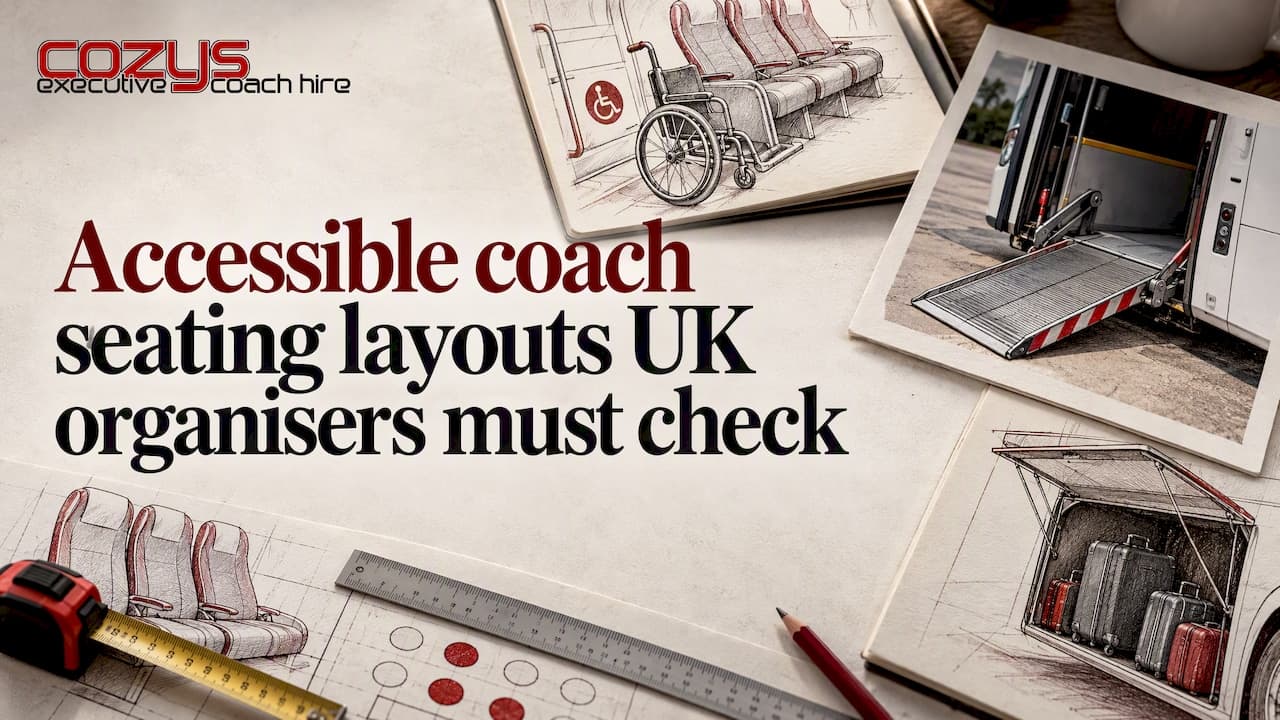
Choose the smallest vehicle that safely seats your full party, plus any wheelchair spaces and luggage, without compromising on comfort for a long journey. Groups under 24 typically suit a minibus, 25 to 48 fits a mid-size coach, and 49 to 85 needs a full-size coach. If anyone in the party needs a wheelchair space, confirm the lift type and securement system first, because accessible fitting often reduces total seat count. The next step is simple: ask suppliers for an actual layout diagram, not a brochure seat number.
TL;DR:
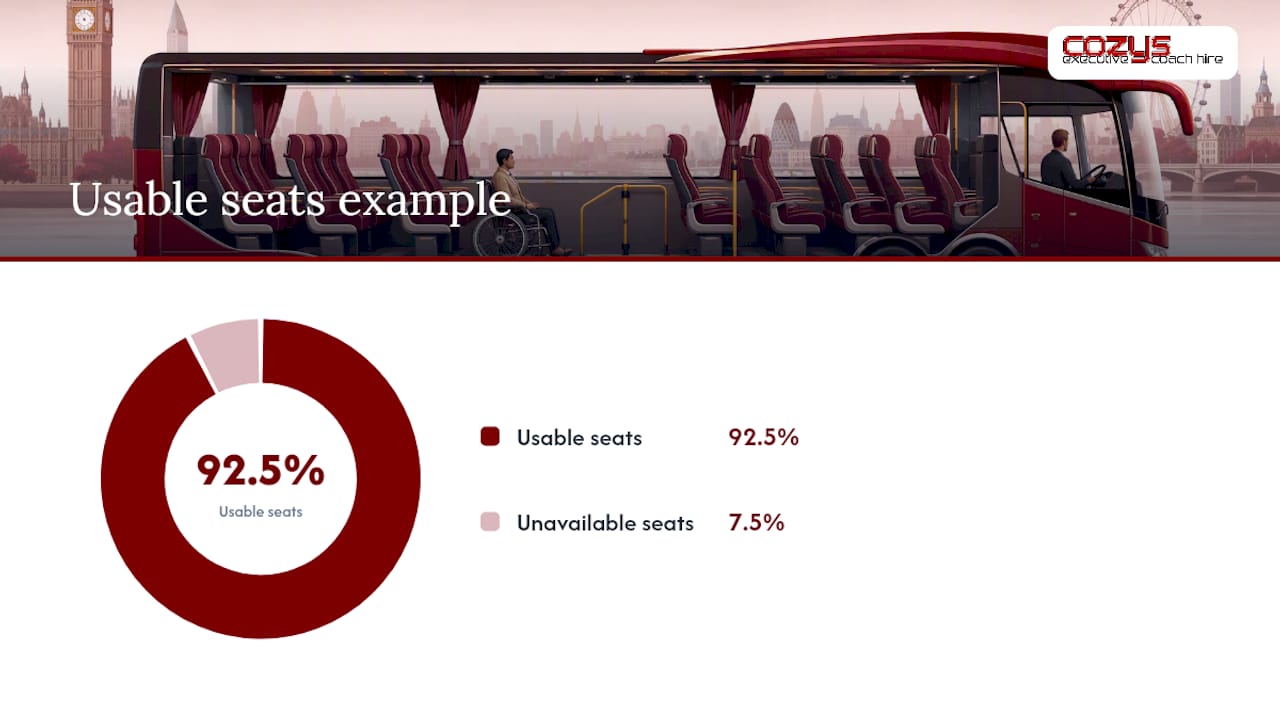
The actual usable seat count often drops by two to four seats due to luggage bays, staff seats, or toilet facilities, even if brochure numbers show higher capacity.
Vehicles with accessible lifts may still be unsuitable for pick-up points with high steps or limited external ramp space, despite meeting regulatory standards.
Confirm the specific lift type, securement system, and wheelchair capacity directly with suppliers, especially for larger groups or those with mobility needs.
For groups with multiple pick-up points or wheelchair users, splitting into two smaller vehicles can improve journey time and boarding dignity.
Always request a detailed layout diagram and site check from the operator before finalizing coach numbers to avoid booking errors or accessibility issues.
Table of Contents
-
What are the standard coach seat brackets and what suits each one?
-
What do typical coach and minibus seating plans actually look like?
-
How do accessible seating and wheelchair layouts actually work?
-
Cozy’s practical perspective on layout choice and accessibility
What are the standard coach seat brackets and what suits each one?
Seat count brackets aren’t arbitrary. Each one reflects a genuine break point in vehicle type, driver licensing, and how the interior gets configured.
-
16 to 24 seats: Minibuses. Suited to school trips, small community groups, and short transfers where manoeuvrability in tight streets or car parks matters more than raw capacity.
-
25 to 35 seats: Small to mid coaches. A common choice for single-class school outings or corporate teams needing a bit more room per passenger.
-
36 to 48 seats: Standard coaches. The workhorse bracket for multi-class school trips, sports fixtures, and society outings, though DPTAC has flagged that a 48-seater is not always the right call for routes with many pick-up points, as noted by DPTAC guidance.
-
49 to 57 seats: Large coaches. Efficient for single-site pick-ups and longer motorway journeys where fewer stops mean fewer accessibility headaches.
-
58 to 85 seats: The largest coaches, best reserved for one departure point, one destination, and minimal luggage complexity.
Published seat numbers rarely survive contact with reality. A toilet cubicle, a luggage bay, or a supervising staff seat can quietly remove two to four seats from the total before a single passenger boards. Bigger vehicles also mean longer pick-up routes, which cuts against them for school runs with scattered addresses, even when the raw capacity looks tempting on paper.
What do typical coach and minibus seating plans actually look like?
Brochure capacities and usable capacities are two different numbers, and the gap between them catches out a lot of first-time organisers.
-
Forward-facing 49 to 57 seat coach: Standard 2+2 rows down a central aisle, often with a rear toilet cubicle that removes the back row entirely, and a front luggage rack that can eat another two seats on long trips.
-
Mid-size 25 to 35 seat coach: The same 2+2 layout in a shorter body, popular for schools because it clears low bridges and narrow lanes that larger coaches cannot reach.
-
16 to 24 seat minibus: Forward-facing rows as standard, but this is the bracket where accessible conversions typically use tracking systems, removable seats and four-point restraint securements to open up wheelchair space without a bespoke rebuild.
-
Purpose-built accessible minibus: Vehicles such as the Mobility+ configuration can carry around 17 seated passengers alongside dedicated wheelchair positions, trading some seated capacity for guaranteed accessible space.
Onboard features matter more than most organisers expect. A toilet cubicle, a driver’s rest area, or a crew seat for a supervising teacher can each cost a row. On a nominal 53 seater, that can mean the real number booking-worthy is closer to 49 once staff and luggage needs are factored in.
Pro Tip: Never book against the brochure figure. Ask the supplier for the exact usable seat count for your specific trip, including any staff seats, toilet fitment, and luggage bay, before you confirm numbers with parents or delegates.
How do accessible seating and wheelchair layouts actually work?
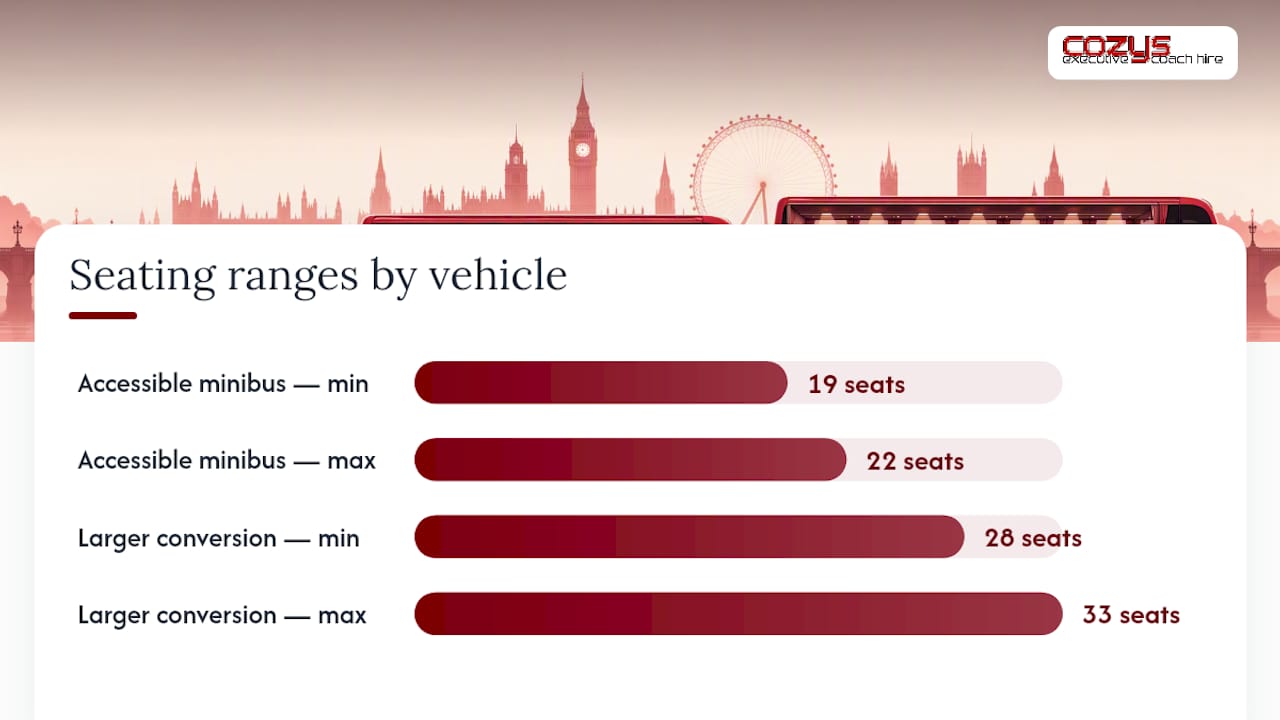
Three lift types dominate the UK coach and minibus market: platform lifts (PLS), underfloor lifts, and fold-away tail-lifts. Underfloor and PLS systems tend to appear on purpose-built accessible minibuses and larger coaches, while fold-away ramps are more common on smaller conversions. Capacity varies sharply by vehicle: some accessible minibuses offer 19 to 22 seats with up to 4 wheelchair positions, while larger 28 to 33 seat conversions can carry up to 8 wheelchairs depending on how the interior is fitted out.
Regulation sets a floor, not a ceiling, on what “accessible” actually means in practice. PSVAR requires coaches to carry a lift enabling wheelchair travel, but DPTAC’s own guidance is blunt about the gap between the rule and the reality: high entry steps and the external space a ramp needs can still block boarding at many pick-up points, and a large coach that ticks the regulatory box may still be the wrong choice for a school run with awkward kerbside access.
The accessibility gap: PSVAR mandates lift provision on coaches, yet DPTAC warns that entry steps and external ramp space requirements can prevent boarding at many real-world pick-up points, even on a fully compliant vehicle.
A working lift is the starting point, not the whole checklist. Before confirming any accessible booking, verify:
-
Grab-rail placement relative to the actual wheelchair user’s reach, not a generic fitting.
-
Anti-slip flooring and contrast markings on steps, which matter for passengers with visual impairment as much as mobility needs.
-
Internal lighting levels around the boarding point and securement area.
-
Door width against the wheelchair’s actual dimensions, not a standard estimate.
These details rarely appear in a spec sheet, but operators who work accessible contracts regularly know they decide whether a lift-equipped coach is genuinely usable on the day.
How do you choose the right coach layout for your group?
Work through this checklist before contacting any supplier, in this order:
-
Confirm total passenger count, including staff and supervisors who need a seat.
-
Establish whether any passenger needs a wheelchair space or other mobility accommodation.
-
Estimate luggage volume: day bags versus suitcases versus sports equipment change the maths considerably.
-
Count pick-up points. Multiple stops favour a smaller, more manoeuvrable vehicle over one large coach.
-
Note journey length, since longer trips justify toilet fitment and reclining seats over raw seat count.
-
Set your budget band, recognising that accessible fitment and lower seat counts both raise the price per head.
Once you have those answers, put the following questions directly to any supplier:
-
Are the seats fixed or removable, and can the layout be adjusted for this specific booking?
-
What lift type is fitted, underfloor, PLS, or fold-away, and what’s the model?
-
What wheelchair securement system does the vehicle use?
-
What is the usable seat count once accessibility equipment and any staff seats are fitted?
-
What safety rating does the vehicle and operator hold, such as a BUSK benchmark score?
Pro Tip: If your group has more than two pick-up points and includes a wheelchair user, seriously weigh splitting into two smaller vehicles rather than forcing everyone onto one large coach. It usually protects both journey time and boarding dignity.
Cozy’s practical perspective on layout choice and accessibility
Cozy has run group transport for more than four decades, working across a fleet spanning 16 to 85 seats, including the UK’s first hybrid coach. That range matters because school and accessible contracts rarely fit a single template.
What experience teaches you is that no layout decision should be made from a brochure alone. The operator checks pick-up points in person where accessibility is a factor, confirms lift clearance against the actual kerb, and briefs drivers on assisting passengers who need extra time boarding. The full fleet specification is available for organisers who want to confirm capacity and accessible fitment before committing to numbers.
Regulation tells you what a vehicle must have. It doesn’t tell you whether that lift will actually deploy safely outside a particular school gate on a wet Tuesday morning, and that’s the gap experienced operators are paid to close.
— Cozys
Request a layout plan and site check from Cozy
Getting the seat count wrong costs more than an awkward phone call. It means stranded passengers, a wheelchair user left at the kerb, or a coach that simply can’t turn into the school car park. Cozy is the practical alternative to guesswork: a family-run fleet of 16 to 85 seats, with dedicated accessible specialists who confirm lift type, securement system, and usable seat count against your actual pick-up points before you book.

If your group needs an accurate layout diagram, get in touch through Coach Hire and ask for a site-specific accessibility check alongside your quote. Schools and local authorities can also review Cozy’s client contracts for examples of comparable bookings, and check the BUSK safety benchmark before confirming any provider. Get your layout confirmed properly the first time, not after the coach arrives.
Sources
FAQ
How many seats do I need for a school trip of 40 pupils?
A coach in the 36 to 48 seat bracket suits groups in that range, but you should confirm the exact usable count once any toilet cubicle or luggage bay is fitted. If the route has several pick-up points, a slightly larger bracket with spare capacity often works better than a tight fit.
Does every coach have a wheelchair-accessible layout?
No. PSVAR requires lift provision on coaches, but not every vehicle in a fleet carries one, and DPTAC notes that even compliant lifts can struggle at pick-up points with high steps or limited external space. Always confirm lift type and wheelchair capacity for your specific booking rather than assuming.
How many wheelchair spaces can a minibus carry?
It depends on the conversion. Some accessible minibuses offer 19 to 22 seats with up to 4 wheelchair positions, while larger 28 to 33 seat versions can carry up to 8 wheelchairs, so the figure always needs checking against the specific vehicle model.
What’s the difference between fixed and removable coach seating?
Fixed seating stays in one configuration for every hire, while removable seating uses tracking systems that let operators swap standard seats for wheelchair space as needed. Minibus conversions commonly use removable seats and four-point restraints for exactly this reason.
How much does Cozy charge for coach hire with an accessible layout?
Pricing depends on group size, journey length and the accessibility fitment required, so current quotes are available directly through Coach Hire. Cozy can confirm usable seat counts and wheelchair capacity as part of that quote.