
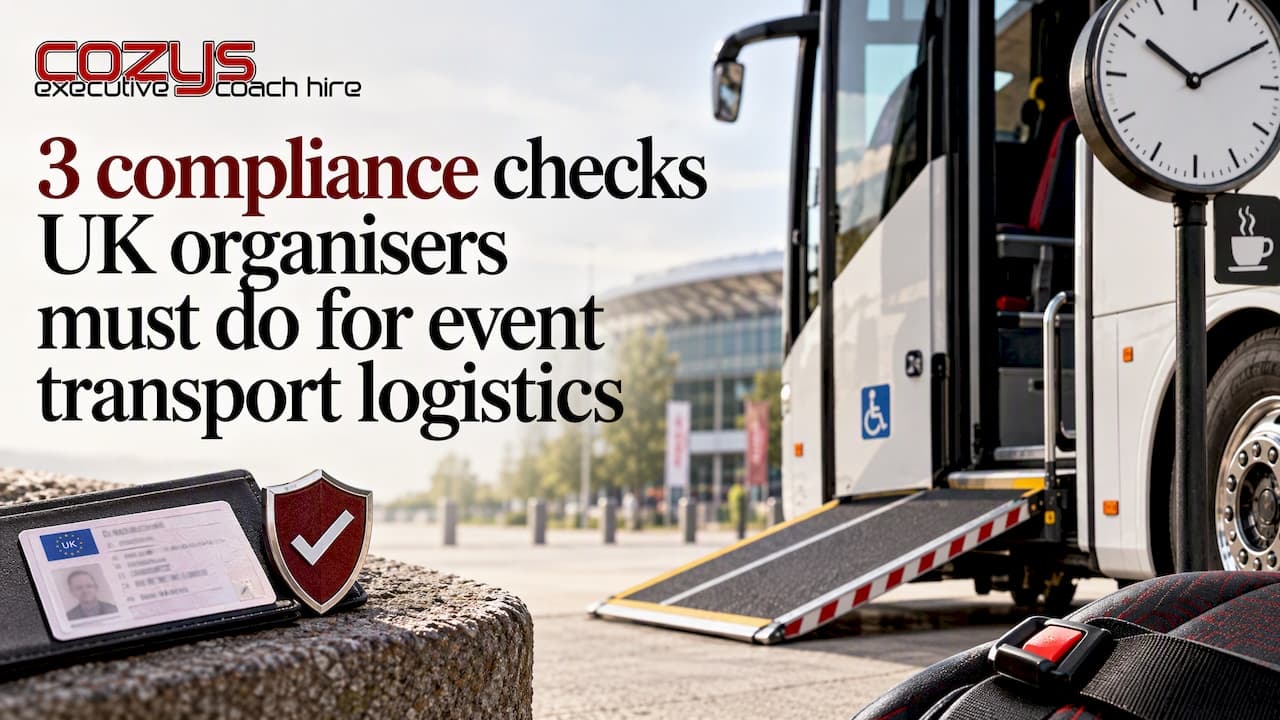
Event transport logistics means arranging coach or minibus travel to move attendees, staff or performers safely to and from a venue. Before contacting any supplier, organisers should complete three checks: confirm the operator holds a valid PSV operator’s licence, verify the vehicle meets accessibility and capacity needs, and agree who supplies the driver. The sections below set out the full checklist and the compliance steps behind each decision.
TL;DR:
Ensuring the coach operator holds a valid PSV license, insurance, and meets accessibility requirements is essential to avoid on-the-day issues like inaccessible ramps or non-compliant vehicles.
Precise arrival details, route planning, and site marshalling are critical to prevent delays, congestion, or safety hazards during loading and unloading at complex venues.
Booking must include written agreements on responsibilities, driver supply, and contingency plans, especially for long journeys or vulnerable groups, to mitigate risks and ensure smooth operations.
Confirming compliance with driver hours, seatbelt use, passenger supervision, and accessibility obligations is necessary to meet legal standards and protect vulnerable passengers.
Hiring a professional operator with extensive experience reduces the organizer’s workload, ensures safety standards, and covers compliance checks automatically for diverse event sizes and needs.
Table of Contents
-
Quick operational checklist for booking and confirming transport
-
Site access and on-site logistics: routing, marshalling and loading
-
Legal and compliance checklist: PSV licences, PSVAR and driver rules
-
Accessibility and special-needs transport: what to check and ask for
-
Hiring arrangements and contracting: dry hire, hire-with-driver and subcontracting
-
Driver hours, passenger seating and supervision rules for school and group travel
-
Why an experienced operator reduces the workload for organisers
Quick operational checklist for booking and confirming transport
Once an organiser has shortlisted a supplier, the booking conversation should follow a fixed sequence rather than an informal chat about price and dates.
-
Ask for the PSV operator’s licence number and request evidence of insurance and current vehicle roadworthiness.
-
Confirm vehicle size, seat belt provision and whether wheelchair spaces, ramps or lifts are fitted for the passenger group.
-
Decide who supplies the driver: an operator-provided driver carries different responsibilities to a dry-hire arrangement, covered in more detail later in this guide.
-
Agree the exact pick-up and drop-off points using GPS coordinates or what3words, plus an arrival buffer and a contingency contact number.
-
Put the agreed responsibilities, payment terms and cancellation policy in writing before the deposit is paid.
Pro Tip: Ask the operator for the licence number in writing, then check it separately rather than taking a verbal confirmation on trust.
Skipping any one of these steps tends to surface as a problem on the day itself, usually at the point when a coach cannot access the promised loading bay or a wheelchair user is told the vehicle has no ramp.
Site access and on-site logistics: routing, marshalling and loading
A postcode tells a driver roughly where to go, not where to stop, and event sites with multiple gates or temporary road closures need more precision than that.
-
Provide exact arrival instructions, including GPS coordinates, a what3words reference and, ideally, a photograph of the loading bay itself.
-
Plan vehicle routes and one-way flows in advance, minimising reversing manoeuvres and marking pedestrian routes clearly away from vehicle paths.
-
Arrange trained traffic marshals or signallers for the loading area, and coordinate with venue security or the local highways authority where the site sits on or near public roads.
-
Brief drivers and event staff together on parking locations, expected crowd flows, welfare facilities and emergency vehicle access routes.
-
For school or youth groups, confirm adult-to-child supervision ratios in advance and agree with the driver how breaks will be handled during the journey.
HSE’s event safety guidance makes clear that organisers retain responsibility for managing vehicle movement risk on their own site, including keeping people and vehicles apart and ensuring marshals are competent. External public transport sits largely outside health and safety law, but organisers still need to coordinate with police and highways authorities where a route affects public roads. Treat this coordination as part of the booking process, not an afterthought once tickets are sold.
Legal and compliance checklist: PSV licences, PSVAR and driver rules
Compliance is not paperwork for its own sake. It determines whether the vehicle turning up on the day is legally entitled to carry your group at all.
-
Anyone providing coach or minibus transport for hire or reward with nine or more passengers must hold a valid PSV operator’s licence, and organisers should ask for the licence number and check it independently.
-
PSVAR accessibility rules require a wheelchair space and boarding device on vehicles carrying more than 22 passengers that were first used on or after 31 December 2000. Smaller vehicles still carry Equality Act duties to provide reasonable assistance.
-
Driver hours rules limit how long a driver can be behind the wheel without a break, so long journeys or tight same-day turnarounds may need a second driver.
-
Some cities apply additional local permit requirements, and hire arrangements between operators involve operator-disc and maintenance responsibilities that should be checked before the booking is confirmed.
Vehicles carrying more than 22 passengers and first used on or after 31 December 2000 must provide a wheelchair space and boarding device under PSVAR rules, a threshold worth checking against your expected group size before booking.
Keep copies of the licence check, insurance evidence and any correspondence. If a dispute arises later, these records are what a procurement or insurance review will ask for first.
Accessibility and special-needs transport: what to check and ask for
Accessibility is not a box to tick after the vehicle is booked. It needs to be part of the first conversation with the supplier.
-
Where PSVAR applies, a compliant coach carries a wheelchair space, a ramp or lift, and restraints suited to securing a wheelchair safely in transit.
-
Ask for written confirmation that the equipment is fitted and that staff are trained to assist boarding and to secure a wheelchair correctly.
-
Record every passenger’s accessibility requirement at the point of booking, then reconfirm it with the operator shortly before departure.
-
Agree in advance who to contact and how to document any failure of equipment or assistance on the day, so the incident is recorded rather than simply absorbed and forgotten.
Pro Tip: Put accessibility requirements in the same written confirmation as the pick-up point and driver arrangement, not as a separate email that can get lost.
Vehicles below the 22-passenger PSVAR threshold are not automatically exempt from responsibility. The Equality Act still requires operators to make reasonable adjustments to assist disabled passengers, even where no ramp is fitted.

Hiring arrangements and contracting: dry hire, hire-with-driver and subcontracting
The way a vehicle is hired changes who is legally responsible if something goes wrong, and this decision deserves more attention than it usually gets.
-
Dry hire, where the organiser hires a vehicle without a driver, can make the hirer the effective employer of whoever drives it, shifting responsibility for driver checks and vetting onto the organiser rather than the operator.
-
An operator-supplied driver keeps licence compliance, driver vetting and maintenance responsibility with the operator, which suits most events better than dry hire, particularly for school and vulnerable-group travel.
-
If the operator subcontracts a vehicle from elsewhere, ask who displays the operator disc during the hire and request evidence of maintenance records for that specific vehicle.
-
Set out essential contract clauses before paying a deposit: driver checks, insurance cover, breakdown provision, a substitution policy if the booked vehicle becomes unavailable, and clear liability limits.
Grey-fleet and subcontracted vehicle arrangements carry their own audit risks, and the checks organisations use to stay audit ready for fleet management apply just as well to a one-off event hire as to a permanent fleet.
Safety and contingency planning for the event day
Plans that only work when everything goes to schedule are not plans, they are hopes. Build in the response before you need it.
-
Set a clear communications plan for delays, with one nominated contact for the driver and one for the organiser, so instructions do not get lost between multiple phone numbers.
-
Agree contingency resources in advance: a backup vehicle, a later departure slot and a plan for adverse weather or unexpected traffic.
-
Brief drivers and stewards on safeguarding responsibilities, emergency contacts and a clear assembly point for children or vulnerable passengers if the group is separated.
-
Record any incident in writing, and know that unsafe vehicles, drivers or breaches of accessibility rules can be reported to DVSA with the operator name, date and journey details.
A contingency plan drafted the week before the event is far more useful than one improvised in a car park when a coach fails to arrive.
Driver hours, passenger seating and supervision rules for school and group travel

Driver hours rules exist to stop fatigue turning a long journey into a dangerous one, and they matter most on the trips organisers are tempted to squeeze into a single day. A driver taking a school group on an early departure and a late return needs rest breaks built into the schedule, and a same-day return over a long distance may require a second driver to stay within legal limits. Ask the operator directly how they plan to manage hours on your specific route rather than assuming it will sort itself out.
Passenger seating rules matter too. Seat belts must be fitted and used on coaches and minibuses carrying children, and the vehicle’s registered seating capacity is a hard limit, not a guideline to stretch for one more passenger.
Supervision is the organiser’s responsibility, not the driver’s. Guidance for youth group travel recommends at least one additional adult beyond the driver on any group journey, with a clear adult-to-child ratio agreed before departure. The driver’s job is to drive safely and communicate with that lead adult, not to manage behaviour or headcounts. Confirm break timings with the driver in advance so supervision does not lapse at a service station while the driver is focused on the vehicle.
Why an experienced operator reduces the workload for organisers
An experienced operator has run group transport for many years, with a fleet ranging from 16 to 85 seats and including a hybrid coach option. A top safety rating reflects driver training and vehicle standards that organisers would otherwise need to verify themselves, one by one. A professional operator with accessible vehicles and managed contracts removes much of the compliance burden this guide describes. Organisers running events with vulnerable passengers, tight schedules or accessibility needs should generally insist on a professional operator rather than assembling ad hoc dry hire.
— Cozys
Book your event transport with Cozy Travel
This operator handles the compliance checks this guide covers as a matter of course, so organisers do not have to verify a licence, chase insurance evidence or ask whether a vehicle carries a wheelchair ramp: that groundwork is already done. Coach Hire covers vehicles from 16 to 85 seats for events of any size, Accessible Specialists provides PSVAR-compliant vehicles with trained crew for passengers who need a wheelchair space or boarding assistance, and Group Travel, Schools & Colleges and Corporate services cover the contract arrangements many organisers already need.

To get a quote quickly, have ready: your event dates, passenger numbers, the exact pick-up and drop-off coordinates, and any accessibility requirements.
-
Coach and minibus hire for 16 to 85 passengers, including PSVAR-compliant accessible vehicles.
-
Home-to-school and Schools & Colleges contracts for local authorities and private schools.
-
Corporate and Group Travel bookings for one-off events or recurring contracts.
Get in touch through the Coach Hire page to request a quote for your event.
Sources
FAQ
What counts as event transport logistics?
Event transport logistics covers arranging coach or minibus hire to move attendees, staff or performers to and from a venue safely, including licence checks, accessibility provision and on-site vehicle routing. It is a passenger transport task, not a freight or equipment delivery one.
How do I check an operator has a valid PSV licence?
Ask the operator for their PSV operator’s licence number and verify it independently rather than relying on a verbal assurance. Any operator carrying nine or more passengers for hire or reward must hold this licence.
When does a coach need to be wheelchair accessible?
Vehicles designed to carry more than 22 passengers and first used on or after 31 December 2000 must provide a wheelchair space and boarding device. Smaller vehicles are not automatically exempt, since Equality Act duties to provide reasonable assistance still apply.
What is the difference between dry hire and hire with a driver?
Dry hire means the organiser hires the vehicle without a driver, which can make the hirer responsible for driver checks and employment status. Hire with a driver keeps that responsibility, along with licence and vetting duties, with the operator.
How do I report an unsafe coach or driver?
You can report an unsafe vehicle or driver to DVSA with details including the operator name, date and journey. Use this route if you suspect safety or accessibility rules were breached during your event transport.