
For most events, a standard coach suitable for larger groups fits groups of around 40 or more, a midi coach is generally sized for mid-sized groups, and a minibus covers smaller groups up to around 16 passengers. Before booking anything, ask for the operator's licence number, proof of Driver CPC, and DBS clearance where the journey involves under-18s or vulnerable adults. Once you know your headcount, luggage volume, and route, request quotes from at least two licensed operators.
TL;DR:
- Choosing the right vehicle depends on group size, luggage volume, and route complexity, with minibuses suitable for up to 16 passengers and larger coaches for bigger groups.
- Verify operator licenses, driver qualifications, and safeguarding checks directly through official government records before booking to avoid unlicensed or unsafe operators.
- Pricing varies based on vehicle size, route distance, driver hours, overnight needs, and peak season demand, making early booking six to twelve weeks in advance advisable.
- For accessible needs, confirm vehicle features such as ramps, lifts, and securement points, and gather passenger assistance requirements during planning.
- Effective logistics hinge on clear timing, communication, and contingency plans, including designated stewards and pre-arranged meeting points, to ensure smooth group travel.
Table of Contents
- What size vehicle does your group actually need?
- What legal checks should you make before booking?
- How much does large group transport cost, and how far ahead should you book?
- Planning the day: a checklist for moving people smoothly
- How do you plan transport for passengers with mobility needs?
- What an experienced operator gets right that others miss
- Get a fast, accurate quote for your next group trip
- Where to verify the details yourself
- Sources
- FAQ
What size vehicle does your group actually need?
Matching headcount to vehicle class sounds simple until you factor in luggage, sports kit, or a group that's split across pick-up points. Get this wrong and you either pay for empty seats or leave people stranded at the roadside.
Here's how the vehicle classes break down in practice:
- Minibus (up to 16 seats): ideal for small teams, school clubs, or a single department heading to a conference. Cheapest option per mile but limited luggage space.
- Midi coach (25 to 35 seats): a good fit for mid-sized school trips, community groups, or a sports squad plus coaching staff.
- Standard coach (49 to 57 seats): the workhorse of large group transportation solutions. Covers most corporate away-days, wedding guest shuttles, and full-year-group school trips.
- Multi-coach or double-decker (80+ passengers): needed for large conferences, festivals, or events where multiple schools are involved and a single vehicle can't cope.
For journeys over two hours, ask specifically about onboard toilets, reclining seats, Wi-Fi, USB charging points, and enlarged luggage holds. Some corporate clients also request executive coaches with tables and additional legroom for working during transit. When a group exceeds one coach's capacity, plan for staggered departures or a lead-and-follow convoy rather than assuming a bigger vehicle will always be available at short notice. Cohesion matters as much as capacity: splitting 90 people across two coaches that arrive twenty minutes apart can undo the point of travelling together.
What legal checks should you make before booking?
Every operator running passenger transport for hire or reward in the UK must hold a valid Operator's Licence issued by the Traffic Commissioner, and every driver needs a Category D licence plus a Driver Certificate of Professional Competence. These aren't optional extras. They're the baseline that separates a licensed carrier from an uninsured broker subletting the job to whoever's available.
Verification checklist before you sign anything:
- Confirm the operator's licence number and check it against the official GOV.UK lookup, not just what's printed on their invoice.
- Ask for written confirmation of the assigned driver's Category D licence and Driver CPC status.
- Request DBS check confirmation in writing for any journey involving school groups, youth organisations, or vulnerable adults.
- Ask for proof of a safety benchmarking standard, such as a BUSK rating, and evidence of ongoing staff training.
Drivers' hours and tachograph rules vary depending on vehicle size and whether the trip crosses into assimilated or AETR territory, which directly affects how long a single driver can legally work before a mandatory rest break. This is why a "quick" 10 hour round trip sometimes needs a relief driver rather than one person doing the whole run. Never take a broker's word for any of this. Verify it yourself through the government's own records, because the consequences of an unlicensed operator fall on the group leader who booked it, not just the driver.
How much does large group transport cost, and how far ahead should you book?
Quotes for coach rental for groups are built from several moving parts, and understanding each one helps you compare providers fairly rather than just picking the cheapest headline figure.
- Vehicle size and distance. Larger coaches and longer routes cost more per mile, but per-passenger cost usually drops as group size rises.
- Driver time, not just drive time. You're paying for the driver's full working day, including positioning to your pick-up point and getaway after drop-off.
- Overnight stays and relief drivers. Multi-day trips or long single journeys often require a second driver to comply with drivers' hours rules, which adds to the quote.
- Parking, congestion charges, and event permits. Venues with restricted access or city-centre events often carry additional fees.
- Peak season and multi-vehicle coordination. Wedding season, exam-leaver trips, and major sporting fixtures push prices up, and coordinating several coaches for one event adds complexity that's usually reflected in the quote.
Book six to twelve weeks ahead for standard trips and as early as possible for peak-season dates. Expect to pay a deposit to secure the booking, with balance due closer to travel, and always get the cancellation terms in writing before you commit.
Planning the day: a checklist for moving people smoothly
Good large group travel logistics come down to timing and clear communication, not luck. Build your itinerary around fixed pick-up and drop-off times, but pad in a contingency buffer of at least fifteen minutes either side for traffic or delayed stragglers.
- Assign at least one steward per vehicle to manage boarding, headcounts, and passenger queries.
- Distribute a passenger manifest to the driver and lead steward before departure.
- For multi-coach events, designate a lead vehicle, agree a communication method (mobile group chat or two-way radio), and set a fallback meeting point in case of separation.
- Label luggage where practical, especially for school trips or events with identical bags.
- Plan comfort breaks in advance rather than leaving them to driver discretion on a tight schedule.
Pro Tip: Share your steward's mobile number with the coach operator's control office before departure, not just with the driver. If a vehicle needs to be swapped mid-route, the office can reach your steward directly instead of relaying messages through the cab.
How do you plan transport for passengers with mobility needs?
Accessible group transportation solutions need to be built into planning from day one, not bolted on afterwards. Ask operators to confirm ramp or lift access, wheelchair securement points, and the number of accessible bays available on the specific vehicle assigned to your trip, not just what's advertised on their general fleet page.
- Request written confirmation of DBS checks for drivers and any onboard assistants, matching the same safeguarding standard expected for school journeys.
- Gather mobility and assistance requirements from passengers before booking, so vehicle choice reflects actual need rather than a rough guess.
- Ask about kerbside access at both pick-up and drop-off points, particularly for venues without a dedicated coach bay.
- Confirm luggage handling support for passengers who cannot manage their own bags.
What an experienced operator gets right that others miss
Four decades of running school contracts, corporate accounts, and community bookings teaches you where large group travel logistics usually go wrong: it's rarely the driving, it's the planning gaps. Groups that hand over final headcounts the night before a trip create avoidable stress for everyone, including the operator trying to find a bigger vehicle at short notice.
Operators who invest in their own Driver CPC training and maintain rigorous vehicle servicing schedules see fewer day-of breakdowns, not because their vehicles are newer, but because the checks are consistent. Contingency planning, meaning a genuine relationship with nearby fleets for last-minute vehicle swaps, is the difference between a delayed pick-up and a cancelled trip.
— Cozys
Get a fast, accurate quote for your next group trip
Cozy runs a fleet spanning 16 to 85 seats, including the UK's first hybrid coach, so you're choosing from minibuses through to double-decker capacity without juggling multiple suppliers for one event. Every vehicle and driver combination is backed by our BUSK safety benchmarking, and our wheelchair-accessible coaches mean mobility needs get planned in from the first phone call rather than treated as an afterthought.
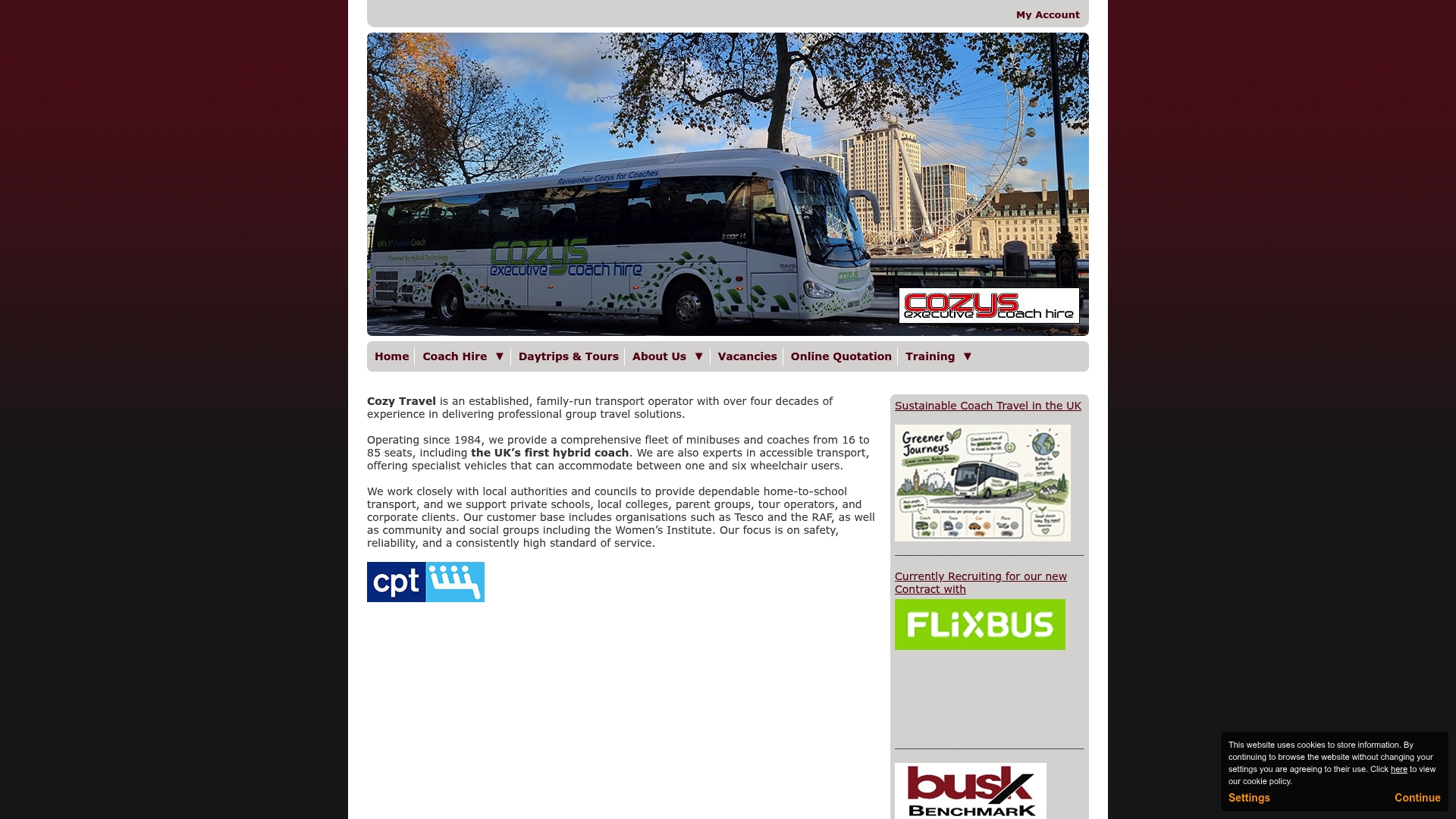
To get an accurate quote quickly, have these ready when you contact us: passenger numbers, luggage or equipment volume, pick-up and drop-off points, timings, and any accessibility requirements. Check our full fleet range or head straight to our coach hire enquiry page to request a quote. Most enquiries get a response within one working day.
Where to verify the details yourself
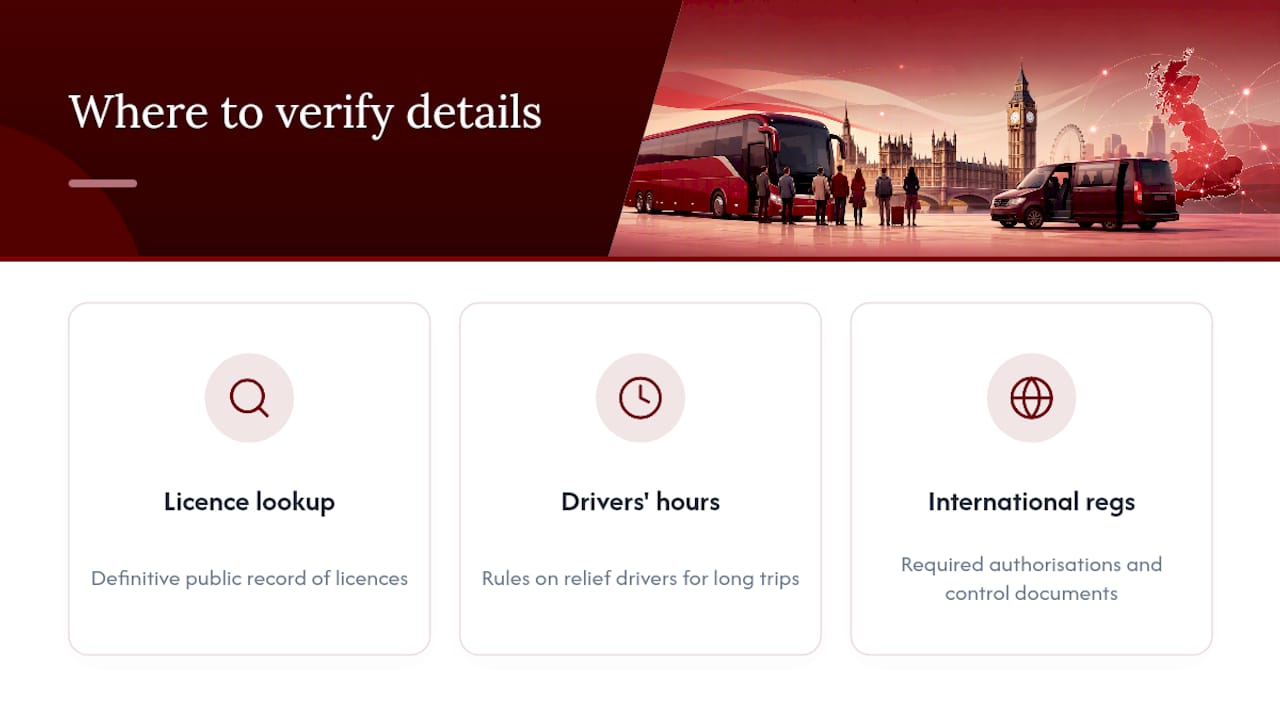
Don't take an operator's word for their compliance status. The GOV.UK operator's licence lookup is the definitive public record and instantly separates licensed carriers from unlicensed brokers. If your trip involves an overnight stay or long single journey, the drivers' hours and tachograph guidance explains why a relief driver might be legally required. For any journey crossing international borders, the regulations governing international passenger services set out the authorisations and control documents operators must carry.
Sources
- Operator’s licences: guidance and how to check
- The Road Transport (International Passenger Services) Regulations 2018
FAQ
What is the best coach tour company for seniors?
Look for an operator offering accessible coaches with ramp or lift access, comfort-focused vehicles with reclining seats and onboard toilets, and clear safeguarding practices. Ask specifically about wheelchair securement points and driver experience with older or less mobile passengers before booking.
Who is the biggest transport company in the UK?
The UK coach and bus sector includes large national operators alongside many regional and family-run firms; size varies by fleet count, contract type, and geographic coverage rather than a single ranking. What matters more for group hire is verified compliance and a fleet matched to your specific trip.
What are the four main types of transport?
In passenger road transport specifically, the common categories are minibuses, midi coaches, standard coaches, and double-decker or multi-coach configurations for very large groups. Choosing between them depends on headcount, luggage, and journey length.
How much does it cost to hire a coach for a group?
Cost depends on vehicle size, distance, driver hours, and any overnight or peak-season surcharges, so quotes vary significantly between operators and trip types. Requesting itemised quotes from at least two licensed operators is the most reliable way to compare fairly.
How far in advance should I book large group transport?
Book six to twelve weeks ahead for standard trips, and earlier for peak dates such as wedding season or exam-leaver trips, to secure both availability and better rates. Always confirm deposit and cancellation terms in writing at the time of booking.