
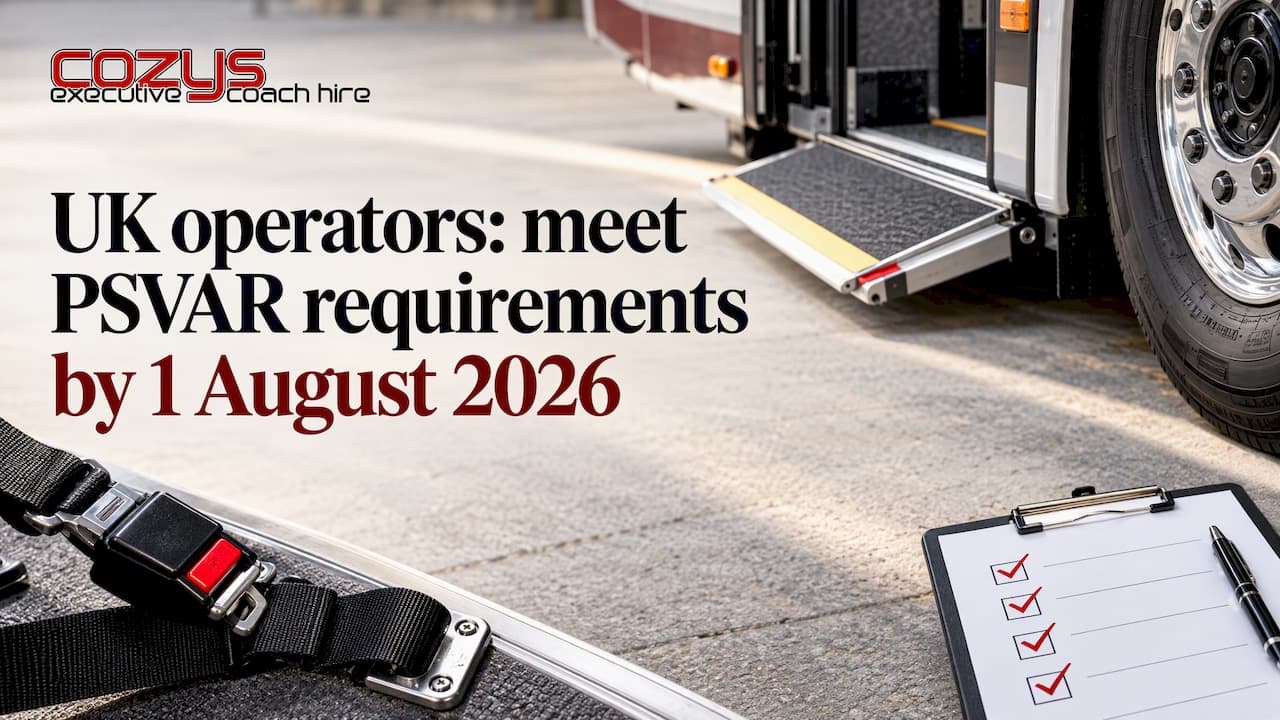
If your bus or coach carries more than 22 passengers on a local or scheduled service and entered service on or after 31 December 2000, PSVAR applies to you, in full. That means functioning wheelchair access, boarding equipment, restraints and signage on every journey, not just at MOT time. Ignore it and the exposure is criminal, not administrative: prosecution under the Equality Act 2010, DVSA scrutiny, and a Traffic Commissioner who can put your operator’s licence at risk.
TL;DR:
Vehicles with over 22 passengers and introduced after December 31, 2000, must fully comply with PSVAR, including operational wheelchair access and signage.
Regular testing and maintenance of ramps, restraints, and communication devices are critical, as non-functional equipment counts as a breach and risks fines up to £2,500.
Exemptions for specific duties like home-to-school or rail replacement are limited; new exemptions must be applied for and are valid only until August 2030.
Operators should retain all compliance certificates and conduct routine checks to ensure readiness during DVSA inspections, including driver training and proper documentation.
Treating PSVAR compliance as a daily operational procedure minimizes legal and regulatory risks, emphasizing procedure over equipment alone.
Table of Contents
-
PSVAR requirements: which vehicles and services are actually in scope
-
Core technical requirements for wheelchair access and boarding equipment
-
Enforcement risk: DVSA, Traffic Commissioners and the Equality Act
-
Why Cozy Travel treats PSVAR as a management system, not a fleet spec
PSVAR requirements: which vehicles and services are actually in scope
The Public Service Vehicles Accessibility Regulations 2000 use two tests together, not separately. A vehicle is caught if it carries more than 22 passengers and operates on a local or scheduled service in England, Scotland or Wales (Northern Ireland runs its own accessibility framework). The statutory instrument itself sets out these thresholds in detail, and it’s the reference point to check against your own fleet register rather than relying on secondhand summaries.
The second test is a date filter: the vehicle must have been introduced into service on or after 31 December 2000. Anything older sits outside PSVAR entirely, though most operators have long since retired pre-2000 stock.
Where fleets get this wrong is mixed use. A coach that spends most of its week on private hire but occasionally covers a school run or rail replacement duty still counts for PSVAR purposes on those duties.
-
Check each vehicle against both tests: capacity over 22, and in-service date from 31 December 2000
-
Home-to-school and rail replacement duties bring a vehicle into scope even if it’s not a full-time service bus
-
Northern Ireland operators should check the separate regional framework rather than assuming UK-wide parity
Core technical requirements for wheelchair access and boarding equipment
Schedules 1 to 3 of the 2000 Regulations set out the physical specification in granular detail, covering everything from doorway widths to lighting levels. For a transport manager, the checklist boils down to five areas that maintenance teams need to inspect and sign off, not just fit once and forget.
-
Wheelchair spaces and restraints — anchorage points must be static and dynamically tested, not just bolted in. The restraint system has to hold under crash-test conditions, not just look secure.
-
Boarding lifts and ramps — whether powered or portable, these need to meet minimum doorway widths and deploy reliably in service, not just during a depot demonstration.
-
Priority seating and handrails — positioned and marked so a passenger with reduced mobility can identify and reach them without asking the driver.
-
Signage and lighting — audible and visible information systems, plus adequate internal lighting around steps and doorways.
-
Communication devices — where fitted, these must work, because a driver who can’t hear a wheelchair user’s signal is a compliance gap as much as a service failure.
The regulations don’t distinguish between “fitted” and “working.” Legal analysis of enforcement trends makes clear that equipment which is present but non-functional still breaches PSVAR — a ramp that jams or a restraint that’s seized from disuse counts against you exactly as if it were never installed.
Pro Tip: Build a weekly, not just annual, functional test into your maintenance schedule for ramps and restraints. DVSA inspectors ask for evidence the equipment works, not just that it exists on the vehicle spec sheet.

PSVAR exemptions and the current compliance timetable
Full compliance across the fleet was expected by 1 August 2026, with a formal banding system (Band A to D) introduced from 1 August 2024 to phase in the proportion of fully versus partially compliant vehicles operators needed, scaled to fleet size, as DVSA’s compliance letter to operators set out. Larger fleets faced steeper compliance ratios earlier in the cycle than smaller ones.
Exemptions exist for closed-door home-to-school services and rail replacement work, but the scheme has just reset. Previous exemptions expired on 31 July 2026, and a new four-year cycle began on 11 August 2026, running to 10 August 2030, as confirmed on Gov. If you’re relying on an old exemption certificate, it’s no longer valid.
-
Apply for a new exemption through GOV.UK if your fleet runs closed-door HTS or rail replacement duties
-
Only count vehicles actually used on HTS or rail replacement work towards your banding calculation, per DfT exemption guidance
-
Check delivery and registration dates carefully on new vehicle orders; industry guidance flags additional rules around vehicles registered from 1 February 2027
Certification and how ECE Regulation 107 fits in
An accessibility certificate issued by a vehicle examiner is the primary proof that a vehicle meets PSVAR’s technical schedules, and it’s what DVSA will ask to see first during any inspection. But UK type approval isn’t the only route.
The 2009 amendment to the original Regulations opened a second path: vehicles conforming to specified Annexes of the relevant EU directive, or to UNECE Regulation 107 (including the 107.01 and 107.02 series), can be treated as meeting PSVAR requirements without a separate UK-specific certificate. That’s a practical simplifier for operators buying coaches built to European accessibility standards, as DfT’s own commentary on the regulations explains.
-
Retain the accessibility certificate or ECE 107 conformity declaration for every vehicle in scope
-
Keep supplier test certificates for anchorage points; these speed up DVSA desk-based assessments considerably
-
Don’t assume equivalence is automatic. Confirm which series (107.01 or 107.02) your vehicle conforms to before citing it as proof
Enforcement risk: DVSA, Traffic Commissioners and the Equality Act
PSVAR sits inside the Equality Act 2010, which makes non-compliance a criminal offence carrying a fine of up to Level 4, currently £2,500, as GOV.UK’s own guidance confirms. That fine is only the starting point of the exposure.
DVSA runs both desk-based compliance checks and roadside inspections, and either can trigger a referral to the Traffic Commissioner, who has separate powers over your operator’s licence entirely independent of the criminal process. Legal analysts tracking enforcement trends describe PSVAR as a growing regulatory and legal risk precisely because civil discrimination claims from passengers are rising alongside DVSA activity.
-
DVSA desk-based checks request accessibility certificates, maintenance logs and exemption paperwork on demand
-
A Traffic Commissioner referral can affect your licence even where no criminal conviction follows
-
Civil claims under the Equality Act sit entirely separate from DVSA enforcement, and poor records make both harder to defend
A practical checklist for staying inspection-ready
Compliance on paper means little if a DVSA officer finds a jammed ramp or an untrained driver. Build these steps into routine operations rather than treating them as an annual audit exercise.
-
Pre-service checks — ramps, lifts and restraints tested before the vehicle leaves the depot, every day it’s in use.
-
Scheduled maintenance — set intervals for anchorage point testing and lift servicing, logged against each vehicle, not just the fleet as a whole.
-
Document retention — keep accessibility certificates, ECE conformity declarations, maintenance logs, driver training records and current exemption paperwork together and accessible.
-
Driver training — every driver needs to know how to deploy a ramp and secure a wheelchair correctly; refresh this at least annually, more often for new starters.
-
Inspection evidence — when DVSA runs a desk-based assessment, having certificates and logs ready in one file turns a stressful call into a five-minute exchange.
Pro Tip: Treat your accessibility paperwork the same way you treat your operator’s licence file. If you can’t produce it in minutes, DVSA will assume it doesn’t exist.
Why Cozy Travel treats PSVAR as a management system, not a fleet spec

Four decades of running accessible coaches has taught Cozy one thing above all: PSVAR compliance lives or dies on procedure, not just equipment. Every vehicle in our fleet is checked for ECE conformity at procurement stage, and our 6-star BUSK safety rating reflects operational discipline as much as vehicle specification.
Contracts with local authorities and various organisations demand exactly this kind of rigour, because a compliance failure on a school run or a corporate contract carries reputational cost well beyond the fine itself. Operators who treat PSVAR as paperwork rather than daily practice are the ones DVSA tends to catch out.
— Cozys
Sources
For direct verification, the 2000 Regulations, GOV.UK’s PSVAR guidance, the exemption application page, and Weightmans’ legal analysis cover every claim made above.
If your organisation needs an operator who already runs this compliance system daily, Cozy’s Accessible Specialists service and Coach Hire fleet are built around exactly this standard, from anchorage testing through to driver competence.
-
Apply for an exemption from PSVAR accessibility regulations for home-to-school coaches
-
PSVAR compliance: a growing legal and regulatory risk for bus operators
FAQ
What are the requirements for PSVAR compliance?
PSVAR requires vehicles carrying more than 22 passengers on local or scheduled services, and introduced into service since 31 December 2000, to have functioning wheelchair spaces, tested restraints, working boarding lifts or ramps, priority seating, handrails, and accessible signage. Equipment has to be operational in service, not just fitted, as confirmed by GOV.UK’s PSVAR guidance.
What changes to PSVAR regulations should operators watch for in 2026?
The exemption scheme reset with previous exemptions expiring on 31 July 2026 and a new four-year cycle running from 11 August 2026 to 10 August 2030. Compliance banding introduced from 1 August 2024 also continues to shape fleet renewal decisions through this period.
What is the difference between PSVAR and PSVAR?
There’s no separate standard called “PSVAIR”; this is a common misspelling of PSVAR, the Public Service Vehicles Accessibility Regulations 2000. Any guidance referencing “PSVAIR” is describing the same statutory framework under its correct name.
Is WCAG a legal requirement in the UK?
WCAG (Web Content Accessibility Guidelines) governs digital accessibility for websites and apps under separate public sector accessibility rules, and it’s unrelated to PSVAR, which covers physical vehicle accessibility. Operators need to treat the two as entirely distinct compliance obligations rather than assuming one covers the other.