
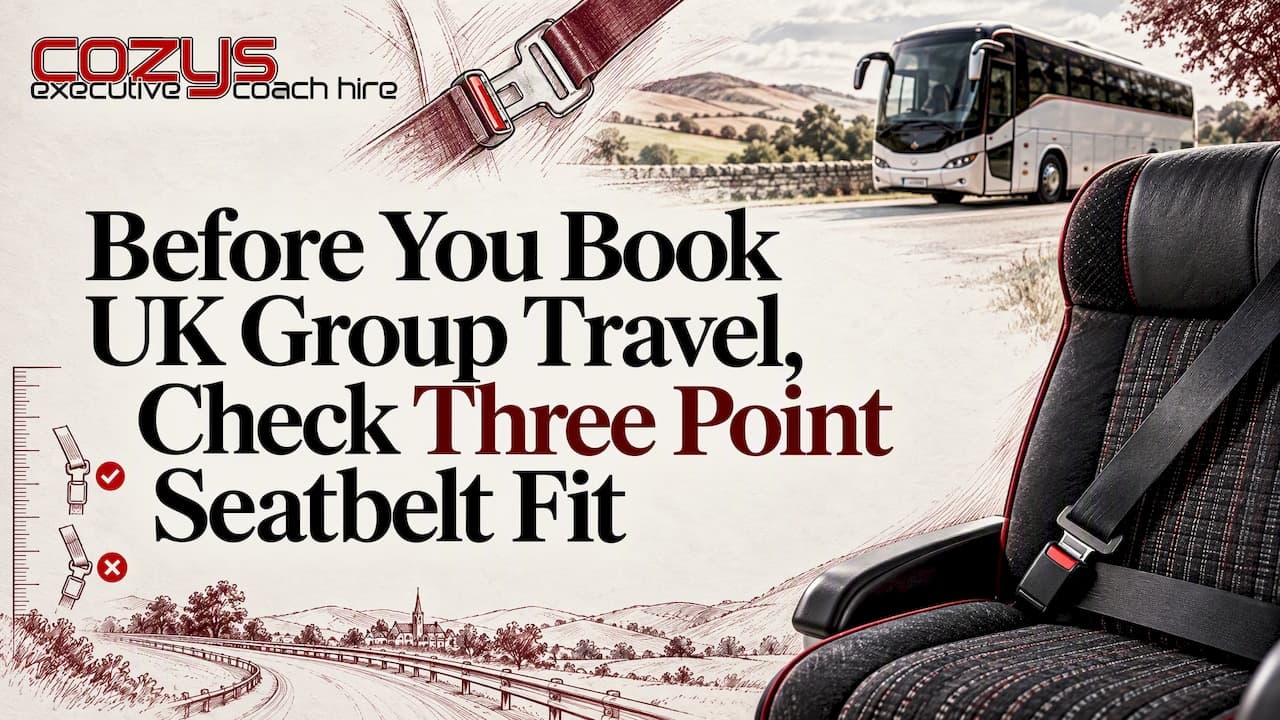
A three-point seatbelt is the lap-and-diagonal strap system that restrains the pelvis, chest and shoulders simultaneously, spreading crash forces across the body’s strongest points. It is the default primary restraint fitted to almost every car seat and a growing share of coach and minibus seats, and its protection depends entirely on correct fit. The design was perfected by Nils Bohlin at Volvo in 1959, and UK law now requires suitable restraints for the great majority of vehicle occupants.
TL;DR:
Proper belt fit is crucial, especially for children, as misadjusted straps can lead to different injury patterns despite the belt’s design.
UK regulations require children under 135cm or 12 years old to use a suitable child restraint or booster seat to ensure correct belt positioning.
A three-point belt only provides optimal protection when the lap strap stays low on the hips and the diagonal strap crosses the chest properly.
Regularly inspecting the inertia reel for proper locking and ensuring seat anchorage points are secure can prevent ineffective restraint performance.
Reputable transport operators should always confirm and document seatbelt type and fit standards before group travel bookings.
Table of Contents
The invention that changed road safety
Nils Bohlin, an engineer working for Volvo, combined the separate lap and diagonal straps used in earlier designs into a single Y-shaped belt anchored below the hip. Volvo fitted it as standard from 1959 and then released the patent freely to every other manufacturer, a decision that let the design spread across the entire industry rather than staying locked to one brand.
The three-point belt succeeded where earlier two-point lap belts had not, mainly because it restrained the upper body as well as the pelvis without requiring any extra thought from the occupant: buckle it once, and both straps tension together. Later refinements built on that simplicity:
-
Inertia reels, letting the webbing move freely until a sudden pull locks it
-
Pretensioners, which snap the belt tight the instant a crash begins
-
Load limiters, which release a small amount of webbing to reduce chest pressure
-
Belt integration with airbags, so the two systems work as one coordinated restraint
How the lap and diagonal straps restrain the body
The lap section sits across the pelvis, the strongest bony structure available, while the diagonal section crosses the sternum and collarbone to hold the chest and shoulder. Together they stop the body moving forward independently of the vehicle, which is what causes the worst injuries in a sudden stop.
Three components do the active work during an impact:
-
The inertia reel locks the webbing solid the moment it detects rapid deceleration or a sharp pull.
-
The pretensioner removes any slack within milliseconds of a collision, pulling the occupant firmly into the seat.
-
The load limiter then allows a controlled, small amount of webbing to spool out, reducing the peak force on the ribcage.
None of this works if the belt sits in the wrong place or if the anchorage points are damaged. A loose lap strap, a twisted diagonal section or a corroded anchor bolt can all turn a well-engineered system into a far less effective one.
Pro Tip: Pull the belt sharply by hand once a year. If the inertia reel does not lock instantly, have the vehicle inspected before it’s driven again.
What the evidence shows about benefit and limits
Three-point belts clearly outperform lap-only belts for one serious injury in particular. Research comparing injuries in children restrained in two and three-point belts found that three-point systems reduced the odds of lumbar spinal fracture compared with lap-only restraints.
The same study, based on 98 belted children, also found differing patterns of abdominal and solid-organ injury, which the researchers linked to how well the belt fitted rather than to the belt type itself. That single point runs through almost every piece of seatbelt research: the design helps enormously, but fit decides how much.
A few findings are worth holding onto:
-
Lumbar fracture risk fell with three-point belts versus lap-only belts in the cited study.
-
Poorly fitted diagonal straps, especially ones that cross the neck or slip under the arm, were associated with different injury patterns in children.
-
The study’s authors flagged its own sample size as a limitation, so the finding should be read as a strong signal rather than a settled number.
-
Booster seats and child restraints exist precisely because adult belts are not geometrically sized for smaller bodies.
None of this undermines the case for three-point belts. It does mean that a belt fitted badly, particularly on a child too small for the adult geometry, can behave quite differently to the same belt fitted well. That is why booster seats remain part of the safety chain rather than an optional extra.
What UK law requires for cars, coaches and minibuses
UK rules set out clearly who must be restrained, how, and from what age. For private cars, Gov make the driver responsible for ensuring that children under 135cm in height, or under 12 years old, whichever comes first, use a child restraint suited to their weight and height. Infants under three must use an appropriate child restraint with narrow exceptions for some taxi and minibus journeys.
Group transport carries its own rules. GOV.UK guidance on seat belts in minibuses, coaches and other buses states that organised trips carrying three or more children require forward-facing seats fitted with at least a lap belt, with full three-point inertia reel belts required in many forward-facing seats depending on the vehicle’s weight and passenger capacity. The underlying legal detail sits in regulation 48A of the Road Vehicles (Construction and Use) Regulations 1986, which sets anchorage standards for seats fitted after 10 February 1997.
Practical takeaways for anyone organising group travel:
-
Ask the operator to confirm, in writing, whether forward-facing seats carry at least a lap belt.
-
For vehicles under 3,500kg, check whether three-point inertia reel belts are fitted to forward-facing seats.
-
Keep written confirmation of the vehicle’s seatbelt specification alongside the booking.
Checking that a seatbelt actually fits
A three-point belt only protects as designed when it sits correctly on the body. For adults and older children, the checklist is short:
-
The lap strap should sit low across the hips and pelvis, never riding up over the stomach.
-
The diagonal strap should cross the centre of the chest and the middle of the shoulder, never the neck or the outer arm.
-
There should be no slack anywhere in the webbing once the buckle clicks home.
-
The inertia reel should feed out smoothly and lock instantly on a sharp tug.
-
Anchorage points should show no corrosion, cracking or loose fixings.
For children who have outgrown a car seat but are not yet tall enough for an adult belt alone, a booster seat raises the body so the lap strap stays on the hips rather than the stomach. Restraints meeting Regulation 44 or the newer Regulation 129 (i-Size) are the two approved standards, and i-Size seats generally fit via ISOFIX points rather than the adult belt itself. A child is usually ready to use an adult three-point belt unaided once they reach 135cm or their twelfth birthday, in line with the GOV.UK rule already cited.
Pro Tip: If the diagonal strap crosses a child’s neck even with a booster in place, they still need a different restraint, not a looser belt.

Myths that put passengers at risk
A few persistent misunderstandings undo otherwise sound safety habits:
-
Airbags are a supplement to the belt, not a substitute for it; US safety guidance is explicit that belts must still be fastened correctly for airbags to work as intended.
-
Wearing the diagonal strap under the arm or behind the back removes almost all upper-body protection, even though the lap section stays fastened.
-
Drivers who fail to secure a child correctly can receive a fixed penalty and points on their licence, separate from any wider offence.
How an operator applies these standards in practice
Cozy Travel runs a fleet from 16 to 85 seats, holds the highest six-star BUSK safety rating and trains drivers through a DVSA-approved programme, all of which shape how vehicles are specified before they ever carry a group. Organisers booking a coach or minibus should always ask, as the regulation requires, whether forward-facing seats carry lap or three-point belts and request that detail in writing before confirming a trip.

Booking group transport with seatbelt standards built in
Choosing a coach or minibus for a school trip, a corporate outing or a community group means checking seatbelt provision before anything else, and reputable operators should build that into every quote rather than leaving it to a last-minute question.

Our fleet, detailed on the coach fleet page, includes the UK’s first hybrid coach alongside accessible vehicles for wheelchair users, and every booking through Coach Hire or Group Travel comes with written confirmation of seatbelt specification. Schools and local authorities can also view our dedicated home-to-school transport and Schools & Colleges services, while organisations needing wheelchair-accessible seating can check our Accessible Specialists page. Get in touch to request a quote for your next group journey.
Where these figures and rules come from
Anyone planning travel abroad should also check local requirements, since rules differ by country, as this guide to Poland’s child seat law for UK families illustrates.
Sources
FAQ
What does a three-point seat belt mean?
A three-point seat belt is a restraint made of a lap strap and a diagonal shoulder strap joined at one buckle point, holding the pelvis, chest and shoulder together in a crash. Volvo’s Nils Bohlin perfected this Y-shaped design in 1959, and it remains the primary restraint fitted in most vehicles today.
What age can a child use a three-point seat belt alone?
A child can generally use an adult three-point belt without a booster once they reach 135cm in height or their twelfth birthday, whichever happens first, under GOV.UK’s child car seat rules. Before that point, a booster or child restraint keeps the lap strap positioned correctly on the hips.
Are three-point harnesses legal on the road?
Yes, three-point belts are the standard legal restraint for cars and are required in many forward-facing seats on coaches and minibuses carrying children on organised trips, as set out in GOV.UK guidance on seat belts in minibuses and coaches. The specific anchorage and fitting standards sit in regulation 48A of the relevant vehicle construction regulations.
Can a driver get penalty points for a child not wearing a seat belt?
Yes, a driver can receive a fixed penalty and points on their licence for failing to ensure a child passenger is properly restrained, since the driver carries that legal responsibility under GOV.UK’s child car seat rules. The penalty applies regardless of whether the child themselves unbuckled the belt during the journey.
— Cozys