
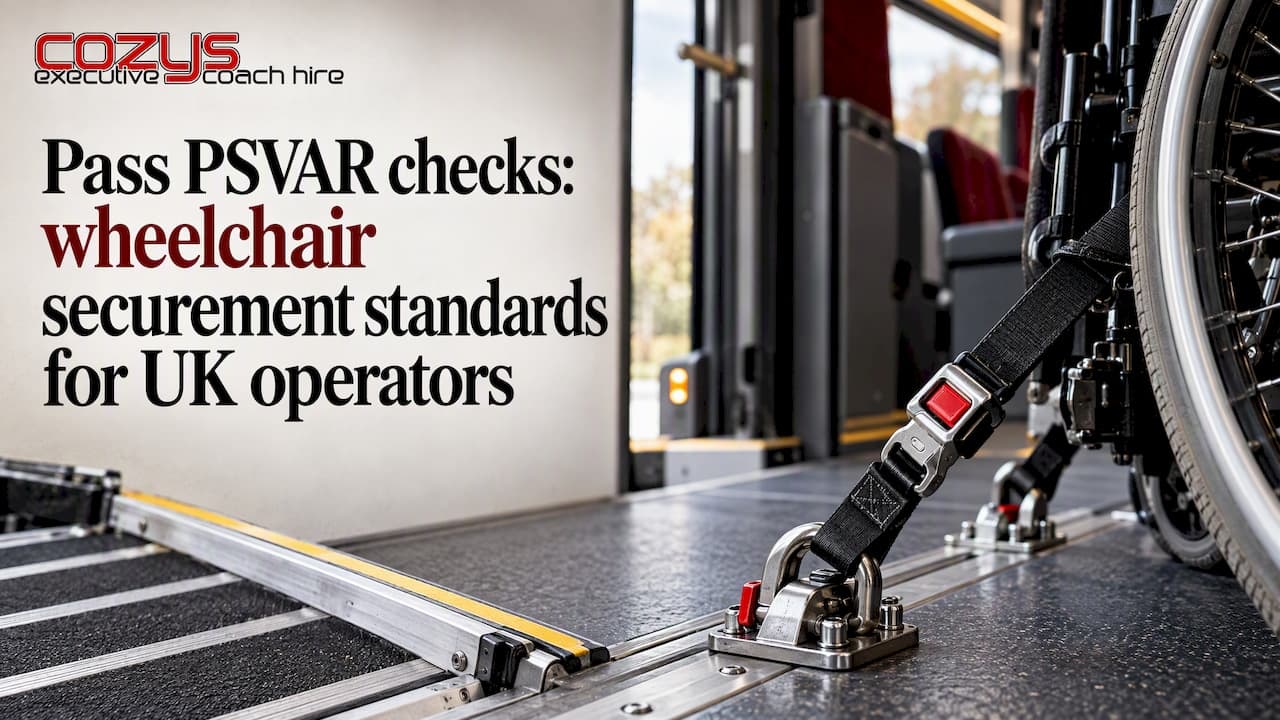
Short answer: the Public Service Vehicles Accessibility Regulations require a wheelchair space fitted with a suitable wheelchair restraint system and a wheelchair user restraint with at least two anchorage points and a pelvic restraint. Every WTORS component and its anchorages must meet static and dynamic test requirements, drivers must assist passengers and verify securement before departure, and a documented pre-trip check should confirm all of it every single time.
TL;DR:
All WTORS components and anchorage points must pass strict static and dynamic crash tests before being used in passenger vehicles.
Operators should carry multiple types of WTORS to improve compatibility and reduce boarding refusals caused by hardware mismatch.
The vehicle’s anchorage points must be installed into reinforced structures capable of transmitting the required static loads safely.
Drivers and conductors are responsible for assisting, securing, and verifying each wheelchair’s restraint before departure, according to manufacturer instructions.
Proper documentation, regular inspection, and staff training are essential to ensure ongoing PSVAR compliance and passenger safety.
Table of Contents
-
How should the wheelchair space and boarding equipment be built?
-
Operator checklist: what four decades on the road teaches you
What does the law actually require?
The Public Service Vehicles Accessibility Regulations 2000 (PSVAR) set the statutory floor for wheelchair securement standards on regulated buses and coaches. Vehicles used for local or scheduled services with a capacity above 22 passengers must carry at least one wheelchair space fitted with a wheelchair restraint system suitable for general application, alongside a wheelchair user restraint comprising a minimum of two anchorage points and a pelvic restraint. That’s not a recommendation. It’s a legal specification, and it applies whether the operator runs a single accessible minibus or a mixed fleet of forty coaches.
The regulations go further than equipment lists. Schedule 1 sets out how anchorages must be constructed, how restraint systems must release in an emergency, and what test evidence manufacturers must hold. An operator buying a wheelchair tie-down system, or specifying anchorage points during a fleet refit, needs to check that evidence exists before the vehicle ever carries a passenger.
Duties don’t stop with the hardware. Under the Conduct of Drivers, Inspectors, Conductors and Passengers Regulations and GOV.UK guidance for accessible buses and coaches, drivers and conductors must provide reasonable assistance to disabled passengers. That includes helping someone use the wheelchair space and its restraint correctly, not simply pointing at it. Refusal of access is only lawful in narrowly defined circumstances, such as the wheelchair exceeding the vehicle’s rated dimensions or the space already being occupied.
For compliance officers, the practical reading is this: PSVAR governs the vehicle, the Conduct Regulations govern the person delivering the service, and both need to be satisfied on every journey, not just at MOT or PSV inspection time.
What do ISO 10542 and ISO 7176 actually test?
Two international standards sit behind most credible wheelchair tie-down standards used in the UK: ISO 10542, which covers wheelchair tiedown and occupant restraint systems (WTORS), and ISO 7176, which covers wheelchairs themselves, including strength and crashworthiness where the chair is intended for use as a vehicle seat. Neither standard is UK-specific, but PSVAR’s technical schedule draws heavily on the same testing logic.
Two distinct test types matter for procurement and inspection. A static test measures how much load an anchorage point or restraint webbing can withstand without failing structurally. It confirms the hardware is strong enough in principle. A dynamic test goes further: it simulates a frontal impact deceleration pulse, typically loading a test wheelchair and restraint system through a rapid stop, to prove the entire assembly holds under crash-like forces rather than just static tension. Under Schedule 1 of PSVAR, restraint systems must satisfy both, or be fitted to anchorages demonstrably capable of meeting the dynamic requirement in combination with the restraint used.
Seat belt type-approval under the 1977 EU Directive can satisfy part of the occupant restraint requirement, but only where the belt itself carries the correct approval marking and is fitted to anchorages tested for that use. A generic retail seatbelt bolted to an untested bracket is not equivalent, whatever it looks like from the aisle.
Manufacturer marks matter more than they might seem to. A WTORS label without a visible standard reference, or a wheelchair missing IFU documentation confirming crash-tested transit suitability, should be treated as a red flag during procurement, not a paperwork oversight to chase up later.

Which WTORS system suits which wheelchair?
No single wheelchair tie-down standard fits every chair, and operators who stock only one system routinely hit compatibility problems on the kerb, not in the depot.
Four-point tiedown systems remain the most flexible option. Four straps anchor to the wheelchair frame at defined points, tensioned manually or with retractors, and they work across a wide range of manual and powered chairs. They need floor space to manoeuvre into position and a driver who’s practised the sequence, but they adapt to irregular frame shapes better than fixed hardware.
Clamp and docking systems trade flexibility for speed. A compatible wheelchair base plate locks into a floor-mounted docking point in seconds, which matters hugely on high-frequency routes like home-to-school runs. The limitation is compatibility: the wheelchair needs the matching docking hardware fitted, which not every chair has.
Auto-docking systems sit at the high-confidence end of the scale but are only as good as the manufacturer’s Instructions for Use confirm. MHRA guidance is explicit that IFU compatibility, not visual fit, decides whether a docking system is appropriate for a given chair.
-
Four-point tiedown: broadest compatibility, slower to fit, needs trained hands
-
Clamp/docking: fastest boarding, requires matching hardware on the chair
-
Auto-docking: high confidence when IFU-matched, unsuitable when it isn’t
Pro Tip: Carrying two or three WTORS types on a vehicle, rather than standardising on one, cuts the number of boarding refusals caused by incompatible hardware. Document which system was used for which passenger so drivers aren’t guessing on the next trip.
How should the wheelchair space and boarding equipment be built?
Anchorage points aren’t just bolted to the floor panel. PSVAR’s Schedule 1 requires anchorages to withstand specified static loads and to be fixed into vehicle structure capable of transmitting that load safely, which is why aftermarket fitment on a non-reinforced floor is a common source of failed inspections.
Space design carries its own rules. Wheelchair spaces can face forwards or rearwards depending on the restraint configuration used, but lateral clearances must allow safe manoeuvring without the chair overhanging the aisle or blocking emergency egress. Clear signage marking the space, along with adequate lighting for evening boarding, is expected as standard, not an optional extra for premium vehicles.
Boarding equipment gets equal scrutiny. Lifts and ramps must be maintained to a standard that guarantees repeatable, safe operation, and stowage of portable ramps matters more than operators sometimes realise: a ramp stored where it obstructs the gangway, or one that takes two minutes to retrieve at a stop, creates both a compliance gap and a genuine safety risk during boarding.
Who is responsible for training and oversight?
Drivers and conductors carry the frontline duty: assisting passengers into the wheelchair space, positioning the chair correctly, and visually verifying every anchorage and restraint is engaged before the vehicle moves. That verification step is where most near-misses get caught, and where most gaps get missed if it’s skipped.
Training needs to cover more than strap tensioning. Staff should understand how to fit each WTORS type the fleet carries, how to operate the emergency quick-release under pressure, how to interpret a wheelchair’s IFU to confirm transit suitability, and how to complete a basic risk assessment when a chair or passenger doesn’t match standard procedure. HSENI guidance recommends drivers are trained to run rapid compatibility checks, which speeds boarding without cutting corners on safety.
Recordkeeping closes the loop. Log which WTORS was used, when anchorages were last inspected, and any incident, however minor, involving a wheelchair or restraint. Scheduled maintenance intervals for anchorage hardware should mirror the vehicle’s wider inspection regime, not run on a separate, easily forgotten cycle.
What’s the correct securement procedure step by step?
-
Check the IFU first. Confirm the wheelchair’s Instructions for Use permit occupied transit; if the manufacturer doesn’t support it, the chair should not be used as a vehicle seat, per MHRA guidance.
-
Offer a transfer where feasible. A standard vehicle seat is generally the lower-risk option; only proceed with an occupied wheelchair when transfer genuinely isn’t possible.
-
Prepare the chair. Switch off powered wheelchairs, apply brakes, fold or stow loose accessories, and check tyres and frame for anything that would compromise securement.
-
Position the chair within the marked space, facing the required orientation, with wheels blocked if the system requires it.
-
Apply the WTORS in the manufacturer’s specified sequence, tensioning each anchorage point evenly rather than pulling one strap tight first.
-
Fit the occupant restraint separately from any lap belt built into the wheelchair. Built-in postural belts are not crash-rated occupant restraints and should never substitute for the vehicle’s own system.
-
Test the emergency release is accessible and functioning before departure, not after an incident.
-
Brief the passenger, confirm they’re comfortable, and log the securement in the vehicle record.
Pro Tip: Never assume a wheelchair’s built-in lap belt is doing the job of a vehicle restraint. It’s usually there for posture, not for a 30mph deceleration.
Operator checklist: what four decades on the road teaches you
A workable checklist covers five things: equipment (a stocked range of WTORS, inspected on schedule), training (documented and refreshed, not a one-off induction), risk assessment (per passenger, not per route), inspection records (anchorages, straps, lifts), and an incident protocol that pulls a WTORS or wheelchair from service immediately after any collision until checked by the manufacturer. Involving prescribers early, as Fife Council’s guidance on assisted school transport notes, avoids compatibility surprises later.

Balancing accessibility and safety in everyday operations
Decades of accessible transport work teach you that safety-first and passenger-first aren’t opposites. Every rule here exists to protect dignity as much as limbs. Getting both right, consistently, is the actual job.
— Cozys
How Cozy can help you meet these standards
Cozy is the practical route to compliant accessible transport for organisations who’d rather not build wheelchair securement expertise from scratch. With a 6-star BUSK safety rating, decades of fleet experience, and a modern fleet including the UK’s first hybrid coach, Cozy’s Accessible Specialists service handles the WTORS selection, driver training, and risk assessment documentation that PSVAR compliance demands, so your organisation gets a wheelchair-accessible journey without carrying the regulatory burden alone.

Whether you’re a local authority arranging home-to-school transport, a school booking a trip, or a corporate group needing accessible coach hire, Cozy’s trained drivers verify every securement before departure and can supply safety documentation on request for your own audit files. Get in touch to discuss your accessible transport requirements and request a quote.
Where to check the rules yourself
Keep these sources on hand for audits, procurement decisions, or staff training references:
-
The Public Service Vehicles Accessibility Regulations 2000 for core wheelchair space and restraint requirements
-
PSVAR Schedule 1 for detailed static and dynamic test specifications
-
MHRA guidance on the safe transport of wheelchair users for IFU checks and WTORS selection
-
Gov for driver and conductor duties
Sources
-
The Public Service Vehicles Accessibility Regulations 2000 No. 1970
-
MHRA: The safe transport of people who use wheelchairs — guidance (2016)
FAQ
What are the requirements for proper wheelchair securement?
A compliant setup needs a wheelchair restraint system anchored to the vehicle structure, plus a separate occupant restraint with a minimum of two anchorage points and a pelvic restraint, all meeting PSVAR’s static and dynamic test requirements. The wheelchair’s own IFU must also confirm it’s suitable for occupied transit before the chair is used as a vehicle seat.
What are the legal requirements for wheelchair access on regulated vehicles?
PSVAR requires regulated buses and coaches over 22 passenger capacity to fit at least one wheelchair space with a compliant restraint system, alongside driver duties to assist boarding and verify securement. Access can only be refused in narrowly defined situations, such as the wheelchair exceeding rated dimensions.
Where should restraint straps attach on a wheelchair?
Straps should attach to points the manufacturer’s IFU identifies as structural anchorage points, never to armrests, footplates, or other non-load-bearing fittings. Built-in postural lap belts are not designed as crash restraints and shouldn’t be used in place of the vehicle’s occupant restraint system.
How many straps are recommended to secure a wheelchair safely?
A standard tiedown system uses multiple straps anchored to the wheelchair frame, which most guidance treats as the baseline for stable securement across a wide range of chair types. The occupant restraint is separate again, requiring at minimum two anchorage points and a pelvic restraint under PSVAR.
Does Cozy provide wheelchair-accessible coach hire?
Yes. Cozy’s Accessible Specialists service offers wheelchair-accessible coach hire with trained drivers and documented safety procedures backed by a 6-star BUSK safety rating. Pricing is available on request through the booking team.