
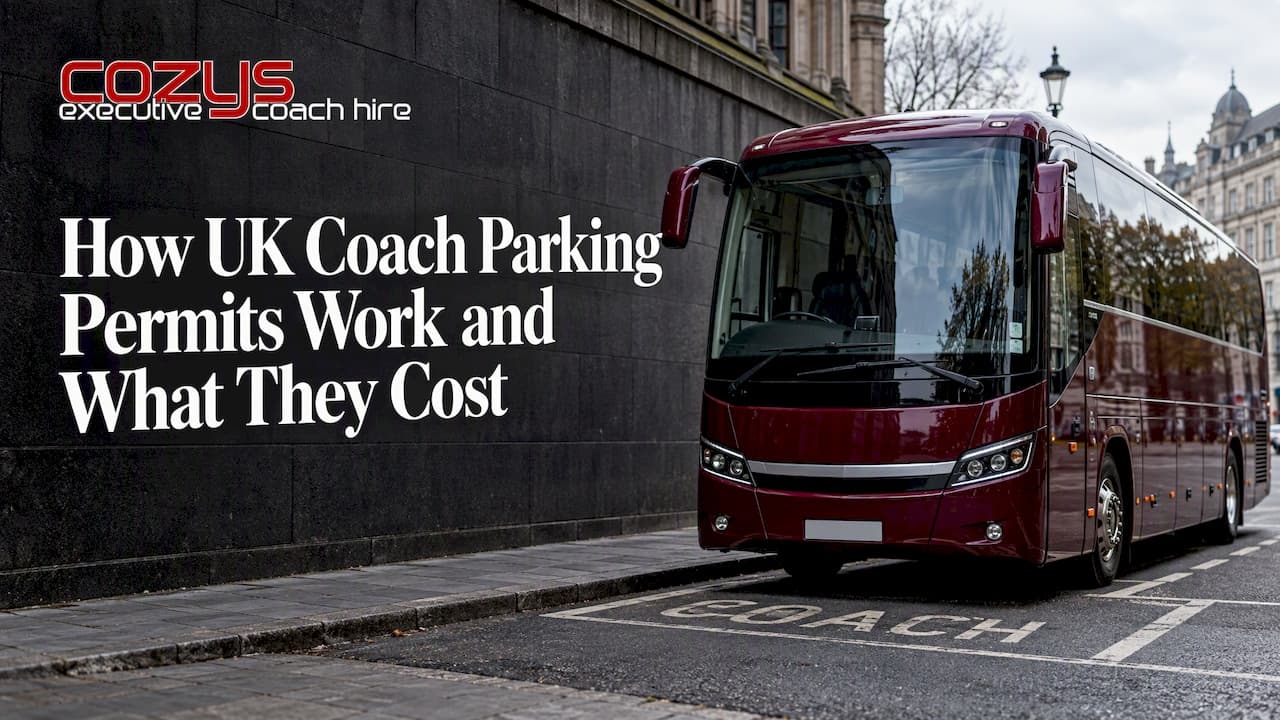
There is no single UK coach parking permit. Each council, and some operators of airports and stadiums, sets its own rules, prices and application routes, so the permit you need depends on where the coach will stop and for how long. This guide explains how the system works, what published permits cost, how to apply, and how organisers and operators avoid penalty charge notices (PCNs).
TL;DR
- Coach parking is regulated locally. In England and Wales, your council holds the information on permit schemes for its area, so check the council where the coach will stop.
- Published prices vary widely: from £18.48 for 24 hours on a Cornwall rover ticket to £145.60 for a 7-day Isle of Wight permit.
- Some areas need no permit at all. Southampton, for example, offers free coach parking for up to 10 hours in designated areas.
- Apply early. One English council asks for 10 working days to process a coach park permit application.
- Entering the wrong location or registration number can lead to a PCN, and the driver carries that responsibility.
Table of Contents
- Do you need a coach parking permit at all?
- What published coach permits and tariffs cost
- How to apply for a coach parking permit
- Drop-off, pick-up and long stays are treated differently
- Airports and private sites have their own rules
- What happens without a valid permit
- A planning checklist for group organisers
- Our perspective
- Booking a coach with parking planned in
- FAQ
- Sources
Do you need a coach parking permit at all?
Not always, and that is the first source of confusion. A permit is one of several mechanisms councils use to manage large vehicles. Depending on the place, you may meet:
- Pay-and-display or pay-by-phone tariffs in a dedicated coach park, charged by the hour or by a band of hours.
- Multi-day permits or rover tickets aimed at touring coaches that visit several car parks.
- Free designated bays with a time limit.
- Prohibition of coach parking in a centre, with set-down and pick-up points elsewhere.
- Private permit systems at airports, stadiums and attractions.
Because the rules are devolved, a coach that needs a permit in one town may park free in the next. The GOV.UK page on parking permits confirms that in England and Wales it is the council that provides the information on schemes in its area, which is why every itinerary needs a council-by-council check.
What published coach permits and tariffs cost
The table below collects current published figures from council and airport pages. Prices change each financial year, so treat these as a guide to the range and confirm the figure on the official page before you book.
| Location | Product | Published price | Notes |
|---|---|---|---|
| Cornwall | Coach rover ticket | £18.48 for 24 hours, £43.13 for 4 days, £61.61 for 7 days | Valid in specified car parks |
| North Devon | Coach permit | £35.00 for 4 days, £50.00 for 6 days, £60.00 weekly | Non-refundable, for designated lorry parks |
| Isle of Wight | Multi-location coach permit, 2026 to 2027 | £83.20 for 4 days, £145.60 for 7 days | Bought through PayByPhone |
| Windsor and Maidenhead (Alma Road) | Coach park charge from 1 April 2026 | £40.00 up to 4 hours, £60.00 for 4 to 10 hours | Permit application, 10 working days |
| City of Edinburgh | Designated coach parking, such as Regent Road | £9.80 per hour | Paid through RingGo |
| Manchester Airport | Coach permit via AIRDAT | £25.00 | Bought online in advance |
| Southampton | Designated city centre coach parking | Free for up to 10 hours | Separate pick-up and set-down points |
Three patterns stand out.
First, multi-day permits suit touring groups. A coach staying a week in Cornwall pays £61.61 on a 7-day rover ticket, against building up hourly charges in separate car parks.
Second, the cost of a single day can differ sharply. A full day in Edinburgh's hourly bays at £9.80 per hour adds up quickly, while Hastings offers a coach park where coaches can stay for up to 10 hours.
Third, a permit is often tied to a vehicle registration and a location, which is where most errors happen.
How to apply for a coach parking permit
Procedures differ, but the working process is similar everywhere. Use these steps.
- Identify every stopping point. List each drop-off, pick-up, layover and overnight location on the itinerary, with the council or landowner responsible for each.
- Read the official page for each. Look for whether a permit, a ticket or nothing is needed, plus the permitted hours and any restrictions on vehicle length.
- Gather the details the application asks for. Expect the vehicle registration number, the dates of use and the operator's contact details. Individual councils set their own requirements, so confirm exactly what each asks for on its form.
- Apply in good time. Windsor and Maidenhead asks applicants to complete its coach park permit application and allow 10 working days for processing. A last-minute change of vehicle is the classic cause of a mismatch.
- Buy through the specified channel. Some councils use pay-by-phone apps (the Isle of Wight uses PayByPhone, Edinburgh uses RingGo), and Manchester Airport requires purchase through its AIRDAT online system.
- Brief the driver. Give the driver the permit confirmation, the exact location names and the rules for each stop, and keep a copy in the vehicle file.
Who is eligible and what is needed
Eligibility is set by whoever issues the permit. In practice, permits for coaches are issued against a specific vehicle, so the operator or the driver usually applies using the registration number. A group organiser who has hired a coach should ask the operator which permits are included in the quotation and which stops have no permit requirement. Because documents and eligibility differ between councils, the issuing authority's own page is the only authoritative answer for a given scheme.
Drop-off, pick-up and long stays are treated differently
A frequent mistake is assuming that a permit covering parking also covers passenger set-down. It often does not, and the reverse is also true.
Oxford is a clear example. Oxford City Council prohibits coach parking in the city centre and directs operators to designated pick-up and drop-off points managed by Oxfordshire County Council. A coach there drops its passengers at a set point, then leaves for an allowed parking area rather than waiting nearby.

Southampton separates the two functions as well, with free coach parking for up to 10 hours in designated areas and specific pick-up and set-down locations alongside.
In London, Transport for London's guidance on operating coaches warns that parking or waiting at bus stops is generally prohibited and may result in a PCN. Set-down at a bus stop is therefore not a safe assumption for a group. Our own detailed notes are in prebooking coach parking in London, and for event days at the capital's venues see stadium coach parking in London.
A simple way to plan each stop is to ask three questions:
- Will passengers get on or off here, and is that allowed?
- Will the coach wait here, and for how long?
- Where does the coach go between drop-off and pick-up?
If the answers involve three different places, you may need three different permissions.
Airports and private sites have their own rules
Council rules are only part of the picture. Airports, stadiums, attractions and ports are often private land, and the operator sets conditions. Manchester Airport is a useful example: coach operators must buy permits through AIRDAT, the coach permit is priced at £25.00, and the airport also sets operating rules. These include a 10mph speed limit in passenger transport areas and high-visibility vests for coach drivers in manoeuvring areas.
The lesson for planners is that safety and access conditions travel with the permit. A driver who has the permit but not the vest, or who ignores the speed limit, is still in breach of site conditions. For group transfers to airports from our area, see our group airport transfers by coach.

What happens without a valid permit
The usual consequence is a Penalty Charge Notice. Windsor and Maidenhead states that entering the wrong parking location or registration details can result in a PCN, and it places responsibility on the driver to make sure those details are correct. TfL gives the same warning for waiting at bus stops.
The practical points follow from that:
- Check the registration on every transaction. One transposed character on a pay-by-phone entry is enough to make a valid payment look invalid.
- Check the location code, not just the town. Pay-by-phone systems identify car parks by number or name, and a nearby one can look identical.
- Replacement vehicles need new details. If a breakdown or a change of fleet means a different coach, update the registration with the issuer before the vehicle arrives.
- Keep evidence. Retain the receipt, confirmation email or screenshot with the journey file.
For a city that illustrates how fast charges mount when planning is thin, our guide to avoiding PCNs in York sets out tariffs and a checklist.
A planning checklist for group organisers
Whoever books the coach, the organiser benefits from asking the right questions early. Before travel, confirm:
- the name of the council or landowner for each stop;
- whether a permit, a ticket or nothing is needed;
- the cost, the validity period and whether it is refundable (North Devon's permits, for instance, are non-refundable);
- the application lead time, remembering the 10 working days one council asks for;
- the maximum stay, which is 10 hours at both Southampton and Hastings;
- who pays: the operator, the organiser or the passengers;
- what happens if the itinerary changes.
The broader booking sequence, including operator checks, is covered in our coach booking playbook for organisers. Schools and colleges with a trip to plan will find the practical side of group travel on our Schools and Colleges page.
Our perspective
We have operated group transport for over four decades, and parking is the part of a trip that organisers most often leave until last. It should be settled first. A coach is a large vehicle with a fixed driver's-hours allowance, and a stop with nowhere legal to wait puts the schedule, the passengers and the driver under pressure.
Our approach is to treat permits as part of the quotation, not an afterthought. We identify the council or site for every stop, confirm the rule, and give the driver the details before the vehicle leaves the yard. That matters most for the groups we serve every day: schools, local authorities, corporate clients and community organisations that cannot afford a PCN or a late arrival.
Our fleet runs from 16 to 85 seats, including the UK's first hybrid coach, and our maximum 6-star BUSK safety rating reflects how seriously we take compliance in every part of the operation. A group that hires a coach from an operator that plans parking properly is buying fewer surprises.
Cozys
Booking a coach with parking planned in
If your group needs a coach in Bedfordshire, Hertfordshire or beyond, we handle the route and the stopping points as part of the booking. Tell us where you are going, how many passengers you have and whether anyone needs step-free access, and we will confirm the vehicle and the arrangements for each stop.
See our coach hire service for standard group bookings, our group travel options for clubs and societies, or the Accessible Specialists page if wheelchair access is a requirement. We do not publish prices for these services, so please request a quotation for your journey.
FAQ
Is there a national coach parking permit in the UK?
No. In England and Wales, councils provide the information on permit schemes in their own areas, and airports and other private sites run their own systems. A coach touring several areas may therefore need several permits, or none, depending on the stops.
How far ahead should I apply?
As early as the itinerary is fixed. Windsor and Maidenhead, for one, asks for 10 working days for processing. Other schemes, such as pay-by-phone products, can be bought online, but buying in advance still avoids problems on the day.
Who is responsible for a PCN: the operator or the organiser?
The issuing authority holds the driver responsible for entering the correct location and registration details. Contractually, who bears the cost is a matter for the booking terms, so agree it in writing with the operator when you book.
Can a coach stop to drop off passengers without a permit?
Often only at designated points. Oxford directs operators to designated pick-up and drop-off locations, and TfL warns that waiting at bus stops is generally prohibited. Check the set-down arrangements for each destination.
Sources
- Get a parking permit, GOV.UK
- Parking for lorries, coaches, motorhomes and other large vehicles, Oxford City Council
- Coach and motorcycle parking, East Sussex County Council
- Coach Park, Royal Borough of Windsor and Maidenhead
- Tourist multi-location parking permits, Isle of Wight Council
- Coach permits, North Devon Council
- Coach rover tickets, Cornwall Council
- Motorcycles, coaches, buses, caravans, long and large vehicles, City of Edinburgh Council
- Coach operators, Manchester Airport
- Parking guidance, Southampton City Council
- Operating Coaches in London, Transport for London
Recommended
- Prebook coach parking in London: what drivers and operators must check
- Coach Cost per Mile in the UK: What You Really Pay
- Avoid PCNs in York: Coach Parking, Tariffs and Cozy's Operator Checklist
This article is produced as general information only and is not professional advise.