
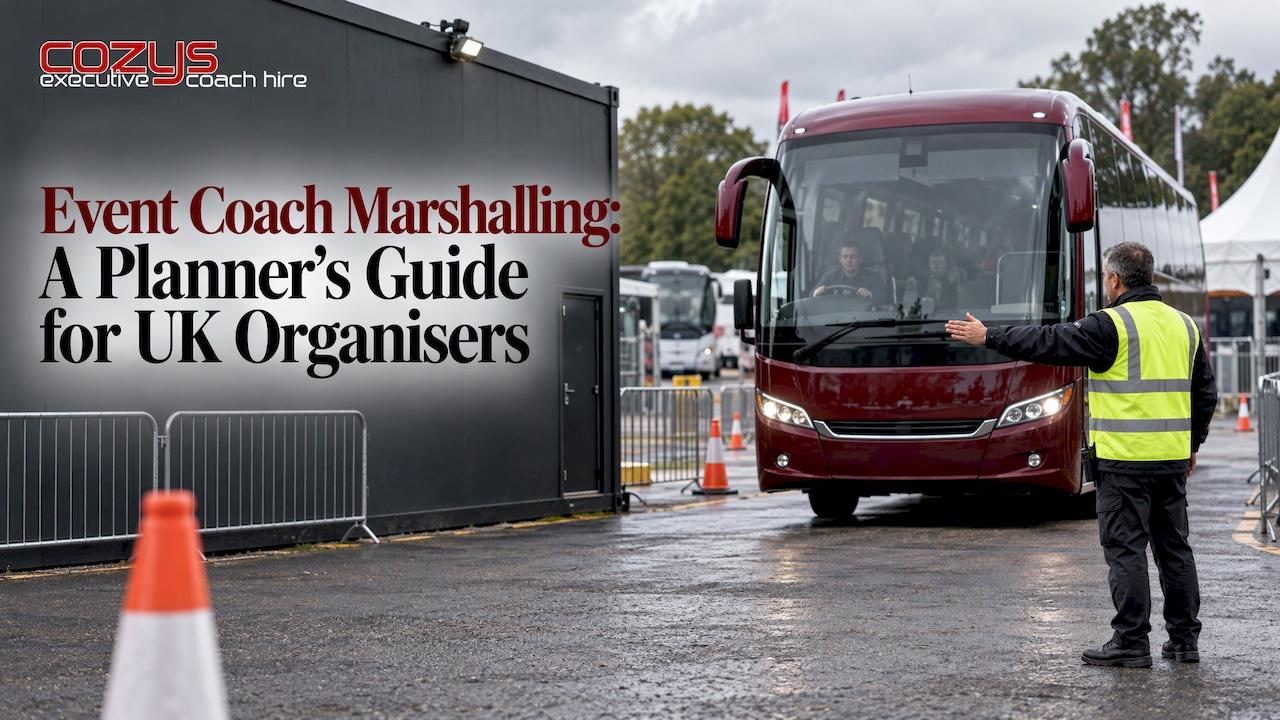
Event coach marshalling is the organised control of coaches and their passengers on and around an event site: where vehicles arrive, where they wait, where people board and alight, and how everyone leaves. Done well, it rests on a written traffic plan, named people in charge of each zone, trained marshals, a briefing that reaches everyone, and a fallback for when the schedule slips. This guide sets out how UK organisers can build that, using HSE and local authority guidance, and what to agree with your coach operator before the day.
TL;DR
- Appoint one overall coordinator and a named lead for each zone (set-down, staging, boarding, accessible drop-off).
- Follow HSE transport guidance: keep people and vehicles apart, use one-way routes where possible and minimise reversing.
- Plan arrivals and departures in phases, and never let queues block emergency routes or run into vehicle paths.
- Design accessible set-down and communication in from the start, not as a late addition.
- Brief marshals and drivers in advance and again on the day, and write down what happens if coaches are late, full or broken down.
Table of Contents
- What event coach marshalling involves
- Who is in charge of coaches, passengers and staff
- Planning arrivals, staging, boarding and departures
- Marshalling on and around the public highway
- Accessibility in coach marshalling
- What to put in the plan and the briefing
- Handling delays, congestion and emergencies
- What to agree with your coach operator
- Plan your event coaches with Cozy Travel
- FAQ
- Sources
What event coach marshalling involves
A coach at an event touches three jobs at once: traffic management, crowd management and passenger care. Marshalling is the thread that links them. In practice it covers directing drivers to the right entrance, holding vehicles in a staging area until a bay is free, supervising boarding so that queues do not spill into the road, counting passengers, and releasing coaches in a sensible order at the end.
The terms "marshal" and "steward" are used loosely across the sector. What matters is not the label but that each person knows their zone, their radio contact and what they are, and are not, allowed to do. That last point is covered under the public highway section below.
HSE guidance gives the foundations. Organisers should assess the risks from vehicle movement on site, keep people and vehicles apart, use a traffic management system with one-way routes where possible, minimise reversing, plan entry and exit for emergency vehicles and prepare a traffic management plan. Coach marshalling is how that plan is carried out in real time.
Who is in charge of coaches, passengers and staff
The most common failure is not a lack of marshals but a lack of clarity about who decides. When a coach is late, a driver wants to move off a bay, or a group arrives early, someone must be able to make the call quickly.
Cheshire West and Chester's event guidance recommends appointing one person with overall responsibility as the event's key contact and coordinator, responsible for coordinating everyone's roles and the final delivery. Scottish Athletics' 2025 marshalling resource takes the same line from an endurance-event angle, placing ultimate responsibility with the organiser or race director, who should work with knowledgeable event leads, local authorities and emergency services when preparing the risk assessment.
For a coach operation, a workable structure looks like this:
| Role | Responsibility | Typical contact method |
|---|---|---|
| Event coordinator | Overall decisions, link to police, highways authority and operators | Mobile and radio |
| Transport lead | Coach schedule, bay allocation, liaison with operator control | Radio |
| Staging marshal | Holds coaches in the waiting area, releases them to bays | Radio |
| Boarding and set-down marshals | Passenger flow, counts, queue control | Radio |
| Accessible transport lead | Priority set-down, ramps and lifts, assistance | Radio and phone |
| Chief marshal or control room | Incident log, escalation, emergency response | Radio and phone |
Scottish Athletics treats access and egress, parking, spectator movement and start and finish areas as separate stewarding functions. That supports the idea of a named lead per operational zone rather than one team trying to cover everything.
Planning arrivals, staging, boarding and departures
HSE describes three phases of event crowd management: arrival and entry, on-site circulation, and leaving or dispersal. Coaches sit at both ends of that sequence, so your coach plan should be written in two halves: the inbound wave and the outbound wave.

The inbound wave
Treat the site entrance as a sequence of stops, not a single gate.
- Approach. Give drivers a written route and a named contact. External routes and any temporary restrictions should be agreed with police, the local highways authority and transport providers, as HSE advises.
- Staging. Hold coaches away from public areas until a bay is free. A staging marshal confirms the vehicle, operator and expected passenger numbers.
- Set-down. One-way flow through the set-down area, with passengers alighting on the pavement side and no reversing. HSE recommends minimising reversing, and where it cannot be avoided a trained signaller is needed.
- Clear. The coach moves out to parking or a holding area before the next arrives, so bays never stack up.
Where possible, work vehicle tasks in public areas should be finished before the audience is admitted, and service routes should avoid public areas. For coaches this usually means arranging driver parking, refuelling and any waste or catering deliveries away from the passenger set-down.
The outbound wave
Departure is where most problems appear, because everyone wants to leave at once. HSE recommends phased arrivals and departures for larger crowds and warns that queues must not block emergency routes or push people into the paths of moving vehicles.
Practical measures include:
- Allocating each coach a numbered bay and a return time printed on passenger tickets or wristbands.
- Using signage, barriers and queue lanes that separate walking routes from vehicle routes.
- Calling groups forward in waves by bay number over the public address system.
- Holding a reserve of coaches in staging so that a delayed vehicle does not leave a queue standing.
If you run a high-frequency service from an off-site car park, the same logic applies, and our guide to avoiding TMP rejections with park and ride shuttles covers what traffic management plans need to show. For multi-venue events, designing conference shuttle routes sets out how to keep loops short and predictable.
Marshalling on and around the public highway
There is a legal line that organisers must not blur. The marshals you appoint can direct vehicles and pedestrians inside the event site. Regulating traffic on the public road is different, and it is not something ordinary stewards should be asked to do. Agree any on-road arrangements, such as temporary stops, closures or signed diversions, with the police and the local highways authority, and use qualified traffic management providers where the plan calls for them. HSE's guidance is clear that police, highways authorities and transport providers should be consulted on external traffic management so that site access is safe and off-site disruption is kept down.
HSE also expects drivers, banksmen or signallers and traffic marshals to be trained and competent. Marshals working near moving coaches need appropriate high-visibility clothing and protection from the weather, and the briefing should cover what to do if a driver ignores an instruction or a member of the public walks into a vehicle path.
If your event is in a city with tight kerbside rules, plan the parking as carefully as the set-down. Our pages on prebooking coach parking in London and booking stadium coach parking explain what drivers and operators need to confirm in advance.
Accessibility in coach marshalling
Accessible transport should be planned at the same time as general coach flow, because it changes where vehicles stop and how long they take.
The HSE Event Safety Guide says organisers should prepare an access strategy covering people with mobility, walking, visual or hearing impairments and publish a contact number for access information. It also expects flat surfaces or ramps linking accessible parking or drop-off areas to designated event areas, together with adequate emergency escape.
The Association of Event Venues' August 2026 guidance adds recent, practical points: give advance access information, consider priority coach set-down close to the entrance, train front-line staff in disability equality and brief them on access barriers and support arrangements.
In marshalling terms, that translates to:
- A dedicated, signed set-down point nearest the entrance, kept clear of general coach traffic.
- A marshal at that point who knows how the vehicle's lift or ramp works, or who has the driver to hand.
- Extra time in the schedule for boarding and alighting wheelchair users.
- Pre-event information telling passengers where to find the set-down and who to call.
If you are hiring vehicles for wheelchair users, our UK buyer's guide to wheelchair accessible coach standards sets out what to ask for, and our accessible specialists page describes the service.
What to put in the plan and the briefing
A coach marshalling plan is a section of the wider event plan, not a separate document that nobody reads. Cheshire West and Chester's guidance lists what an event plan should identify: the timeline, roles and responsibilities, stewarding and security, first aid, site layout, risk assessment, weather, evacuation, traffic management, parking, welfare and accessibility. Coaches feature in nearly every item on that list.
Thurrock Council's template adds the communications side: contact and radio-channel details, a clear chain of command, emergency procedures, signage, public address announcements and information points, covering residents, the audience and internal staff. Residents matter more than organisers sometimes assume: a short letter about coach times and routes prevents complaints and last-minute calls to the council.
For the briefing itself, Scottish Athletics recommends circulating it in advance and updating it face to face on the day, including chief marshal and control room contacts, emergency access procedures, marshal identifiers and location references. A one-page coach briefing should include:
- A site map with the route, staging area, set-down, bays and exit marked.
- The coach schedule with operator, vehicle size, registration and driver contact.
- Radio channels and the escalation route.
- Where emergency vehicles enter and leave, and what to do if a coach is in the way.
- The accessible set-down point and who runs it.
- The wet weather and delay fallbacks (see below).
A solid crowd management plan ties these elements to numbers: expected arrivals per hour, queue capacity and the point at which you slow or stop admissions.
Handling delays, congestion and emergencies
The plan is only as good as its response to the first thing that goes wrong. HSE advises organisers to consider alternatives if routes deteriorate in bad weather and to keep consulting police, highways authorities and transport providers about external traffic. HSE also recommends monitoring arrival numbers and liaising with police, transport operators and other agencies where attendance may exceed what the venue can safely hold.
Build a short decision table into the briefing:
| Situation | First action | Who decides |
|---|---|---|
| Coach arrives early | Hold in staging, do not release to a full bay | Staging marshal |
| Coach late | Inform control, release reserve vehicle if one is on standby | Transport lead |
| Queue approaching an emergency route | Pause boarding, redirect queue, call control | Boarding marshal, then coordinator |
| Vehicle breakdown on site | Cordon, move passengers to a safe area, call the operator | Transport lead |
| Ground or access route unusable in bad weather | Switch to the alternative route in the plan | Event coordinator |
Two of our guides help here. Backup coach provision explains what to insist on from an operator when a vehicle fails, and a coach breakdown contingency plan lists what to write into it. For a wider view of paperwork, see our compliance checks for event transport logistics and coach risk assessments.
What to agree with your coach operator
Marshals can only control what they know about, so most of the marshalling plan is built from information the operator provides. Before the event, agree in writing:
- The number, size and type of vehicles, and which can carry wheelchair users.
- Arrival and departure windows for each coach, and the driver's contact number.
- Where drivers will park and rest between runs, and how they reach staging.
- How the operator's control room will communicate with your transport lead.
- Reserve vehicles and the time it would take to bring one on site.
- Who is responsible for passenger counts and lost property.
For corporate events away from the venue, corporate offsite transport covers the same ground from the buyer's side.
Our perspective on coach marshalling
In our experience as a family-run operator with more than four decades in group travel, the events that run smoothly are the ones where the operator is involved early. We would rather receive a site map and a draft schedule weeks ahead than a phone call the evening before, because that is when we can match the vehicle to the job: a 16-seat minibus for a shuttle loop, an 85-seat coach for a peak departure, or a wheelchair accessible vehicle for priority set-down.
We believe marshalling and driving are one operation. Drivers who know the bay plan, the radio contact and the exit route make a marshal's job easier, and our safety approach, reflected in the highest 6-star BUSK safety rating we have received, is built on that kind of preparation. Our work for organisations such as Tesco and the RAF has taught us that large groups value predictability above all.
Our fleet includes the UK's first hybrid coach, which matters at events where shuttles idle in staging areas and organisers are asked to show how they are reducing emissions. We would encourage every planner to put the vehicle specification into the traffic plan, not leave it to the day.
Cozys
Plan your event coaches with Cozy Travel
If you are organising an event and need coaches or minibuses from 16 to 85 seats, we can help you match vehicles to your schedule, including accessible transport for wheelchair users. Our coach hire page explains how to make a booking request, and our group travel page covers larger bespoke programmes.
Corporate organisers can start from our corporate transport page, and schools or colleges running sporting or cultural events can use our schools and colleges page.
FAQ
Do I need professional traffic marshals for a coach event?
It depends on your site and your risk assessment. HSE expects the people managing vehicle movements to be trained and competent, so at minimum your marshals need traffic-marshalling training. If the plan involves controlling traffic on the public road, agree it with the police and highways authority and use appropriately qualified providers.
How many marshals do I need for coach arrivals?
There is no single ratio, because it depends on the number of coaches, the layout and the speed of boarding. Base the number on your risk assessment, with at least a lead for staging, set-down, boarding and accessible drop-off. Add extra marshals for the departure peak, when crowds and vehicles are most likely to meet.
Who should brief the marshals and coach drivers?
The event coordinator or transport lead should own the briefing. Send it in advance, then update everyone face to face on the day with radio channels, emergency access arrangements and the schedule. Operators should confirm that each driver has seen the site plan.
How do I make coach set-down accessible?
Designate a priority set-down close to the entrance, connect it to the event area with a flat surface or ramp, and tell passengers about it in advance with a contact number. Brief marshals on how vehicle lifts or ramps work and allow extra time for boarding.
Sources
- Transport, HSE Event Safety
- Put crowd controls in place, HSE Event Safety
- The event safety guide, second edition, HSE
- Guidance for Event Planning 2025, Cheshire West and Chester
- Event management plan template, Thurrock Council
- Marshalling at off-track endurance events, Scottish Athletics
- Association of Event Venues eGuide, August 2026
- Crowd management plan guide
Recommended
- Coach Risk Assessments: 8 Checks UK Organisers Need Before Booking
- 3 compliance checks UK organisers must do for event transport logistics
- Backup Coach Provision: 3 Checks UK Planners Must Insist On
- Wheelchair Accessible Coach Standards: A UK Buyer's Guide
This article is produced as general information only and is not professional advise.