
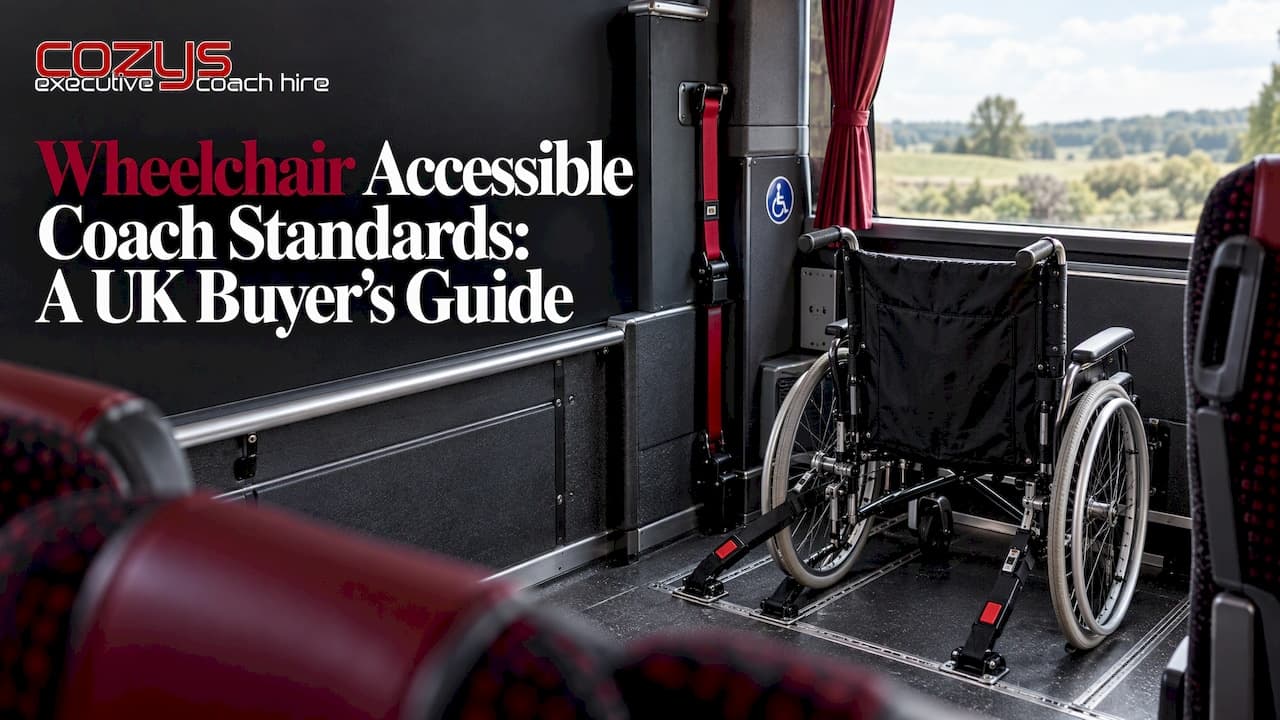
In Great Britain, wheelchair accessibility on coaches is set by the Public Service Vehicles Accessibility Regulations 2000 (PSVAR). They require a lift or ramp, at least one restrained wheelchair space, slip-resistant floors, a wide enough aisle, contrasting handrails, lighting and signs. The regulations apply to vehicles on timetabled services. Many private group hires fall outside them, so organisers should write the standard they need into the booking. This guide explains what the rules say, where they apply and how to check a coach before it arrives.
TL;DR
- PSVAR 2000 sets the technical standard for accessible coaches in Great Britain. Breaching it is a criminal offence with a fine of up to £2,500.
- The law does not cover private or hired coaches that do not run to a timetable, or vehicles carrying 22 or fewer passengers. Group organisers should specify accessibility in the contract.
- Check five things: a working lift or ramp, a wheelchair space with a restraint, a clear route to it, slip-resistant floors and the right signs and lighting.
- Confirm the wheelchair fits. A standard wheelchair is taken as 70cm wide, 120cm long and 1.35m high.
- Ask about the boarding and drop-off points too. A working ramp is of little use at a kerb where it cannot be deployed.
Table of Contents
- Which laws and guidance apply
- Features an accessible coach must have
- What drivers must and need not do
- A coach accessibility checklist for organisers
- Seating layouts and mixed groups
- Home-to-school and contract transport
- Our perspective
- Arranging accessible group transport with us
- FAQ
- Sources
Which laws and guidance apply
The main instrument is the Public Service Vehicles Accessibility Regulations 2000. Its schedule sets out the technical requirements for wheelchair spaces, restraint systems and other features on regulated public service vehicles. The Department for Transport explains how the regulations work in practice and states that non-compliance is a criminal offence under the Equality Act 2010, with a fine not exceeding Level 4 on the standard scale, currently £2,500.
The regulations are about the vehicle. Separate duties cover how staff treat passengers, and the Equality Act 2010 sits behind both. For an organiser, the practical effect is that a coach built and certified to PSVAR is a known quantity. Its features are defined in law rather than left to a sales description.
Who is covered and who is not
The government's guidance on features and help for disabled people on buses and coaches is plain about the limits. The accessibility law does not apply to private or hired coaches that do not operate on a timetable, nor to vehicles carrying 22 or fewer passengers. The same guidance says coaches used for some home-to-school services are exempt from meeting all PSVAR rules until 10 August 2030.
This is where many bookings go wrong. A school trip, a corporate event or a community outing is usually a private hire. The law does not oblige the operator to supply a lift-equipped coach, so nothing happens by default. The organiser has to ask. If you have a wheelchair user in the group, say so at the enquiry stage and ask for a vehicle that meets the PSVAR specification, then have that written into the quote or contract.
Coach trips sold as part of a holiday package fall under different consumer rules again, set out in the UK package travel regulations. Those concern financial protection and the seller's duties, not the vehicle's features, so they sit alongside the accessibility standards rather than replacing them.
| Journey type | Is PSVAR accessibility law the deciding factor? | What the organiser should do |
|---|---|---|
| Timetabled coach service | Yes, where the vehicle is regulated | Expect compliance and ask for the Accessibility Certificate if in doubt |
| Private hire, no timetable | No, not required by that law | Specify the accessible features in the booking |
| Vehicle carrying 22 or fewer passengers | No | Specify the features and confirm the wheelchair space |
| Some home-to-school services | Partly exempt until 10 August 2030 | Check the contract specification with the operator or authority |
Features an accessible coach must have
The same government guidance lists what an accessible coach must provide for boarding, travelling and leaving. In summary:
- a working lift or ramp at the entrance;
- at least one wheelchair space;
- slip-resistant flooring;
- an aisle wide enough for a standard wheelchair;
- contrasting handrails;
- interior and exterior lighting;
- wheelchair signs.
The lift is the feature that changes who can travel. The Disabled Persons Transport Advisory Committee (DPTAC) noted in 2021 that PSVAR lifts allow wheelchair users to travel on coaches, while entrance steps remain a barrier for some people with mobility impairments. A passenger who can walk a short distance but cannot manage steep steps needs different support from a full-time wheelchair user, and a good enquiry asks about both.
Wheelchair space and restraint
The regulations require a regulated vehicle to have at least one wheelchair space, fitted with a restraint system and a user restraint (a pelvic belt) that can be released easily in an emergency. The 2000 Regulations also allow forward or rear-facing positions and set minimum dimensions, for example 1300mm in length for a forward-facing space.
In plain terms, the guidance says a wheelchair must occupy a space facing the front or rear. If it faces the front, the space must have a user restraint, and signs must show the direction of travel and give safety instructions. Securing the chair itself matters as much as the passenger belt. Our own piece on wheelchair securement standards for UK operators goes through what a compliance check looks at.
Dimensions to verify
The guidance treats a standard wheelchair as 70cm wide, 120cm long and 1.35m high. The aisle must be wide enough for that chair to move between the entrance, the wheelchair space and the exit. If a passenger uses a larger power chair, a tilting chair or one with a raised headrest, measure it and send the figures to the operator before booking. Do not wait for the day of travel.

What drivers must and need not do
Drivers carry duties as well. The guidance says they must help disabled passengers board and alight if asked, and offer help with the wheelchair-space restraint. They need not lift passengers, and they may withhold help if they reasonably believe there is a health, safety or security risk.
A driver can also refuse a wheelchair user in four situations: the wheelchair is larger than standard, it cannot be safely located in the space, carrying it would take the vehicle over its maximum seating or standing capacity, or the space is already occupied.
Those refusal grounds are a planning checklist in themselves. Each one can be removed in advance:
- Chair size: send the measurements early.
- Safe positioning: agree which way the chair will face and how it will be restrained.
- Capacity: confirm the number of wheelchair spaces against the number of wheelchair users in the group.
- Occupied space: agree that the space is reserved for the wheelchair user and not used for luggage.
A carer or escort who will help the passenger with personal care or transfers should be named in the booking. The driver's duty is to assist with boarding and the restraint, not to provide personal care.
A coach accessibility checklist for organisers
Use this before you confirm a booking and again when the vehicle arrives.
Before booking
- Tell the operator how many wheelchair users are travelling and give each chair's width, length, height and weight, including any occupant.
- Ask for a vehicle that meets the PSVAR specification, and ask for it in writing.
- Ask how many wheelchair spaces the coach has and whether they face forwards or backwards.
- Ask whether the coach has a lift or a ramp, and whether it has been serviced and tested recently.
- Ask whether the vehicle holds an Accessibility Certificate. GOV.UK states that it lasts for the lifetime of the vehicle provided no further alterations are made, and that compliance is monitored annually during the vehicle's test. The published fee is £51 for one schedule and £104 for two.
- Agree who will help with boarding, restraint and any luggage or equipment.
Checking the pick-up and drop-off points
DPTAC has highlighted that many passenger pick-up points across the UK remain unsuitable for deploying boarding ramps. A lift needs level, firm ground and clear space to open. Visit or photograph each stop. Look for:
- a flat, hard surface where the lift or ramp will land;
- a kerb or drop that will not leave the platform at an angle;
- no parked cars, bollards or street furniture in the deployment area;
- a safe place for the coach to stop that is not in a live traffic lane;
- step-free access from the building or entrance to the coach stop.
Where the usual stop fails, agree an alternative in advance. A school gate, a hotel forecourt or a venue's own drop-off bay is often easier than the road outside.
On the day
- Check the lift or ramp operates before the passenger approaches.
- Confirm the restraint system and pelvic belt are present, adjusted and release easily.
- Look at the route from the door to the space: no luggage in the aisle, no loose items.
- Check the signs show the direction of travel and the safety instructions.
- Confirm interior lighting and the floor surface are in good order, particularly in wet weather.
- Make sure the driver and any escort know the plan for an emergency exit.
Seating layouts and mixed groups
A coach with one wheelchair space and a full load of walking passengers is a different proposition from a coach with two or three spaces and fewer seats. Every wheelchair space reduces the number of fixed seats, so a group of 50 with three wheelchair users may need a larger vehicle than a group of 50 without. Our guide to accessible coach seating layouts shows the trade-offs. For wider planning options, see wheelchair group transport options for UK organisations.
It also helps to think beyond wheelchairs. Passengers with reduced mobility, sensory needs or learning disabilities benefit from seats near the door, contrasting handrails, clear signage and a driver who has been briefed. Ask the operator how drivers are trained and whether a briefing can take place before the trip.

Home-to-school and contract transport
Local authorities and schools face the most complex version of this question, because a contract runs for years and children's needs change. The exemption for some home-to-school services until 10 August 2030 is a transition, not a reason to wait. A contract specification should name the accessible features required, the number of wheelchair spaces, the restraint standard and the passenger assistant arrangements. Pupils' individual transport plans should be matched to the vehicle, not the other way round.
Private schools hiring for trips have a similar duty of care. The law may not oblige the operator, but the school still has to make reasonable provision for pupils, and a vehicle that cannot carry one child excludes that child from the trip. Our overview of private school transport options covers how schools can structure this.
Driver suitability and vehicle condition belong in the same specification. Two further pieces cover coach driver DBS checks and coach maintenance records and intervals, both of which affect whether accessibility equipment is reliable.
Our perspective
Accessibility is easiest to deliver when it is planned at the first enquiry, not solved at the kerb. We have provided group travel for over four decades, and the pattern is consistent: the bookings that run smoothly are those where the organiser told us early who was travelling, what equipment they used and where they would be collected.
We run a fleet from 16 to 85 seats, and accessible transport for wheelchair users is one of our specialisms. We treat the PSVAR specification as a sensible benchmark even where the law does not require it for a private hire, because a lift, a restrained space and clear signage are what a wheelchair user needs to travel safely. They are not extras to be added if someone remembers.
Safety and accessibility belong together. We hold the highest 6-star BUSK safety rating, and we regard securement, driver briefing and vehicle maintenance as one system. Our aim is that the passenger who needs a lift is treated as an ordinary member of the group, not a special case that delays departure.
Cozys
Arranging accessible group transport with us
If you are planning transport for a group that includes wheelchair users, our accessible specialists can talk through the vehicle, the wheelchair spaces and the boarding points before you commit. Schools and colleges can start from our schools and colleges page, and organisations arranging other trips can look at our coach hire options.
Send us the group size, the wheelchair measurements and the pick-up addresses, and we will tell you what vehicle suits the journey. Our fleet includes the UK's first hybrid coach, so accessibility and lower-emission travel need not be a choice between one and the other.
FAQ
Does a hired coach have to be wheelchair accessible by law?
Not necessarily. The government guidance says the accessibility law does not apply to private or hired coaches that do not run to a timetable, nor to vehicles carrying 22 or fewer passengers. That is why organisers should ask for a lift-equipped, PSVAR-specification coach in writing when a wheelchair user is travelling.
How many wheelchair spaces must a coach have?
A regulated public service vehicle must have at least one wheelchair space, fitted with a restraint system and a pelvic belt that can be released easily in an emergency. If your group includes several wheelchair users, confirm the number of spaces with the operator, because one space carries one wheelchair.
Can a driver refuse to carry a wheelchair user?
Only in limited cases. The guidance allows refusal if the wheelchair is larger than standard, cannot be safely located in the space, would take the vehicle over its capacity, or the space is already occupied. Sending the chair's measurements and agreeing the arrangements before travel removes most of these risks.
Do drivers have to lift passengers?
No. Drivers must help disabled passengers board and alight if asked, and offer help with the wheelchair-space restraint, but they are not required to lift passengers. If someone needs lifting or personal care, arrange an escort or carer to travel with them.
What is an Accessibility Certificate?
It is the certificate showing a vehicle meets the accessibility requirements. GOV.UK says it lasts for the vehicle's lifetime provided no further alterations are made, with compliance monitored annually at the vehicle's test. Ask the operator to confirm that the coach you are booking holds one.
Sources
- Public Service Vehicles Accessibility Regulations 2000, Schedule 1
- Bus and coach accessibility and the Public Service Vehicle Accessibility Regulations 2000, GOV.UK
- Buses and coaches: features and help for disabled people, GOV.UK
- DPTAC position on the accessibility of coach services, GOV.UK
- Vehicle approval: Accessibility certificate test, GOV.UK
Recommended
- Accessible coach seating layouts UK organisers must check
- Wheelchair Group Transport Options for UK Organisations
- Pass PSVAR checks: wheelchair securement standards for UK operators
- Coach Procurement Checklist for UK Buyers
This article is produced as general information only and is not professional advise.