
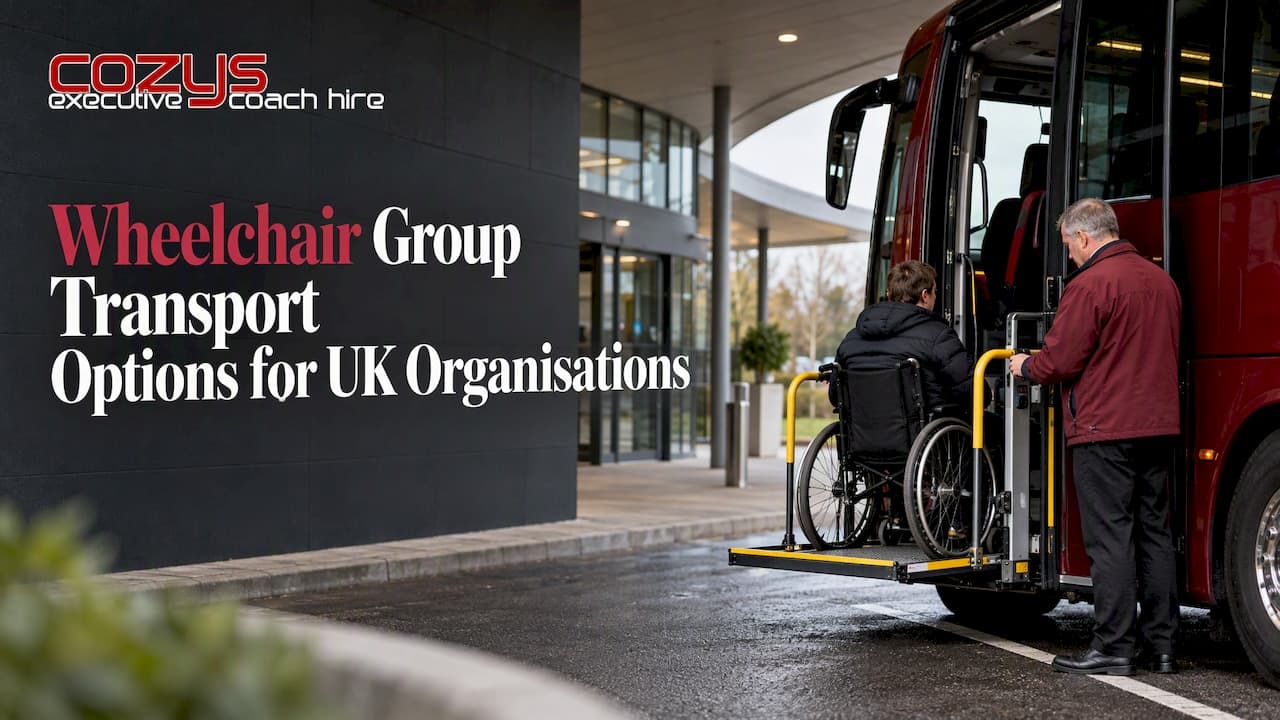
If you are arranging a journey for a group that includes wheelchair users, your realistic options in the UK are community transport, NHS patient transport (for medical appointments only), public buses and trains, or hiring an accessible minibus or coach from a licensed operator. Which one fits depends on who is travelling, why, how many, and whether the organisation booking is a charity or a commercial body. This guide sets out each option, what it can and cannot do, and the checks that prevent a problem on the day.
TL;DR
- Community transport is often the right choice for non-profit groups, but it runs under permit rules that generally restrict it to non-profit, community-based purposes.
- NHS patient transport is for eligible medical journeys only, assessed at the time of booking. It is not a group outing service.
- Commercial accessible coach and minibus hire suits schools, corporate clients, tour organisers and any group that falls outside a community permit.
- Check that the vehicle is PSVAR compliant and ask how many wheelchair spaces it has, how securement works and how long boarding will take.
- Plan accessibility from the first draft of the itinerary, not as an extra bolted on afterwards.
Table of Contents
- The four routes for moving a group with wheelchair users
- Community transport: strong for non-profit groups, with boundaries
- NHS patient transport: only for medical journeys
- Public transport: improving, but not built for groups
- Accessible minibus and coach hire from a licensed operator
- What PSVAR compliance means and why to ask
- A booking checklist for organisers
- Our view: why we plan the wheelchair spaces first
- Choosing between the options
- Typical group journeys we plan
- Where we operate
- Arranging accessible transport with Cozy Travel
- FAQ
- Sources
The four routes for moving a group with wheelchair users
Group transport for wheelchair users is not one market but four, each with its own rules and its own limits.
| Option | Best for | Main limit |
|---|---|---|
| Community transport | Charities, social clubs, care groups, local voluntary bodies | Permit-based, generally non-profit and community purposes |
| NHS non-emergency patient transport | Eligible patients attending healthcare appointments | Assessed medical need; not for leisure or group trips |
| Public buses and trains | Individuals or very small groups on fixed routes | Fixed timetables, limited wheelchair spaces per vehicle |
| Accessible minibus or coach hire | Schools, employers, tour groups, larger community events | Needs a licensed operator and early planning |
The sections below take each in turn, then explain how to choose.
Community transport: strong for non-profit groups, with boundaries
The Community Transport Association describes community transport as localised, often demand-responsive travel for people who cannot use mainstream public transport. Many schemes offer group hire to voluntary and community organisations, which makes them a natural first call for a day centre, a faith group or a residents' association.
The boundaries matter. Most schemes operate under Section 19 or Section 22 permits issued under the Transport Act 1985, and these are generally limited to non-profit use. That is why a community transport operator will usually decline a booking from a company, or for a purpose that is commercial rather than community-based. It is not a failure of service; it is the legal basis on which they run.
If your own group is considering running its own scheme rather than hiring, our guide to the steps to a Section 19 permit for UK community groups explains what is involved.
Questions to ask a community transport scheme
- Do you hold the right permit for our type of group and journey?
- How many wheelchair users can you carry at once, and what are the chair size and weight limits?
- Do you provide trained drivers or escorts, and is a carer travelling free?
- What is your availability at weekends and for longer distances?
Community schemes often have small fleets and heavy demand, so the answer to the last question is frequently the deciding factor. Book early, and have a fallback.
NHS patient transport: only for medical journeys
People often assume that NHS-funded transport can carry a group of wheelchair users. It cannot be used that way. Non-emergency patient transport is not a universal entitlement: as Northumbria Healthcare explains, eligibility rests on medical need and mobility, and patients must typically be unable to travel by other means. A medical condition alone does not qualify someone.
The Mid Cheshire Hospitals guidance puts it in similar terms: the medical need must affect mobility so severely that other forms of transport are not an option. Assessment takes place when the journey is booked.
For an organiser, the practical point is simple. If your group includes people attending hospital appointments, individual patients should ask their hospital or their local integrated care board about eligibility. For outings, activities, school journeys and work travel, patient transport is not the route.

Public transport: improving, but not built for groups
Buses and trains are increasingly accessible, and for one or two wheelchair users on a regular route they can work well. For groups, the limits show quickly. A bus typically has a restricted number of wheelchair spaces, so a party of six chairs cannot board together, and a timetable leaves little slack for boarding.
The NHS guidance on using public transport with mobility issues recommends contacting the operator before you travel. That lets you confirm that ramps are working, that priority seating will be available and that staff know to assist. Do that for each leg of a journey, and do it more than once for a group.
Where a day involves a change of vehicle, a missed connection with several wheelchair users can strand the whole party. For that reason, organisers usually turn to a single dedicated vehicle once the group is larger than a few people.
Accessible minibus and coach hire from a licensed operator
For schools, employers, tour organisers and any group outside the community permit model, hiring a vehicle with a driver from a licensed operator is the most dependable option. You get one vehicle, one timetable, a driver who knows the vehicle and, with the right operator, equipment that suits your passengers.
This is the work we do at Cozy Travel. We are a family-run operator with over four decades of experience in specialised group travel, with a fleet from 16 to 85 seats and a dedicated accessible transport service for wheelchair users.
Which vehicle size suits which group
The right size is set by two numbers: how many people are travelling and how many of them use wheelchairs. Wheelchair spaces take up the room of several standard seats, so a 16-seat minibus does not carry 16 passengers if some are in chairs. The seat count on the brochure and the usable capacity for your group are different figures.
Our article on accessible coach seating layouts UK organisers must check explains how a layout changes once spaces are allocated to chairs, and what to confirm in writing before you book.
If your organisation is thinking about buying its own passenger van rather than hiring, a US dealer's passenger van range gives a feel for the base vehicles on the market. Remember that a purchased vehicle then needs conversion, maintenance, insurance, a trained driver and the right licensing, which is why many organisations find hiring a better fit for occasional trips.
What PSVAR compliance means and why to ask
The Public Service Vehicles Accessibility Regulations (PSVAR) exist to make sure disabled people can get on and off regulated public service vehicles and travel in them safely. The legal summary published by the Office of Rail and Road sets out the legislative basis, including the power under the Equality Act framework to make these regulations.
In practice, when you book you should not assume a standard coach is suitable. Ask whether the vehicle is PSVAR compliant, because compliance points to the features that matter: secure wheelchair spaces, wide enough gangways and a ramp or lift that works reliably. These are not guaranteed on every passenger vehicle.
A booking checklist for organisers
Whatever the vehicle, work through the same list. Put the answers in writing.
- Count the chairs. Record how many wheelchair users are travelling, the type of chair (manual, powered, tilt-in-space) and any special seating or head support.
- Confirm the spaces. Ask the operator for the number of wheelchair spaces in the specific vehicle allocated, not the fleet in general.
- Check the access equipment. Is it a ramp or a lift? Is it tested and working? What are its weight and size limits?
- Ask about securement. Who secures each chair, and how long will it take? Allow for it in your schedule.
- Plan boarding order. Decide who boards first and last, and where each person will sit relative to the exit.
- Name the carers and escorts. Agree who is travelling to support whom, and whether they need seats beside wheelchair spaces.
- Check the licence. Confirm the operator holds the right licences for the work. Our guide on four legal checks to avoid unlicensed operators covers this step by step.
- Plan the destination. Check the drop-off point, the kerb, the toilets and the route from the vehicle to the entrance.
Build accessibility in from the start
Specialists in inclusive group travel make the same point: the commonest mistake is treating accessibility as an add-on. A workable plan treats boarding sequences, securement time and the mix of needs in the group (mobility, sensory, dietary) as part of the first draft. If you build the itinerary first and then ask whether it can be made accessible, you tend to find that the timings do not hold.
In practice this means allowing longer at every stop, choosing venues with step-free access before choosing the date, and giving the driver a list of passengers' needs in advance. For groups that include autistic passengers, our piece on autism friendly travel covers quiet-journey planning that fits well alongside wheelchair access.
Our view: why we plan the wheelchair spaces first
We have carried school parties, corporate groups and community organisations for more than forty years, and the pattern of problems is consistent. They rarely come from the vehicle itself. They come from a gap between what the organiser thought had been agreed and what the operator understood.
For that reason we begin an accessible booking with the passengers, not the vehicle. We ask how many people use wheelchairs, what type of chair each has, who is travelling as support and what the route and stops look like. Only then do we match a vehicle. A 16-seat minibus and an 85-seat coach lose seats at very different rates once wheelchair spaces are fitted, so the vehicle follows from the count.
We also encourage organisers to contact us earlier than they think necessary. An accessible journey needs a suitable vehicle, a driver briefed on the passengers and a timetable with realistic boarding time. All three are easier to arrange with notice.
Safety is the other foundation. Our operations hold the highest 6-star rating in the BUSK coach safety benchmark, and we regard that as a minimum for work that involves carrying people who depend on equipment working correctly. For organisations that also care about emissions, we run the UK's first hybrid coach, which you can read about on our hybrid coach hire page.
— Cozys
Choosing between the options
Use these questions in order.
Is the journey a medical appointment for an individual? Start with the hospital or ICB about patient transport eligibility. It is the right route only for those who meet the medical criteria.
Is your group a charity, club or voluntary body travelling for a community purpose? Contact your local community transport scheme first. If it has no capacity, or the trip falls outside its permit, move to commercial hire.
Is the group a school, a business, a local authority or a tour party? Commercial hire is the correct route. Our pages for schools and colleges and corporate travel explain how we work with each.
Is it a regular route for one or two people? Public transport may work, provided you contact the operator in advance.

Many organisations use more than one route: community transport for weekly sessions and commercial hire for the annual trip, the larger event or the journey too long for a local scheme.
Typical group journeys we plan
The same planning applies across very different trips.
- School and college journeys. Educational visits and regular home-to-school travel for pupils who use wheelchairs, arranged with schools and local authorities.
- Corporate and event travel. Staff days, conferences and site visits where colleagues who use wheelchairs travel together with everyone else.
- Community and social groups. Day outings and seasonal trips for clubs, care groups and societies, including our coach day trips from Bedfordshire and Hertfordshire.
- Airport transfers. Group journeys to and from airports, with luggage and mobility equipment to allow for. See our group airport transfers by coach.
- Weddings and family occasions. Guests with mobility needs travelling between venues, covered on our wedding coach hire page.
Where we operate
We serve organisations across Bedfordshire, Hertfordshire and Cambridgeshire, with local pages for Luton, Leighton Buzzard, Cambridge, Huntingdon, Hitchin, Letchworth and Baldock and St Neots. If your group is elsewhere, get in touch and we will tell you plainly whether we can help.
Arranging accessible transport with Cozy Travel
If your group needs a vehicle with secure wheelchair spaces and a driver who knows the job, our accessible specialists team can talk you through the options. Tell us the numbers, the types of chair, the route and the date, and we will propose a vehicle and layout. For wider group bookings, see our group travel and coach hire pages. We do not publish fixed prices, because the cost depends on vehicle, distance, timings and the equipment needed, so we quote for each journey.
FAQ
Can a community group hire a wheelchair accessible minibus from a community transport scheme?
Often, yes, provided the group is non-profit and the purpose is community-based. Schemes run under permits that are generally limited to non-profit use, so a business or commercial trip will usually fall outside them. Ask the scheme about its permit, vehicle capacity and availability before you plan around it.
Can NHS patient transport take a group of wheelchair users on an outing?
No. NHS non-emergency patient transport is for eligible patients travelling to healthcare services, and eligibility is assessed on medical need and mobility at the time of booking. Social outings, school trips and work travel need a different route, such as community transport or commercial hire.
What does PSVAR mean when I hire a coach?
PSVAR refers to the Public Service Vehicles Accessibility Regulations, which exist so that disabled people can get on, off and travel safely in regulated vehicles. When booking, ask whether the vehicle is compliant, as this points to secure wheelchair spaces, usable gangways and a reliable ramp or lift.
How far ahead should I book accessible group transport?
As early as you can. Matching the vehicle to the number and type of wheelchairs, briefing the driver and allowing realistic boarding time all take longer than a standard booking. If the date is fixed, such as a school event, start the conversation before details are final.
Do I need to tell the operator about each passenger's needs?
Yes. Share the number of wheelchair users, the type of chair, any additional seating or support needs and who is travelling as a carer. It lets the operator allocate the right vehicle and layout, and the driver can prepare before the day.
Sources
- What is Community Transport? | Community Transport Association
- Setting Up A Community Transport Service toolkit | Community Transport Association
- Getting to your appointment | Northumbria Healthcare NHS Foundation Trust
- Information for Outpatients | Mid Cheshire Hospitals NHS Foundation Trust
- Non-emergency patient transport | NHS Birmingham and Solihull
- Driving and using public transport if you have mobility issues | NHS
- Legal advice on PSVAR | Office of Rail and Road
- Accessible Small Group Tours | Defying Limits Travel