
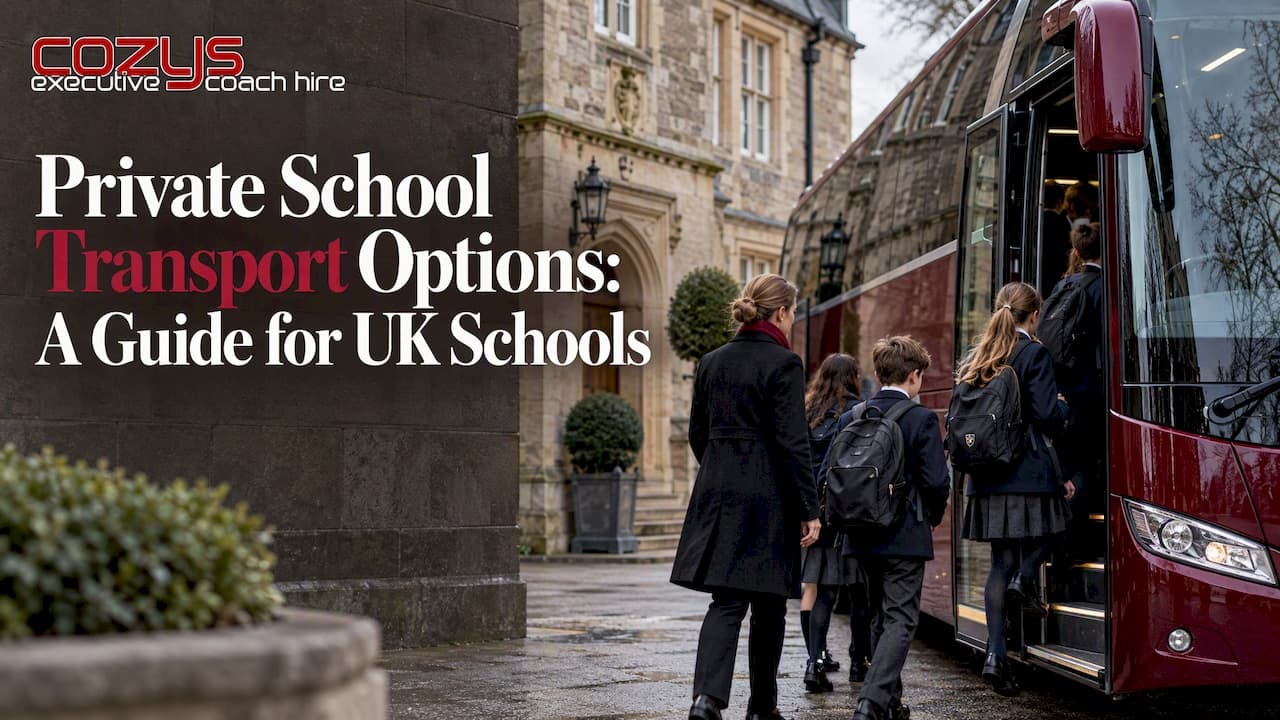
Private schools and the families they serve in the UK have five realistic ways to organise the daily journey: council-arranged transport where a child is eligible, a dedicated contract coach or minibus, taxis or private hire, public buses, and parent-run arrangements. For most schools with more than a handful of pupils on the same corridors, a contracted coach or minibus is the most predictable and the easiest to audit. The right choice depends on pupil numbers, geography, pupils' needs and the safeguarding evidence you can obtain from the operator.
This guide sets out each option, what the law and official guidance say, and what to ask before you sign.
TL;DR
- Council-funded transport depends on the council's own policy, normally on distance and on whether a child with SEND can walk safely. Check the policy for your area before assuming either way.
- For routes shared by many pupils, a contracted coach or minibus gives fixed timings, one point of accountability and a clear audit trail.
- Since 27 April 2026, operators of school services must ensure drivers have had an enhanced DBS check, including the children's barred list, within the previous three years.
- Ask every operator about seat belts, restraints, driver training for SEND, vehicle maintenance records and a named contact for problems.
- Compare options on cost per pupil, reliability, safeguarding evidence and emissions, not on the headline hire rate alone.
Table of Contents
- The main options at a glance
- Council-arranged transport: who qualifies
- Contract coaches and minibuses
- Taxis and private hire
- Public buses and independent travel
- Parent car-share
- Safeguarding checks you should insist on
- Seat belts and child restraints
- Pupils with SEND or additional needs
- Comparing cost and emissions fairly
- Our perspective
- Talk to us about your school's routes
- How to choose: a step-by-step approach
- FAQ
- Sources
The main options at a glance
| Option | Best for | Main strength | Main watch-point |
|---|---|---|---|
| Council-arranged transport | Eligible pupils, including many with an EHCP | Funded or arranged through the education authority | Eligibility rules vary by council and are not automatic |
| Contract coach or minibus | Schools with many pupils on shared routes | Fixed timetable, one contract, scalable capacity | Needs a proper tender and safeguarding checks |
| Taxi or private hire | Small numbers, scattered addresses, individual needs | Door-to-door flexibility | Cost per pupil rises; school-specific checks still needed |
| Public bus | Older pupils with a direct route | Low cost, builds independence | Timings and capacity outside the school's control |
| Parent car-share | Small friendship groups | No contract needed | Liability, insurance and safeguarding sit with parents |
Most schools end up with a mix: a coach network for the main catchment, a minibus or two for outlying villages, and individual arrangements for a few pupils with particular needs.
Council-arranged transport: who qualifies
Home-to-school transport contracts are arranged by the councils responsible for education, which means a county council or a unitary authority, as the Local Government Association guidance note explains. Each authority publishes its own policy.
The common pattern in England is distance-based. Under the Northumberland County Council policy for 2026, eligibility starts beyond 2 miles for children under 8 and beyond 3 miles for children aged 8 to 16, or where a child cannot walk safely because of special educational needs, a disability or mobility problems. Children with an Education, Health and Care Plan (EHCP) usually have transport needs assessed against the plan.
Two practical points for private school parents and bursars:
- Policies differ between councils, and the detail on which school a child must attend to qualify matters. Read your own council's policy rather than relying on a general summary.
- Where a council does arrange transport, it may offer a pass for public transport, a dedicated bus or a taxi. Some councils also offer a personal transport budget or independent travel training for young people with SEND, as the City of York Council describes.
If a child is not eligible, or the school wants a wider service than the council provides, the school or a group of parents arranges transport privately. That is where the remaining options come in.
Contract coaches and minibuses
A dedicated school service is the option most private schools choose once pupil numbers justify it. The school, or a parent body acting with it, contracts an operator to run named routes at fixed times, with vehicles sized to the load. Minibuses suit rural pick-ups and small year groups; coaches suit trunk routes from towns and commuter villages.
Why schools favour it:
- Predictability. The timetable, stops and vehicle are fixed, so staff can plan the morning arrival and afternoon dispersal.
- Capacity that scales. Fleets with vehicles from 16 to 85 seats let the operator match vehicle to route. Our coach capacity guide for group planners explains how seating limits work in practice.
- One point of accountability. A written contract names who is responsible for drivers, vehicles and incident reporting.
- Lower traffic at the school gate. Fewer cars arriving at drop-off means a calmer start to the day. Our piece on contract coach services and BUSK safety looks at how one coach can replace many car journeys.
The weak spot is procurement. A school that buys on price alone can end up with an operator that cannot cover driver absence or evidence its checks. If you want to understand how operators are assessed, our article on how operators win school transport tenders shows the criteria a careful buyer looks for.
Taxis and private hire
Taxis and private hire vehicles work for a small number of pupils, for addresses far from any route, or for children who need a quieter, individual journey. Costs per pupil are higher than on a shared coach, but flexibility is real.
The safeguarding point is easy to miss. Licensed taxi and private hire drivers pass their local authority's fit-and-proper test, but the LGA guidance and wider practice point to schools and education bodies doing their own child barred list checks through their safeguarding leads before awarding a school-specific contract. A general licence check is not a substitute. Ask the firm to show, in writing, what checks apply to every driver who will carry your pupils, including relief drivers.
Public buses and independent travel
For older pupils with a direct route, public buses are the cheapest option and help build independent travel skills. The limits are outside your control: timings, capacity at peak and service changes. Schools using public transport as the main route should keep a fallback plan for cancellations, particularly in winter and for rural catchments.
Public buses are also a poor fit for younger pupils and for children whose risk assessment requires a familiar driver and a predictable journey.
Parent car-share
Informal car-sharing between families is common and sensible for short runs. It is not a school transport service. Insurance, driver suitability and seating arrangements sit with the parents involved, and the school carries reputational risk if something goes wrong on a journey it appears to endorse. The Shropshire Council leaflet Carrying Other People's Children Safely is a useful reminder that anyone carrying other people's children has a legal duty to carry them safely.
Safeguarding checks you should insist on
This is where private school transport is won or lost. The rules changed recently.
Under section 33 of the Bus Services Act 2025, operators of public service vehicles used for school services must not permit a person to drive unless barring information has been checked. As of 27 April 2026 that means an enhanced criminal record certificate, including a children's barred list check, obtained within the previous three years. The duty is aimed at operators, but a school buying transport should still ask to see the evidence.
A practical checklist for any operator:
- Proof of an enhanced DBS check with children's barred list for every driver and relief driver, and the date of each. Our article on coach driver DBS checks for UK operators explains what operators should be doing.
- A documented process for reporting concerns about a driver's behaviour. The LGA note says education authorities must set up data-sharing arrangements so concerns trigger immediate reporting, and that they should know which licensing authority holds a driver's records.
- Maintenance records and inspection intervals you can read. See our guide to coach maintenance records that stand up to DVSA audits.
- A independent safety benchmark. The BUSK scheme rates coach operators on safety, and our BUSK page explains the rating. We hold the highest 6-star BUSK rating.
- Named staff, a phone number that is answered at 7am, and an escalation route in the contract.
Schools should also take account of their own safer working practice policy. Oxfordshire's safer working practices guidance notes that when staff transport pupils, the employer has a duty to carry out a risk assessment, which is a reminder that school-run minibuses driven by staff carry their own obligations.
Seat belts and child restraints
The rules depend on vehicle type and the child's age, so do not assume one answer covers every route. On GOV.UK, the exemptions for travelling without a child car seat are narrow: a child aged 3 or older can travel in a back seat without a child car seat and without a seat belt only if the vehicle does not have one, and the guidance lists the specific situations in which an exemption applies.
For a planned, daily school run, the sensible position is that exemptions framed around unexpected necessity should not be relied on. Write into the contract that the operator provides restraints appropriate to each child's age and height, and that they are used on every journey. Where a taxi or coach company is not required to supply seats, the school or parents may need to provide them, so settle this before the first day.
For coaches and larger minibuses, ask directly whether every seat has a seat belt and whether they are three-point or lap belts. Our checklist, three-point seat belt fit before you book group travel, lists the questions to put to an operator.

Pupils with SEND or additional needs
A driver's licence and background check are necessary but not enough for a child with medical or behavioural needs. The DfE's statutory guidance, Travel to school for children of compulsory school age, points to risk assessments that consider the child's specific needs and make sure drivers are trained to manage them. The strongest assessments draw on input from both home and school.
In practice:
- Agree a written risk assessment before the journey starts. We set out how parents and schools can produce one in co-producing a signed SEND risk assessment.
- Ask for a pre-trip meet and greet. Councils such as York describe familiarisation with driver and vehicle as a way to reduce anxiety on the first journeys, and many parents do not realise they can request it.
- Keep the same driver and escort where possible.
- For wheelchair users, confirm lift or ramp equipment, wheelchair restraint points and driver training, and see our page on accessible transport specialists.
- For autistic pupils, predictability and sensory calm matter. Our article on autism-friendly travel covers planning.
Comparing cost and emissions fairly
Fixed prices are not published for most contract work, because the cost depends on route length, vehicle size, number of days and driver hours. Ask each operator for a quote on the same specification, then compare cost per pupil per term, not hourly rate. Include what happens when a driver is absent, and whether a replacement vehicle is guaranteed.
Emissions deserve a line in the comparison. The UK Government's 2025 greenhouse gas conversion factors methodology notes average local bus occupancy has historically been around 11 passengers. A well-filled school coach spreads emissions across many more pupils than a series of individual car or taxi trips, so emissions per passenger-kilometre fall as occupancy rises. Ask operators for vehicle emission standards and whether hybrid options exist; ours is covered on the hybrid coach hire page.
Our perspective
We are a family-run operator with more than four decades in group travel, and the pattern we see is consistent: school transport succeeds when the paperwork and the people are both in order. Schools that ask for DBS evidence, maintenance records and a named contact before signing rarely have a bad term. Schools that choose on price alone often find out about the gaps in October.
Our view is that a shared coach or minibus route, properly contracted, is the strongest default for a private school with a spread of pupils. It is easiest to audit, it puts one accountable operator in front of the school, and it takes cars off the road at the gate. We would still advise a mixed model: individual taxis or tailored vehicles for pupils whose needs a shared route cannot meet.
We operate vehicles from 16 to 85 seats, including the UK's first hybrid coach, and we hold the highest 6-star BUSK safety rating. We work with local authorities and private schools on home-to-school travel, and we would rather a school asks us hard questions than takes our word for it.
— Cozys
Talk to us about your school's routes
If you are planning or reviewing transport for a private school, our Schools & Colleges service covers daily routes, trips and contract work, and our home-to-school transport team works with local authorities and independent schools. Tell us your catchment, pupil numbers and any pupils with specific needs, and we will propose vehicle sizes and route options. Our coach booking playbook shows what information speeds up a quote.
How to choose: a step-by-step approach
- Map your pupils. Plot home postcodes and group them into corridors. Three or more pupils on a corridor usually justifies a shared vehicle.
- Check council eligibility. Identify pupils who may qualify for council-arranged transport under the local policy, and those with an EHCP.
- List individual needs. Gather medical, mobility and behavioural information with parents, and agree risk assessments.
- Write the specification. Include timings, stop locations, seat belts and restraints, driver checks, relief cover and reporting.
- Request comparable quotes. Ask for per-pupil, per-term figures and for evidence of safety rating, maintenance and DBS processes.
- Run a trial week. Check punctuality, driver conduct and how the operator handles a late pupil or a breakdown.
- Review each term. Track complaints, delays and incidents, and renew only on evidence.
FAQ
Can I send my child to school in a taxi?
Yes, and some councils arrange taxis for eligible pupils, particularly where a child has SEND. If you arrange it privately, ask for written confirmation of driver checks, and settle who provides any child restraint. For a planned daily journey, do not rely on the narrow exemptions set out on GOV.UK for unexpected necessity.
Who qualifies for free school transport?
In England, councils set their own policy, usually based on distance and on whether a child can walk safely. One 2026 council policy sets thresholds of over 2 miles for children under 8 and over 3 miles for ages 8 to 16, with separate consideration for SEND and mobility problems. Check the policy of the council where the child lives.
What checks should school bus drivers have?
Since 27 April 2026, operators of school services must ensure drivers have an enhanced criminal record certificate including the children's barred list check within the previous three years. Schools should still ask to see the evidence and keep their own safeguarding lead involved.
Is a coach better than a minibus for a private school?
It depends on the load and the roads. Coaches suit busy trunk routes with many pupils, while minibuses fit small groups and narrow rural lanes. Many schools use both, sized by route.
Sources
- School transport guidance note, Local Government Association
- School Transport Policy, Northumberland County Council, May 2026
- Transport options for eligible young people with SEND, City of York Council
- Bus Services Act 2025, section 33
- When a child can travel without a car seat, GOV.UK
- Travel to school for children of compulsory school age, DfE
- 2025 GHG conversion factors methodology paper
- Carrying Other People's Children Safely, Shropshire Council
- Professional and Personnel Relationships, Oxfordshire County Council
Recommended
- School Transport Tenders in the UK: How Operators Win
- Wheelchair Group Transport Options for UK Organisations
- Remove up to 50 Cars: UK contract coach services with BUSK safety
- Avoid Unlicensed Operators: 4 Legal Checks for UK Group Transport
This article is produced as general information only and is not professional advise.