
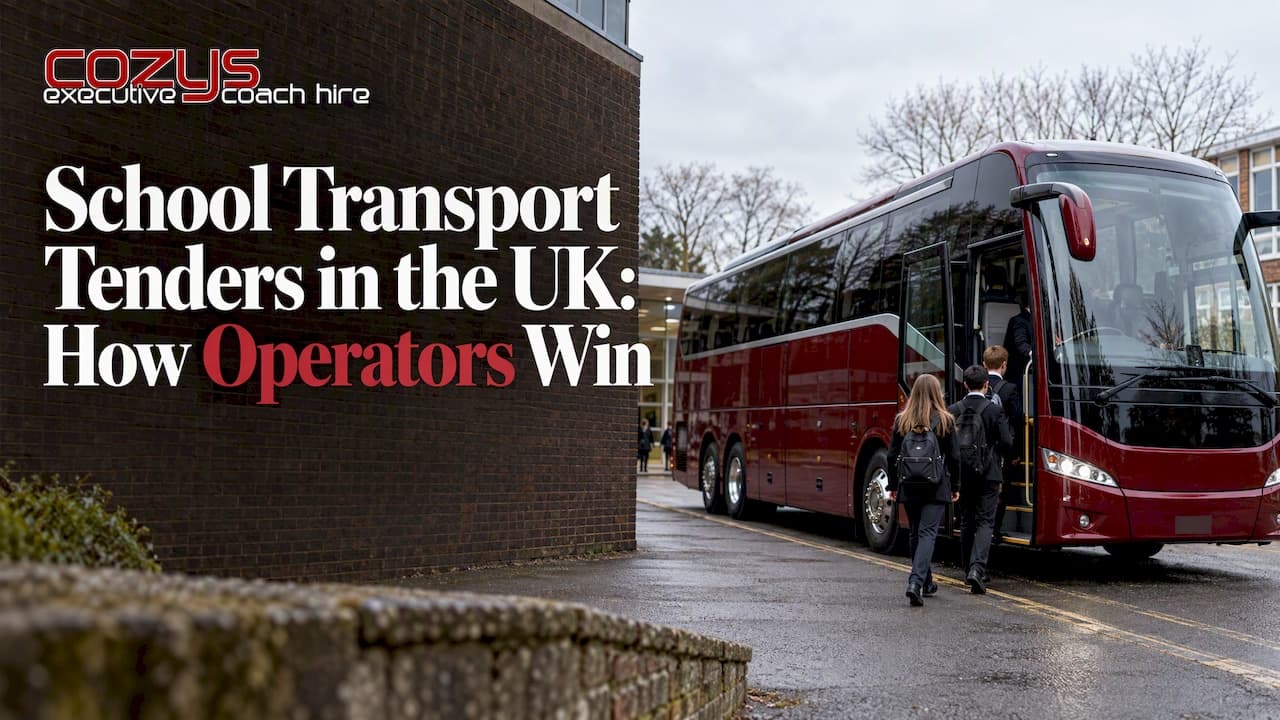
UK councils buy home-to-school transport through tenders, open frameworks and dynamic purchasing systems (DPS), split into lots by vehicle size and service type. Operators win by registering early on the council's e-procurement portal, holding complete compliance documents and showing a safe, reliable operating model. Price matters, but it is rarely the only test. This guide explains how the process works, what councils ask for and how to prepare a bid.
TL;DR
- Councils, not schools or parents, procure most home-to-school transport, and many now use open frameworks under the Procurement Act 2023 or a DPS instead of one-off tenders.
- Registration on the council's own e-procurement portal is the step that decides whether you can bid at all. Late registration often means a closed window.
- Tenders are usually divided into lots (taxis, minibuses, large coaches, accessible vehicles). Bid only where your fleet, licences and drivers fit.
- Safety, vetted drivers and dependable attendance carry weight with councils, particularly on SEND routes.
- Private schools and community groups follow different rules from councils, and Section 19 and 22 permits have strict conditions.
Table of Contents
- Who buys school transport, and why it is tendered
- Tenders, frameworks and DPS: the three routes
- How lots work
- What councils check before they read your price
- Why safety and reliability outweigh the lowest price
- A step-by-step approach to bidding
- Private schools, charities and Section 19 or 22 permits
- Our perspective on school transport tenders
- Working with Cozy Travel
- FAQ
- Sources
Who buys school transport, and why it is tendered
Local authorities in England have a statutory duty under the Education Act 1996 (sections 508B and 508D) to provide free travel arrangements for eligible children of compulsory school age. The Department for Education's statutory guidance, updated in May 2026, covers children who cannot reasonably be expected to walk to school because of distance, a special educational need, a disability or a mobility problem. Eligibility is assessed child by child.
The duty creates a steady demand for vehicles, but councils meet it within tight budgets. They also have to be transparent and fair, and the same guidance expects a clear appeals process for parents. For an operator, that means your punctuality, incident reporting and records can be scrutinised long after the contract is awarded.
Each authority publishes its own travel assistance policy, and the details differ. Stoke-on-Trent's 2026-27 home-to-school travel assistance policy is one example of how a council sets out who it assists. Read the policy of any authority you intend to bid to, because it shapes the service specification.
The Scottish picture is similar in outline but runs through different portals. Public Contracts Scotland, for instance, carries notices from councils such as Dumfries and Galloway for mainstream and additional support needs school transport.
Tenders, frameworks and DPS: the three routes
The old pattern was a standalone tender every few years. That still exists, but many councils now keep a standing list of approved suppliers.
| Route | How it works | What it means for you |
|---|---|---|
| Standalone tender | One notice, one deadline, a contract awarded for a set term | You must spot the notice in time and submit in full |
| Open framework | A multi-supplier list established under the Procurement Act 2023, often lasting several years | Joining the framework is the gateway to individual call-off contracts |
| Dynamic purchasing system (DPS) | A standing list that suppliers can join, with individual contracts competed among members | Registration comes first; mini-competitions follow as routes arise |
West Northamptonshire Council's passenger transport services open framework is an example of a multiple-supplier arrangement. Hull City Council's taxi and small bus open framework shows the same approach applied to smaller vehicles. Our research found frameworks of this kind running for roughly four to eight years, with estimated values from about £4 million to well over £18 million depending on the council's mainstream and SEND needs. Treat any figure as an estimate: values in notices are ceilings for planning, not guaranteed revenue.
The Isle of Wight Council published a pipeline notice for home-to-school bus and coach services for 2026. A pipeline notice is an early signal, and it is exactly the kind of document operators who monitor portals use to plan ahead.
How lots work
Councils commonly divide school transport into lots. The Hull notice, for example, is organised around vehicle capacity and service requirements. Typical categories are:
- Taxis and private hire: up to eight seats, often used for individual or small-group SEND routes.
- Minibuses: nine to sixteen seats.
- Large coaches: up to 80 seats or more, for mainstream routes where many pupils travel together.
- Accessible vehicles: wheelchair-accessible vehicles, with tail-lifts where the route needs them.
Lots may also separate scheduled routes (a dedicated daily service) from ad-hoc work (on-demand journeys). Some frameworks allow a single supplier per lot and others appoint several.
The practical lesson is to bid where you are strong. A fleet of 16 to 85 seats suits minibus and coach lots. An operator without accessible vehicles should not stretch into SEND lots that require them. Councils check capability, and an overreaching bid can damage your standing on later opportunities.
What councils check before they read your price
Council operator guidance is blunt about this. West Berkshire Council's guidance for school and social care transport operators advises all operators to register on its e-procurement portal, and it stresses documentation. Wokingham Borough Council likewise publishes how to bid for its school transport supplier contracts. Expect these items to be requested, usually uploaded to the portal at the first vetting stage:
- A valid operator's licence: PSV for buses and coaches, or taxi and private hire licensing for smaller vehicles.
- Insurance: public liability and employers' liability certificates.
- Vehicle licences and records: vehicle-specific documents, plus maintenance evidence.
- LOLER certificates: for any powered tail-lift on a wheelchair-accessible vehicle.
- Driver vetting: enhanced DBS checks and the council's own safeguarding requirements.
- Systems compatibility: the ability to work with the council's scheduling, communication and reporting expectations.
Holding the licence is not enough. Councils want the paperwork in the portal before they will consider a bid. If you want a closer look at the driver-checking side, our guide to coach driver DBS checks for UK operators explains the process, and our maintenance article covers records and intervals that stand up to DVSA audits.
Accessibility rules
Wheelchair-accessible capability carries weight on SEND lots. Public service vehicle accessibility regulations (PSVAR) matter for coaches and buses used on certain services, and our summary of PSVAR requirements for UK operators sets out what to check against the 1 August 2026 date. Always confirm with the council which accessibility standard its specification requires for each lot.

Why safety and reliability outweigh the lowest price
Local authority guidance consistently points to a compliant and safe operating model as the thing that wins and keeps contracts. On SEND routes especially, authorities value consistent drivers, vetted staff and reliable attendance. A cheap bid that fails on day three costs the council more in complaints, appeals and emergency cover than it saves.
For your tender response, that translates into evidence rather than assertions:
- Independent safety ratings, with the audit date.
- Driver recruitment, vetting and training procedures.
- A contingency plan: spare vehicles, spare drivers and how fast you can cover a breakdown.
- Named contacts for the council's transport team and for schools.
- Your approach to emissions and vehicle age, which more specifications now score.
A step-by-step approach to bidding
- Find the portal. Identify the e-procurement system each target council uses. Examples named in council material include SProc.Net, ProContract and YORtender. Also monitor Find a Tender and Public Contracts Scotland.
- Register before a notice appears. On a framework or DPS, the registration window may already be closed by the time you notice it.
- Join market engagement. Many councils run preliminary market engagement or "how to tender" sessions. Attending shows you the service specification and technical standards before the formal process starts.
- Build a document pack. Keep licences, insurance, LOLER certificates, DBS records and maintenance evidence current and ready to upload.
- Map your fleet to the lots. Match vehicles and drivers to the lots you can fully serve, and cost each route on real mileage, driver hours and standing time.
- Write for the evaluators. Answer each question directly, with evidence. Quality sections are usually scored separately from price.
- Plan mobilisation. Councils often award close to the term start. Be clear about how quickly you can have vehicles, drivers and passenger assistants in place.
- Review after award. Track punctuality and incidents from day one, because the council will.
Private schools, charities and Section 19 or 22 permits
Not every school transport arrangement is a council contract. Private schools, colleges and community groups arrange their own transport, and some consider running it themselves. The GOV.UK guidance on Section 19 and 22 permits explains that not-for-profit bodies may use these permits instead of a full PSV operator's licence in specific circumstances. The same page notes that commercial organisations, including privately owned schools, are treated differently, so read it before assuming a permit applies to you. Breaching permit conditions can bring serious regulatory consequences.
If you are unsure whether an arrangement is lawful, speak to the Traffic Commissioner's office or a transport solicitor before you carry passengers. Our guide to four legal checks for group transport covers how to spot unlicensed operators.
Our perspective on school transport tenders
We are a family-run operator that has provided group travel for over four decades, and school and corporate contracts are a core part of that work. From where we sit, three things matter more than anything else when a council or school looks at an operator.
First, safety has to be demonstrable. We hold the highest 6-star BUSK safety rating, and we would encourage any evaluator to ask every bidder for an equivalent independent benchmark. You can read how it works on our BUSK page.

Second, fleet fit. Our vehicles range from 16 to 85 seats, including wheelchair-accessible options and the UK's first hybrid coach, so we can match a vehicle to a route rather than forcing a route to fit a vehicle. A tender that splits lots by capacity rewards that kind of range. Our approach to contract coach services shows how one coach can replace many private cars on a daily run.
Third, dependable delivery. Councils judge an operator on the 190th school day, not the first. We would rather bid on fewer lots we can serve flawlessly than on many we might serve adequately.
— Cozys
Working with Cozy Travel
If you are a local authority, private school or college looking for dependable pupil transport, we can discuss your routes and requirements. See our home-to-school transport service, our Schools & Colleges page and our accessible specialists for wheelchair users. For one-off trips or wider group needs, our coach hire page is the place to start. We do not publish prices, so please contact us with your requirements.
FAQ
Who awards home-to-school transport contracts?
In England, local authorities do. They have a statutory duty under the Education Act 1996 to provide free travel for eligible children, and they procure the vehicles through tenders, frameworks or a DPS. Schools and parents are not usually the contracting party for statutory transport.
What is the difference between an open framework and a DPS?
Both create a standing list of approved suppliers that individual contracts are then competed among. An open framework under the Procurement Act 2023 is a multi-supplier arrangement that can be reopened for new entrants. A DPS allows suppliers to join as it runs. In both cases, you must register on the council's portal first.
Which documents do I need before bidding?
Councils typically ask for a valid operator's licence, public and employers' liability insurance, vehicle licences, DBS evidence for drivers and LOLER certificates for any tail-lifts. West Berkshire's guidance describes uploading these to the council's portal during initial vetting. Check each council's own list, as requirements vary.
Can I wait for a tender notice before registering?
It is risky. Frameworks and a DPS often close or restrict registration, and the best way to learn a council's expectations is to join pre-tender market engagement sessions and monitor its portal regularly.
Can a school run its own transport under a permit?
Some not-for-profit bodies can use Section 19 or 22 permits, but the conditions are strict and commercial organisations, including privately owned schools, are treated differently. Read the GOV.UK guidance and take advice before relying on a permit.
Sources
- Travel to school for children of compulsory school age, DfE statutory guidance, May 2026
- West Northamptonshire Council, Passenger Transport Services Open Framework
- Hull City Council, Taxi & Small Bus Service Open Framework
- Isle of Wight, Home to School Transport Bus and Coach Services pipeline notice
- West Berkshire Council, guidance for school and social care transport operators
- Wokingham Borough Council, school transport supplier contracts
- Stoke-on-Trent, home-to-school travel assistance policy 2026-27
- GOV.UK, Section 19 and 22 permits