
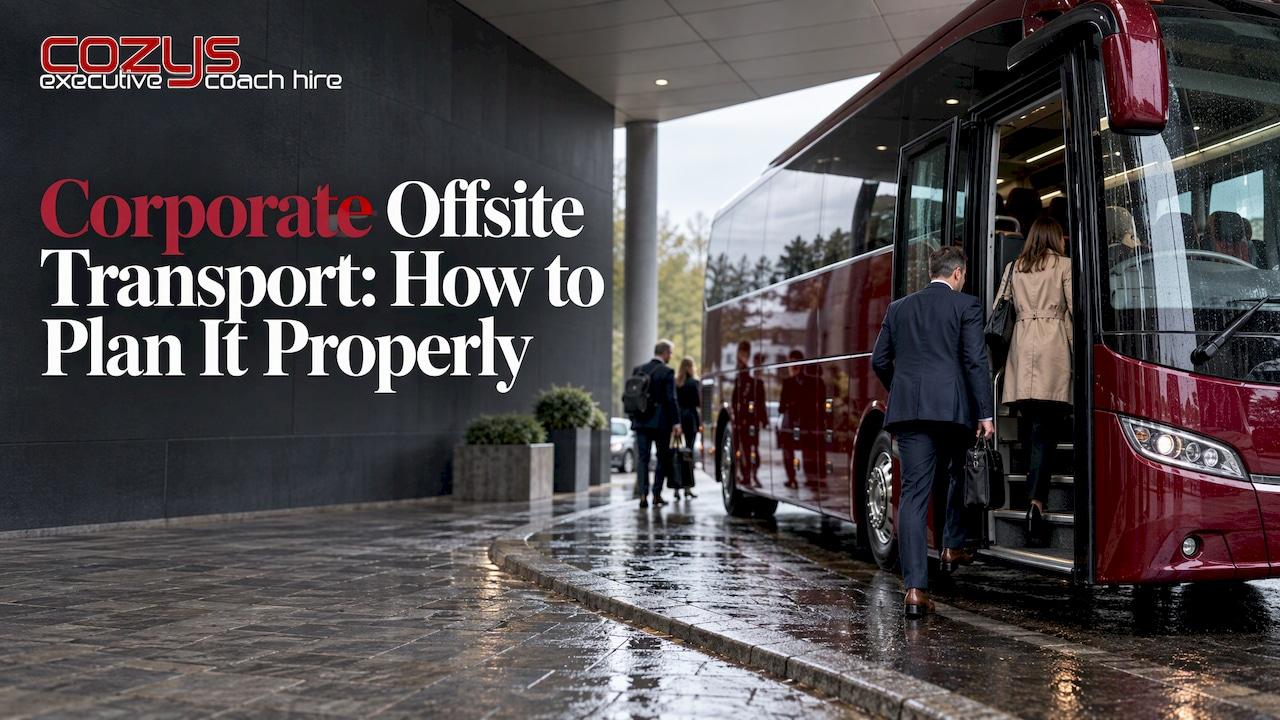
Corporate offsite transport works best when one operator moves the whole team on a single, timed schedule, with the vehicle size, pickup points and return times fixed before the invitations go out. For most UK offsites of 16 or more people, a coach or minibus is the simplest option. It keeps the group together, removes parking and car-sharing problems, and gives the organiser one party to hold accountable. This guide covers how to plan it, what to check legally, and what to confirm with your provider.
TL;DR
- Group transport suits offsites where most attendees travel from the same place, usually an office or station, to a venue they cannot all reach easily by public transport.
- Plan from the headcount, the pickup points and the latest acceptable arrival time, then work backwards to the departure time.
- Check that the operator holds a PSV operator's licence, an independent safety rating and a clear drivers' hours plan.
- Raise accessibility needs at the first enquiry, because wheelchair spaces and ramp access depend on the vehicle and the pickup point.
- Shared transport also lowers the emissions of the journey, and a hybrid coach lowers them further.
Table of Contents
- What corporate offsite transport involves
- Plan the numbers, vehicle and timings
- Check the legal and safety basics
- Accessibility for attendees with mobility needs
- Reduce the emissions of the journey
- What to confirm with your provider
- Our perspective
- Book offsite transport with Cozy Travel
- FAQ
- Sources
What corporate offsite transport involves
An offsite is any working day or overnight stay away from the usual workplace: a strategy day, a training session, a team-building event, a conference or a client visit. Transport is the part that every attendee experiences first and last. If it runs late, the day starts badly and the programme loses its first hour.
Group transport covers three broad formats:
- A single coach or minibus from one pickup point to the venue and back.
- Multiple pickups, for example an office in one town and a station in another, feeding one vehicle or several.
- Shuttles between a hotel, a venue and an evening activity during a multi-day event.
Group transport is the right choice when the numbers justify it. As a rough guide, if 16 or more people are travelling to the same place at the same time, one vehicle will usually be simpler than a mix of cars, taxis and trains. Our fleet runs from 16 to 85 seats, so the same operator can cover a small leadership team and a whole-company event. Our corporate transport service is built around exactly these requests.
When individuals are travelling from many different places, or a few people need to arrive on a different day, a mixed approach may work better. Even then, a coach for the main group usually saves the most effort.
Plan the numbers, vehicle and timings
Good planning starts with four figures and one constraint.
- Confirmed headcount. Add the people who may join late, such as facilitators, speakers and guests. Ask for a seat count with a small margin instead of an exact number.
- Luggage. A day trip with laptops needs very little hold space. A two-night offsite with bags and equipment needs more. Tell the operator about projectors, display boards or catering boxes.
- Pickup points. Each extra stop adds time, so choose points that are easy for a coach to reach and leave.
- Venue arrival time. This is the constraint. Work backwards from it to set departure times.
Matching vehicle size to the group
| Group size | Typical vehicle | Planning notes |
|---|---|---|
| Up to about 16 | Minibus | Flexible for narrow venue access and several small pickups |
| 17 to 50 | Midi or standard coach | Most offsites fall here; allow luggage space |
| 50 to 85 | Large coach, or two vehicles | Two smaller vehicles can give more pickup flexibility |
The table is a planning guide, not a quotation. Your operator will confirm the right vehicle once it knows the route and luggage.
Building the timetable
Start with the arrival time the venue needs, then add a buffer for traffic, usually longer on routes that use the M25, M1 or A1(M) at peak times. Then add the time for each pickup stop, boarding and a short margin for latecomers. Share the departure time with attendees as 10 to 15 minutes earlier than the real one if punctuality is a concern in your team.
A written run sheet helps everyone. It should list the pickup address and time, the driver's contact number, the venue drop-off point, the return time and the person who owns the decision if the schedule changes.
Different journey and return needs
Not everyone wants to leave at the same time. Some attendees will need to catch a train or collect children. Options include:
- A fixed return time with an earlier optional departure for a second vehicle.
- A return that drops at a central station as well as the original pickup point.
- A minibus held back for early leavers while the coach waits for the main group.
Decide the policy before the event and put it in the joining instructions. Changes on the day are harder to handle when the driver is working within legal hours.
Check the legal and safety basics
When you book transport for staff, the organisation takes on responsibility for their safety. Employers must ensure, so far as is reasonably practicable, the health, safety and welfare of employees at work under section 2 of the Health and Safety at Work etc. Act 1974. The Health and Safety Executive says the main areas to cover in a work-driving risk assessment are the journey, the driver and the vehicle.
Courts take away days seriously. In Reynolds v Strutt & Parker, the High Court held that an employer's duty of care at a corporate away day includes making adequate and suitable risk assessments of activities it has arranged. Transport is part of that assessment.
Operator licensing
A PSV operator's licence is usually needed when a vehicle designed or adapted to carry nine or more passengers is used for hire or reward. According to GOV.UK's operator licensing guide, operating before the licence is issued is illegal and can lead to prosecution or the vehicle being impounded. The same guide notes that the DVSA checks compliance in areas including drivers' hours, roadworthiness and safe loading. Ask any provider for its licence details and confirm them.
Independent safety rating
The BUSK Benchmark is described as the UK's first and only independent star rating system for the coach and minibus industry, based on legal and safety compliance, and it is recommended by the Department for Education. The rating is built on a points system in which a basic entry level gives three stars and the maximum is six. Cozy Travel holds the highest 6-star BUSK rating, and for a corporate booker it is one of the quickest ways to compare operators on safety.
Drivers' hours and your timetable
Your schedule has to fit within the law. Under GB domestic rules, bus and coach drivers have a 10-hour daily driving limit, a 16-hour working-day limit (spreadover) and a rest of at least 10 hours between working days. The working time rules also require breaks totalling 30 minutes for a working day of between six and nine hours.

In practice, this matters most for long days. A 7am departure, a full-day programme and a late-evening return can exceed what one driver may legally do, and the operator may need a second driver or a rest period. Telling the operator the full day plan early avoids a last-minute change. Our guide to drivers' hours rules for UK fleets explains how operators plan around them, and our coach booking playbook walks organisers through the DVSA checks.
Seat belts
Coaches first used after 1 October 2001 are fitted with seat belts, and passengers over 14 must wear them after being told of the requirement, usually by a notice, an announcement or a film. Build a short briefing into the boarding routine for your group.
Accessibility for attendees with mobility needs
Ask about access needs in the registration form, not on the morning of the event. Ask what each person needs, such as a wheelchair space, step-free boarding, a seat near the front or extra time, without asking for medical detail.
The main points to know:
- Buses and coaches must have at least one space for a standard wheelchair, measuring 70cm wide, 120cm long and 1.35m high. Larger wheelchairs, or a space already in use, can affect boarding, so give the operator the dimensions in advance.
- The PSVAR regulations apply to vehicles with a capacity above 22 passengers that were introduced after 31 December 2000 and used for local or scheduled services. Private hire arrangements differ, so ask the operator what the specific vehicle offers.
- The Disabled Persons Transport Advisory Committee notes that the space needed to deploy an external ramp means some pickup points cannot be used by wheelchair users. Choose pickup and drop-off points with level, clear kerbside space.
Our accessible transport specialists can advise on vehicles and pickup locations, and our guide to accessible coach seating layouts shows what organisers should check before confirming a vehicle.
Reduce the emissions of the journey
Transport is often the largest single source of emissions from an offsite, and a shared vehicle is the most direct way to lower it. The Green Travel & Transport Guide for Events lists dedicated coaches and shuttle buses, and increased use of shared transport, among its travel impact indicators. It also recommends communicating lower-carbon options to attendees, including dedicated coaches.
Historic England's sustainable travel guidance suggests setting criteria for when travel is justified and encouraging low-emission vehicles in hire contracts. It also says that changing travel behaviour is challenging, so a clear communication plan and visible support from senior staff help.
For an offsite, that translates into three actions:
- Make the coach the default and tell attendees early, before they plan to drive.
- Choose a venue reachable from your main pickup point without extra transfers.
- Ask the operator for vehicle details, including whether a hybrid coach is available.
We operate the UK's first hybrid coach, and you can read the details on our hybrid coach hire page. If your organisation reports emissions, our guides to calculating coach travel carbon savings and procurement-ready sustainability KPIs show how to document the journey.
What to confirm with your provider
A reliable service depends on details agreed in writing. Before the event, confirm:
- Licence and rating: the PSV operator's licence and the BUSK star rating.
- Vehicle and capacity: vehicle type, seat count, luggage space and accessibility features.
- Timings: pickup times and addresses, the venue drop-off point, return time and what happens if the programme overruns.
- Drivers: whether the schedule fits drivers' hours and whether a second driver is needed.
- Contact: a driver or control-room number that someone from your team can call on the day.
- Contingency: what the operator does if a vehicle is delayed or unavailable.
- Changes: the deadline for final numbers and the process for changes.
- Access needs: wheelchair space numbers, ramp or lift arrangements and any assistance required.
- Invoicing: how the quote is structured, what is included and how you will be invoiced, because a coach quote depends on distance, duration, waiting time and vehicle.
Send all this in one email so the confirmation is one document. Keep it with the run sheet.
Our perspective
We have provided group transport for over four decades as a family-run operator, and the pattern is consistent: offsite transport goes wrong when it is treated as an afterthought. The venue, the agenda and the catering are booked months ahead, and the coach is requested a week before.
Our view is that the transport brief should be written alongside the programme. When we know the headcount, the pickup points, the access needs and the real finish time, we can recommend the right vehicle from a fleet of 16 to 85 seats and plan drivers' hours without compromise.
Safety is where we would ask every corporate booker to be demanding. We hold the maximum 6-star BUSK rating because we believe an independent audit is the fairest way for a buyer to compare operators. We also run the UK's first hybrid coach, because many of our corporate clients now need to report on the emissions of the events they run. A shared coach already cuts the footprint of a journey, and a hybrid takes it further.
Our work with organisations such as Tesco and the RAF has taught us that reliability is the product. On the day, nobody remembers the coach if it was on time, which is exactly how it should be.
Cozys
Book offsite transport with Cozy Travel
We plan corporate transport for team days, conferences, site visits and multi-day events, from a 16-seat minibus to an 85-seat coach, including wheelchair-accessible vehicles and our hybrid coach. Tell us your headcount, pickup points and timings, and we will recommend a vehicle and schedule.
Start on our corporate transport page, or look at coach hire and group travel for the wider range. For events that run over a night, our guide to overnight coach travel sets out the rules and the costs to consider.
FAQ
When should we book transport for a corporate offsite?
Book as soon as the date and venue are confirmed, and before you send the invitations. Early booking gives you the choice of vehicles and lets the operator plan drivers' hours around your programme. Final numbers can usually be adjusted closer to the date, so agree the deadline when you book.
Is a coach or a minibus better for an offsite?
It depends on the headcount, luggage and venue access. A minibus suits groups of around 16 or fewer and narrower access roads, while a coach suits larger teams and luggage. Our fleet covers 16 to 85 seats, so we can match the vehicle to your group.
What legal checks should we make on a coach operator?
Ask for the PSV operator's licence, because a licence is usually needed for vehicles carrying nine or more passengers for hire or reward. Ask for an independent safety rating such as the BUSK Benchmark as well. Then confirm that the timetable fits drivers' hours.
How do we arrange transport for attendees who use wheelchairs?
Ask about access needs at registration and tell the operator the wheelchair dimensions and the pickup points. Coaches must have at least one standard wheelchair space, but ramp access depends on kerbside room. Our accessible specialists can plan this with you.
Sources
- Health and Safety at Work etc. Act 1974, duty of care to business travellers
- HSE: Employers, driving and riding safely for work
- Reynolds v Strutt & Parker LLP [2011] EWHC 2263 (Ch)
- GOV.UK: Public service vehicle operator licensing guide
- BUSK Benchmark
- Guild of British Coach Operators: Safety Benchmark status
- GOV.UK: Drivers' hours, GB domestic rules
- GOV.UK: Working time rules for lorry, bus and coach drivers and crew
- Child Car Seats: Buses, coaches and minibuses
- GOV.UK: Buses and coaches, features and help for disabled people
- GOV.UK: Bus and coach accessibility and PSVAR
- GOV.UK: DPTAC position on the accessibility of coach services
- Green Travel & Transport Guide for Events
- Historic England: Sustainable Travel
Recommended
- In-House vs Outsourced Transport: How UK Organisations Decide
- Conference Shuttle Routes: How to Design Them Well
- Corporate Shuttle Policy: What to Include and How to Write It
- Coach Breakdown Contingency Plan: What to Put in It
This article is produced as general information only and is not professional advise.