
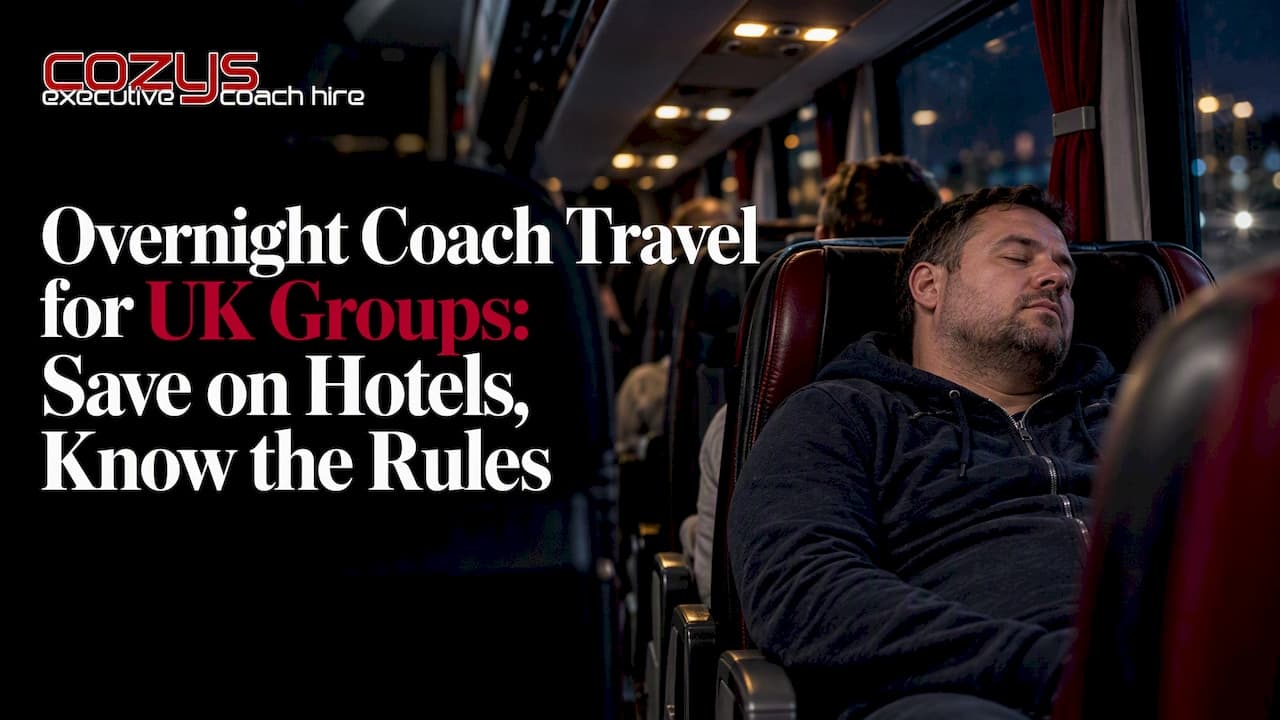
Overnight coach travel is a practical, low-cost option for travellers who prioritise savings and time over a full night's restorative sleep. It suits budget travellers, flexible planners and group organisers moving people between cities without the cost of a hotel. The trade-off is straightforward: you save on accommodation, but the sleep you get is lighter than a sleeper train or hotel bed. Read on for routes, sleeping expectations and booking advice.
TL;DR:
- Routes lasting roughly six to ten hours can save a working day, but check scheduled stops, layovers, arrival time, and any border or ferry procedures.
- Coach seats allow only upright or shallow recline, so light sleepers or travelers facing an early commitment should choose a sleeper train or hotel bed.
- Book several weeks ahead for lower fares, check baggage fees and amenities, and schedule onward travel at least an hour after arrival.
- UK passengers with reduced mobility can arrange free assistance in advance, but should confirm designated terminal staffing and wheelchair securement in writing before travel.
- Group organizers gain control over pickup times, seating, luggage, and assistance through a contracted coach, then verify safety ratings, PSVAR compliance, and driver rest plans.
Table of Contents
- Overnight route types and how operators run them
- What an overnight coach journey actually feels like
- Booking, pricing and timing: how to get the best fares
- Accessibility and legal expectations for passengers with reduced mobility
- Comfort and packing: gear and habits that help you sleep on a coach
- When to choose a contracted coach provider for group overnight travel
- Managing motion sickness and discomfort overnight
- Comparing environmental impact with other overnight options
- How organisers and experienced travellers weigh the choice
- How we can help with overnight group coach bookings
- FAQ
- Sources
Overnight route types and how operators run them
Night coach networks generally run two kinds of service. Trunk routes travel between major cities with few stops, prioritising a continuous overnight run and a predictable arrival time. Hybrid or micro-stop products pick up and set down at more locations along the way, which extends the journey but widens access points for passengers joining partway through the route.
Overnight scheduling tends to suit corridors where the journey takes roughly six to ten hours or more, long enough that travelling while asleep (or trying to) saves a working day. Popular overnight corridors typically link major cities and, on some networks, cross borders, where an overnight departure lands you at your destination for the start of the business day.
Before booking, check an operator's route page carefully:
- Exact departure and arrival windows, since "overnight" can mean anything from a short late service to a ten-hour haul.
- The number of scheduled stops and how long each layover runs.
- Any cross-border or Channel crossing procedures that add time for document checks or ferry loading.
What an overnight coach journey actually feels like
Coaches do not offer lie-flat beds. Even with a generous recline, you are sleeping upright or at a shallow angle, and most passengers describe the result as dozing rather than deep sleep. A neck pillow and an empty seat beside you help, but they do not replicate a berth.
Expect interruptions. Scheduled rest stops, traffic delays and early morning arrivals are all normal, and each one tends to wake light sleepers. An arrival at 5 or 6 AM also means your first few hours at the destination may run on limited sleep, which is worth building into your day plan.

Sleeper trains such as the Caledonian Sleeper and the Night Riviera provide an actual berth and private room, which is a materially different experience from a reclining coach seat; choose one of these if uninterrupted sleep matters more than the fare.
A few traveller types are better suited to a bed than a coach seat:
- Anyone with a medical condition affected by poor sleep, restricted movement or long periods seated upright.
- Travellers with an early meeting, event or physical activity who need to arrive properly rested.
- Light sleepers who already struggle with noise, light or motion in normal travel conditions.
Booking, pricing and timing: how to get the best fares
Overnight coach fares tend to follow the same pattern as most long-distance transport: the earliest tickets released are usually the cheapest, and prices rise as the departure date approaches and seats fill. Checking fares several weeks ahead, rather than the week of travel, is the most reliable way to catch the lower end of the range.
A few practical steps keep the booking process simple:
- Compare prices across a few weeks before committing, since overnight fares can shift noticeably even for the same route.
- Check the luggage allowance before paying, and prebook any hold bag if the operator charges separately for it.
- Build in a buffer after arrival, since an early coach drop-off often lands before hotel check-in opens.
If you land at 6 AM with nowhere to go yet, most hotels offer luggage storage even before check-in, and many city centres have staffed left-luggage points near coach stations.
Pro Tip: Book your onward travel at least an hour after your coach's scheduled arrival time, since night services are the most likely to run late.
Accessibility and legal expectations for passengers with reduced mobility
Disabled passengers and those with reduced mobility are entitled to free assistance on coaches and at designated terminals under UK accessibility rules, provided assistance is arranged in advance. Coaches on scheduled routes with capacity above the standard passenger capacity must meet these accessibility standards, and drivers are required to help with ramps and wheelchair securement.
Before travelling:
- Contact the operator ahead of time to confirm the boarding point has staff trained to assist, since help is guaranteed only at designated terminals.
- Ask for written confirmation of how wheelchair securement will be handled onboard, particularly on an overnight service where staffing may be lighter.
- Keep a record of your booking reference in case you need to raise a complaint.
If assistance is not provided as arranged, the relevant complaint routes run through the operator first, then the DVSA or the Office of the Traffic Commissioner. Our accessible coach seating guidance covers how seat assignment affects accessible group bookings in more detail.
Comfort and packing: gear and habits that help you sleep on a coach
A short kit list makes a real difference to how rested you feel at arrival: a neck pillow, an eye mask, earplugs or noise-cancelling headphones, a light blanket, and layered clothing you can add or remove as the cabin temperature shifts through the night.
Where you sit and what you do before boarding matters just as much as what you pack:
- Choose a window seat so you have something to lean against and are not disturbed by the aisle.
- Reserve extra legroom where the operator offers it, and use a soft bag as a footrest to raise your knees slightly.
- Avoid a heavy meal or alcohol before boarding, since both tend to disrupt sleep and make early stops more uncomfortable.
Check the amenities before you book rather than after. Toilets, power sockets and Wi-Fi vary between operators and even between coaches on the same route, so confirming these in advance avoids an unpleasant surprise mid-journey. Our guide to coach amenities worth checking runs through what to look for before paying.
Pro Tip: Pack your blanket and pillow at the top of your bag, not the bottom, so you are not rummaging through luggage once the cabin lights go down.
When to choose a contracted coach provider for group overnight travel
Group organisers planning an overnight movement, whether a school trip, corporate transfer or community event, generally get more reliability from a contracted provider than from booking individual seats on a scheduled service. We run a fleet of vehicles ranging from 16 to 85 seats, including hybrid coaches, and provide dedicated accessible vehicles for wheelchair users.
A contracted booking gives organisers:
- A tailored pick-up point and schedule, rather than fitting the group around a fixed public timetable.
- Full control over luggage handling and seating allocation for the whole group.
- A named point of contact and guaranteed accessibility assistance arranged in advance, rather than relying on staffing at a public terminal.
Whichever provider you use, confirm their safety rating, PSVAR compliance, driver rest scheduling and emergency procedures in writing before the trip. Our booking playbook for organisers sets out the regulatory checks worth running through at quote stage.
Managing motion sickness and discomfort overnight
Motion sickness tends to worsen on overnight journeys because tiredness lowers your tolerance for the stop-start motion of a coach in traffic. A few adjustments reduce the risk. Sitting further forward, near the front axle, generally produces less sway than a seat at the back. Keeping your eyes on a fixed point outside, rather than a phone or book, helps your inner ear and vision stay aligned.
Ginger sweets, acupressure wristbands and over-the-counter travel sickness tablets taken before symptoms start are commonly used remedies, though anyone with an existing medical condition should check with a pharmacist before taking medication for an overnight trip. Staying hydrated and avoiding heavy or greasy food before boarding also reduces nausea risk.
Beyond sickness, general discomfort from stiffness and poor circulation is common on a journey of several hours seated upright. Standing and stretching during scheduled stops, flexing your ankles periodically and avoiding tight clothing around the waist all help. Travelling in loose, breathable layers also makes it easier to get comfortable enough to doze, even without a full recline.
If you know you are prone to severe motion sickness, a window seat with a clear view ahead and a pre-journey dose of appropriate medication is usually more effective than trying to manage symptoms once they start.

Comparing environmental impact with other overnight options
Coach travel is widely recognised as one of the lower-carbon ways to move a group of people over long distances, largely because a single vehicle carries dozens of passengers on one engine rather than many smaller vehicles or an aircraft. For organisers weighing options for a group of twenty or more, a coach is almost always the lower-impact choice compared with equivalent car journeys or domestic flights covering the same distance.
Against rail, the comparison is less clear-cut and depends on the specific route, the train operator's electricity source and the coach's fuel type. A hybrid coach narrows that gap further by reducing fuel consumption compared with a standard diesel vehicle, which is one of the reasons sustainability-conscious organisers increasingly ask about hybrid options when requesting quotes. Our hybrid coach hire page covers availability for groups wanting a lower-impact option.
For organisers managing transport for vulnerable groups, environmental questions often sit alongside practical ones. Our partner at Clubhouse Group's guidance on day centre transport covers what to check when arranging transport for care settings, a useful reference point for anyone balancing accessibility needs against sustainability goals.
How organisers and experienced travellers weigh the choice
Organisers tend to balance three things: cost, control over the group's movements, and whether every passenger's accessibility needs can be met without relying on a public terminal's staffing. A contracted coach usually wins on the last two points even when it is not the cheapest line item.
Individual travellers face a simpler trade-off. A night coach makes sense when the fare saving matters more than arriving well-rested; a sleeper train or hotel makes more sense when the next day demands your full attention.
— Cozys
How we can help with overnight group coach bookings

If you are organising overnight group travel rather than booking a single seat, we offer a more direct route to a dependable outcome. Our fleet runs from 16 to 85 seats, including accessible vehicles for wheelchair users and hybrid coaches for groups who want a lower-impact option. We hold a BUSK safety rating, and our drivers and scheduling are built around school, corporate and community contracts rather than one-off public bookings.
When you request a quote, expect us to review your route and timings, confirm any accessibility requirements in writing, and talk through driver rest planning and emergency procedures before the day of travel.
- Tell us your route, group size and any accessibility needs so we can match the right vehicle.
- We confirm pick-up points, luggage handling and a named contact ahead of the journey.
- You get a written safety and assistance plan before you travel, not just on the day.
Start a quote through our coach hire page and we will work through the practical details with you from there.
FAQ
Do Shearings coaches do day trips?
Shearings has historically operated UK and European holiday coach tours rather than scheduled day-return services, though offerings change over time and are worth checking directly with the operator. For organisers wanting day trips specifically, a contracted coach hire is generally a more flexible option than a fixed holiday itinerary.
Can you get sleeper buses in the UK?
Sleeper coaches with lie-flat berths are not a standard feature of scheduled UK coach services, which typically use reclining seats rather than beds. Travellers wanting an actual berth are better served by a sleeper train service such as the Caledonian Sleeper or Night Riviera.
Is coach travel cheaper than train?
Coach fares are often substantially lower than advance rail fares on the same corridor, though journeys usually take longer and depend on road conditions. The right choice comes down to whether the time saving of rail is worth the extra cost for your trip.
Which coach tour operators are the best in the UK?
The right operator depends on what you need: scheduled network coverage for solo travel, or a contracted provider for group and accessible bookings. For organisers moving a group overnight, checking an operator's safety rating, PSVAR compliance and accessibility provision matters more than brand recognition alone.
What should I check before booking an overnight coach for a group?
Confirm the operator's safety rating, PSVAR compliance, driver rest scheduling and wheelchair securement procedures in writing before you book. It is also worth checking luggage allowances, onboard amenities and the exact pick-up and drop-off points in advance.