
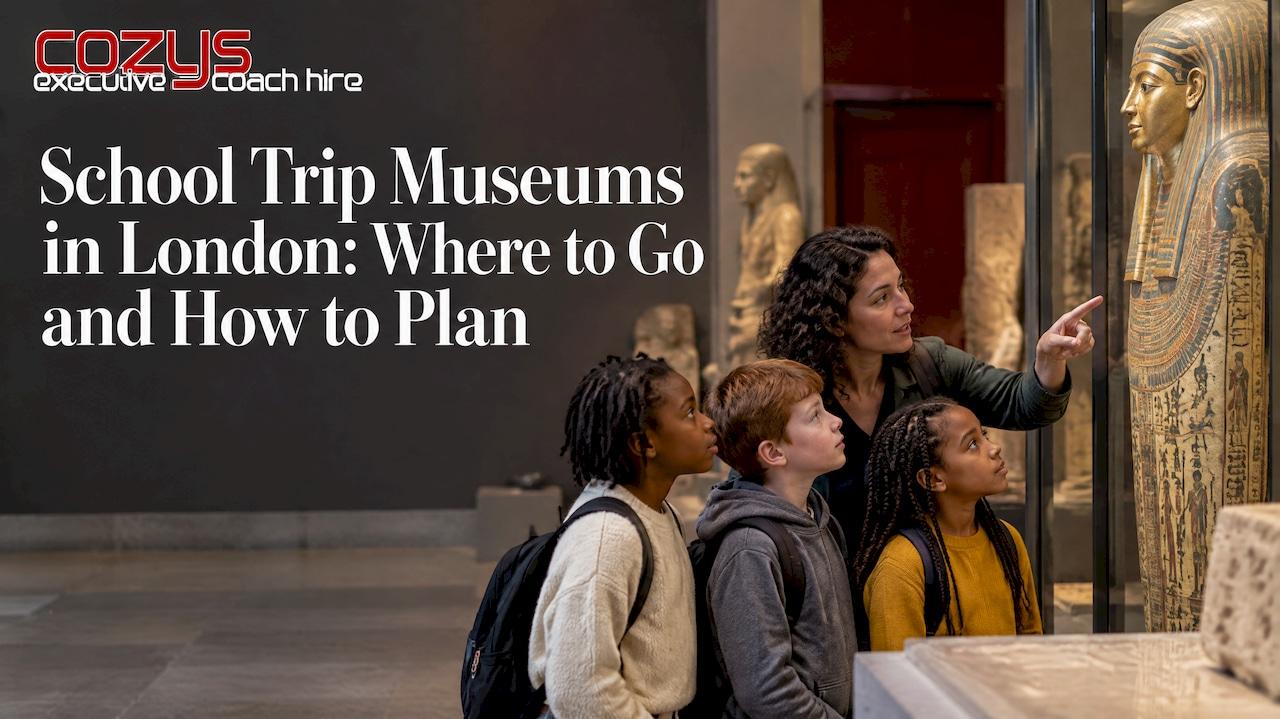
The best London museum for a school trip is the one that matches your curriculum topic and your pupils' age. For science, choose the Science Museum. For ancient history, the British Museum. For the World Wars, Imperial War Museum London. For the capital's own story, London Museum Docklands. Each runs a dedicated schools offer. The harder part is the logistics: booking windows, supervision ratios and getting a full coach to the door on time. This guide covers both.
TL;DR
- Match the museum to the topic: science at the Science Museum, ancient civilisations at the British Museum, 20th-century conflict at Imperial War Museum London, London history at London Museum Docklands.
- Several museums run self-led visits alongside taught sessions, so you can choose between structure and flexibility. Check each museum's schools page for the current booking rules.
- Plan supervision, accessibility and lunch arrangements early. Sort the coach drop-off before you confirm the date.
- The same planning applies beyond London: Birmingham, zoos and other venues publish the same kind of schools information.
- A coach operator experienced in school and accessible travel removes most of the transport risk. See our Schools & Colleges service.
Table of Contents
- How to choose a London museum for your class
- London museums compared by subject and age
- The British Museum: ancient worlds in one building
- Science Museum: hands-on STEM
- Imperial War Museum London: the World Wars and the Holocaust
- London Museum Docklands: the city's own story
- Art, architecture and landmarks
- What to settle before you book
- Getting the group there: coach logistics in London
- Beyond London: Birmingham, zoos and theme parks
- A sample one-day plan for a KS2 class
- Our approach to school transport
- Book your school coach with Cozy Travel
- FAQ
- Sources
How to choose a London museum for your class
Start with the learning outcome, not the building. A visit works best when pupils arrive with a question the museum can answer, and when the teacher has used the free pre-visit material most museums publish. The British Museum's learning team recommends a pre-visit and offers free resources organised by age group, which is sound advice for any venue.
Three questions narrow the list quickly:
- What is the curriculum link? History, science, art and citizenship each point to different museums.
- How old are the pupils? Some sessions start at age four, others suit age seven and over.
- Do you want a taught session or a self-led visit? Taught sessions give structure and a specialist. Self-led visits give flexibility, and you can build your own trail.
Then check the practical limits: how many pupils fit in a session, how early you must book, and whether the museum can take your group size.
London museums compared by subject and age
The table summarises what each venue says about its schools offer. Details change by term, so confirm on the museum's own page before you plan.
| Museum | Best for | Age range and format | What pupils do |
|---|---|---|---|
| British Museum | Ancient history | Self-led visits, facilitated sessions, free downloadable resources; virtual workshops for ages 7 to 11 | Prehistory, ancient Egypt, the Indus Valley, Greek temples and Roman Britain |
| Science Museum | Science and maths | Formal education groups | Hands-on Wonderlab, the Space gallery, IMAX educational films, STEM careers learning |
| Imperial War Museum London | WWI, WWII, the Holocaust | Self-guided visits for ages 7 and over | Work with authentic objects, stories and inquiry activities |
| London Museum Docklands | London history and geography | Self-led visits and free school sessions | Docks, Sailortown, the Blitz, London's role in the trade in enslaved Africans |
| National Gallery | Art and storytelling | Educator-led sessions for ages 4 to 18 | Close study of three to five paintings |
| Tower of London | Medieval and Tudor history | KS1 to A-level sessions plus self-led access | The White Tower, the Normans, prisoners, the Jewel House |
The British Museum: ancient worlds in one building
The British Museum offers self-led visits, facilitated sessions and free downloadable resources. Its UK virtual workshops for ages 7 to 11 use live activities and quizzes to cover prehistory, ancient Egypt, the Indus Valley, Greek temples and Roman Britain.
That range makes it a strong fit for KS2 history topics. It also works as a preparation tool: a virtual workshop in the classroom before the trip means pupils arrive knowing what they want to see. For a self-led visit, choose two or three galleries and give each group a short task. Trying to cover the whole building leaves pupils tired and the learning thin.
Science Museum: hands-on STEM
The Science Museum's formal education offer includes the hands-on Wonderlab for science and maths, the Space gallery, IMAX educational films, STEM careers learning in Technicians, and collaborative problem-solving in Power Up.
The mix suits groups who need movement and interaction. Bookings open for set periods, so check the education page for the current window. A science trip also gives pupils a view of careers, which supports work on aspirations in secondary schools.
Imperial War Museum London: the World Wars and the Holocaust
Imperial War Museum London recommends self-guided visits for ages 7 and over, typically lasting two to four hours. Learning centres on the First World War, the Second World War and the Holocaust, using authentic objects, stories and inquiry activities.
Some of this material is emotionally demanding. Brief pupils beforehand, agree how staff will support anyone who becomes upset, and allow a quiet break in the schedule. Two to four hours is a long time on your feet, so build in a sit-down lunch rather than a rushed one.
London Museum Docklands: the city's own story
London Museum Docklands runs self-led history and geography visits covering the docks, Mudlarks for under-eights, Sailortown, London's role in the British trade in enslaved Africans, and the Blitz. Free school sessions include a KS3 London, Sugar and Slavery enquiry day and SEND school days.

For teachers who want local history with a clear enquiry question, this is one of the most focused options. The SEND days are worth noting if your group includes pupils who need a calmer, more structured visit.
Art, architecture and landmarks
The National Gallery offers educator-led sessions for ages 4 to 18 that focus on three to five paintings. Themes include myths and legends, art and emotion, and religion in art. Practical workshops can build communication, creativity and storytelling. Looking slowly at few works suits younger pupils better than a gallery sweep.
The same source notes that the Tower of London supports KS1 to A-level learning with curriculum-linked sessions on the White Tower, the Normans and prisoners, alongside self-led access to the tower and the Jewel House.
St Paul's Cathedral, established in 604, is a useful add-on for a day built around the City. Monday to Saturday sightseeing tickets cost £27 per adult and £10.50 per child, with discounts for groups and free tickets for visitors with a disability. Sightseeing covers the Cathedral Floor, Crypt and Dome. It opens from 8.30am Monday to Saturday, with last entry usually at 4pm. Prices can change, so check the page when you book.
For a free option, the Bank of England Museum on Threadneedle Street is free, needs no booking and opens Monday to Friday 10am to 5pm, with last entry at 4.30pm. It closes on bank holidays and weekends. It suits a short stop on a financial-literacy or maths-in-context day.
What to settle before you book
Museum schools pages tell you what they require. The examples below come from Birmingham and Whipsnade, but they show the kind of conditions that appear in London too. Read your chosen venue's page for its own rules.
Booking windows and written confirmation
Thinktank in Birmingham requires advance booking, including for self-guided visits, at least 14 days ahead. Birmingham Museum and Art Gallery requires the same notice and may refuse entry to groups without written confirmation. Print or save the confirmation and carry it on the day.
Supervision ratios
Thinktank's minimum is one adult per 10 children for KS2 to KS4 and one adult per six for preschool and KS1. Whipsnade Zoo offers one free supervising adult per five primary pupils and one per ten secondary pupils, plus free entry for one-to-one SEND support staff. Your school's own risk assessment and visit policy set the final numbers.

Accessibility
Ask each venue about step-free routes, quiet spaces and lifts before you confirm. Tell the museum your access needs at booking, not on arrival. If any pupil uses a wheelchair, the transport matters as much as the venue: a vehicle with a lift and secure wheelchair spaces avoids a difficult start to the day. Our accessible transport service is built for this. For pupils on the autism spectrum, our guide to autism-friendly group travel covers the journey side.
Lunch and timing
Thinktank's guidance covers lunch arrangements, arrival timing and risk-assessment advice alongside coach drop-off. Treat these as a checklist for any venue: where will 60 pupils eat if it rains, and what time does your slot actually start?
Getting the group there: coach logistics in London
A museum visit can be lost in the first hour if the coach cannot stop where you expect. Central London has restricted drop-off points, and not every museum has an obvious coach bay. Ask the venue where groups should be dropped and picked up, and agree a collection time with your driver that leaves slack for traffic.
Parking for the empty vehicle is a separate issue. Our guides on coach parking in London and stadium coach parking explain what operators and organisers need to check, so that a driver with a long wait is not left circling.
Two more checks matter for schools. First, confirm the operator is licensed; our guide to four legal checks for UK group transport lists them. Second, ask about the operator's safety record. We hold the highest 6-star BUSK safety rating, an independent coach-safety scheme rating that many schools and local authorities look for when choosing a supplier.
If the trip stretches to an early start or a late return, or if you plan a residential, read our notes on overnight coach travel for the rules on driver hours and rest.
Beyond London: Birmingham, zoos and theme parks
Many readers planning a London trip also compare other cities and venue types. The same principles hold: match the venue to the curriculum, then check the booking and supervision rules.
Birmingham museums
Thinktank offers more than 200 hands-on science and technology displays, a digital Planetarium and an outdoor Science Garden. Taught STEM sessions run from Early Years to KS5 and last 45 minutes to one hour.
Birmingham Museum and Art Gallery's taught sessions are developed for KS2 and last about 45 minutes. They cover Anglo-Saxons, Romans, Ancient Egypt and Ancient Greece on set days of the week, and taught sessions cost £5.50 per pupil at the time of the source page. Check the page for the current term's timetable and price.
Zoos
London Zoo provides Key Stage and National Curriculum-linked resources for use before, during and after a visit, including KS1, KS2 and KS3/4 booklets and teacher guides on endangered animals, rainforests, adaptations and evolution.
Outside the capital, Whipsnade Zoo's KS2 workshops cover habitats and adaptations, classification, endangered animals, teeth and diets, plastics and food chains. They are designed for groups of up to 35 students. The zoo states that workshops are free from 1 September to February half term, and £45 per workshop from then until 31 August.
Puxton Park's education package covers more than 45 species and lets groups pick three activities, with a maximum of 60 pupils on educational visits. Leeds Tropical World links self-guided visits and workshops to EYFS through KS4.
Theme parks
Theme parks fit best as a reward trip or a physics day, where pupils study forces, motion and energy on the rides. Several parks run education programmes, but their offers change often. Ask each park for its current education pack, the free teacher places it offers and the supervision ratio it expects, and make your own risk assessment for ride height and age restrictions.
Whichever venue you choose, the coach question stays the same: a group needs a reliable vehicle, a licensed operator and a clear plan for drop-off. Our coach hire service covers vehicles from 16 to 85 seats, and our fleet page shows the range.
A sample one-day plan for a KS2 class
This plan shows how the pieces fit. Adjust it to your slot times.
- Before the visit: use the museum's free resources in class and set two questions for pupils to answer on the day.
- Departure: leave early enough to arrive 15 minutes before your session, with a named adult on the coach counting heads.
- Morning: one taught session or self-led trail in a single gallery.
- Lunch: an agreed space, with a wet-weather plan.
- Afternoon: a second short activity, such as sketching or a shop-free scavenger hunt.
- Return: a fixed collection point and time, with the driver's contact number held by the lead teacher.
- After the visit: pupils present what they found out, which turns a day out into assessed learning.
Our approach to school transport
We have provided group travel for over four decades, and school journeys are among the most demanding we run. A class trip works only when the transport is dependable: the coach arrives when promised, the driver knows the drop-off, and every pupil has a safe seat.
That is why we run a fleet from 16 to 85 seats, including the UK's first hybrid coach for schools that want to cut the emissions of their trips. It is why we hold the highest 6-star BUSK safety rating, and why we provide accessible vehicles for wheelchair users, so that no pupil is left out of the trip. Schools, local authorities and organisations such as Tesco and the RAF rely on us for regular, contracted travel, and we bring the same discipline to a single museum day.
We recommend that teachers settle the transport at the same time as the venue booking, because the best slot is wasted if the coach cannot stop nearby.
Cozys
Book your school coach with Cozy Travel
We are a family-run operator providing coach and minibus hire for schools, colleges and local authorities, from single day trips to regular home-to-school contracts. Tell us your date, group size and any access needs, and we will plan the vehicle and the route.
See our Schools & Colleges page to request a quote. If you are weighing up how to run regular transport, our guide to private school transport options sets out the choices.
FAQ
Which London museum is best for a primary school trip?
It depends on the topic. The British Museum suits KS2 ancient history, the Science Museum suits hands-on science, and London Museum Docklands suits local history and geography. Imperial War Museum London recommends self-guided visits for ages 7 and over. Choose the venue that matches your scheme of work and read its schools page for session ages.
How far ahead should I book a school museum visit?
Check each venue, because rules differ. Some Birmingham museums ask for at least 14 days' notice, and some venues need written confirmation on the day. Others, such as the Bank of England Museum, are free and need no booking. For a popular London museum in term time, book as early as your school's visit process allows.
How many adults do I need on a school trip?
Venues publish minimum ratios, and your school's policy sets the final number. Thinktank asks for one adult per 10 children from KS2 to KS4 and one per six for preschool and KS1. Whipsnade offers one free supervising adult per five primary pupils. Always follow the stricter of the venue's and your school's rules.
Can we take pupils who use wheelchairs?
Yes, with planning. Tell the museum your access needs when you book, and ask about step-free routes. Arrange a coach with a lift and secure wheelchair spaces. We provide accessible transport for wheelchair users as a core part of our service.
Do you only cover London trips?
No. We provide group transport across our region and for destinations around the UK, including Birmingham, zoos and theme parks. Send us your destination and date and we will advise on the best vehicle.
Sources
- School visits, British Museum
- Formal education groups, Science Museum
- Self-guided visits, Imperial War Museums
- School visits, London Museum Docklands
- Must-see attractions for educational visits to London, School Travel Organiser
- Visit us, St Paul's Cathedral
- Museum accessibility, Bank of England
- School visits to Thinktank, Birmingham Museums
- School visits to Birmingham Museum and Art Gallery
- Teaching resources, London Zoo
- Key Stage 2 Workshops, Whipsnade Zoo
- Education pre-visit checklist, Whipsnade Zoo
- Schools and Education, Puxton Park
- Group Visits, Tropical World
Recommended
- Autism Friendly Travel: Accessible Transport Eases UK Family Trips
- Private School Transport Options: A Guide for UK Schools
- Avoid Unlicensed Operators: 4 Legal Checks for UK Group Transport
- Coach Risk Assessments: 8 Checks UK Organisers Need Before Booking
This article is produced as general information only and is not professional advise.