
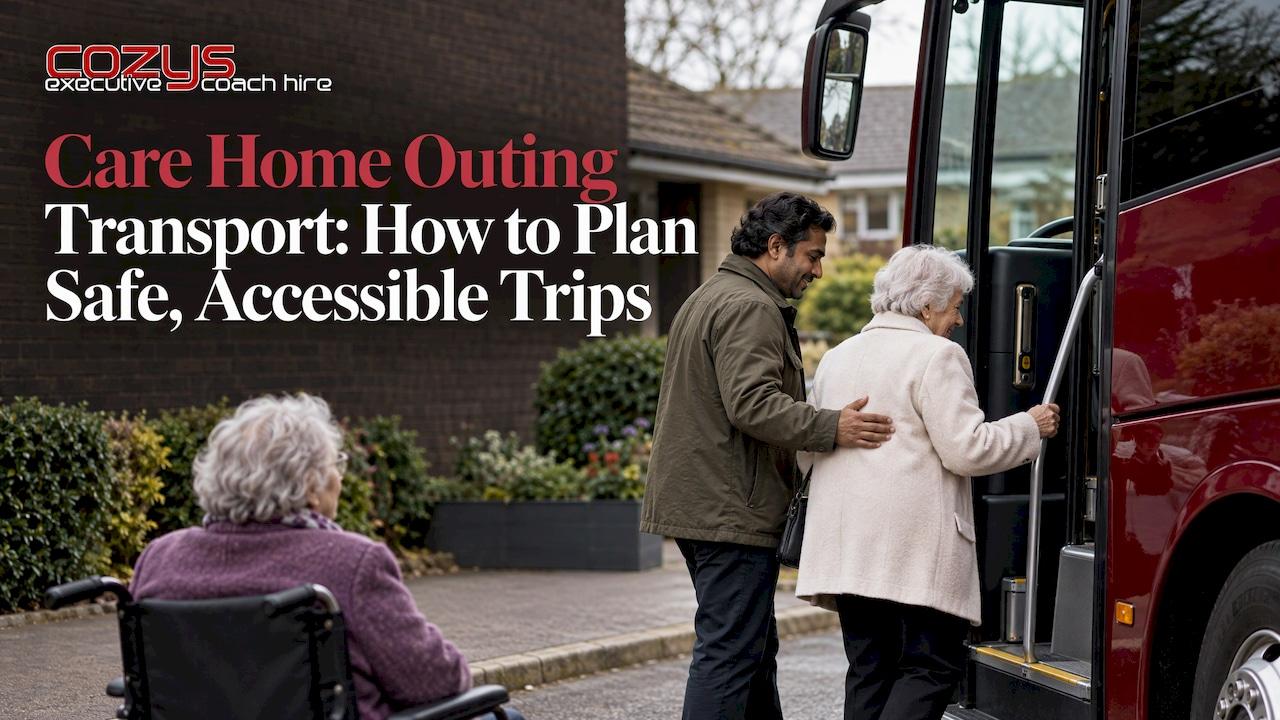
The most dependable way to move a group of residents on an outing is a hired minibus or coach with wheelchair access, a trained driver and a seating plan built around the people travelling. Hiring means the vehicle, the driver's licensing and the maintenance sit with an operator, so your staff can concentrate on the residents. We run accessible minibuses and coaches from 16 to 85 seats, and this guide sets out what a care home, community organisation or local authority should settle before booking: the residents' needs, the vehicle, the paperwork and the plan for the day.
TL;DR
- Assess each resident's mobility, medical and supervision needs first. The vehicle and the number of escorts follow from that assessment.
- In England, CQC Regulation 9A expects care homes to support visits out and to manage risk with the least restrictive precautions, not to avoid outings.
- Legal accessibility rules for buses and coaches do not cover hired vehicles or those carrying 22 or fewer passengers, so ask the operator to confirm lifts, ramps and restraints for your group in writing.
- Plan the whole journey: the door, the boarding, the seating, the route, the drop-off and what happens if something goes wrong.
- Book early, give the operator the full access picture, and choose a vehicle size that leaves room for wheelchairs, walking frames and escorts.
Table of Contents
- Who this guide is for
- Start with the residents, not the vehicle
- What the rules expect of a care home outing
- Check the vehicle against what your group needs
- Paperwork and safeguarding before the day
- Plan the journey from door to door
- Who pays, and what the council covers
- Choosing between your own vehicle and hire
- How to book transport for a care home outing
- Booking with us
- Our view: outings are part of care, not an extra
- FAQ
- Sources
Who this guide is for
This article is written for the people who arrange group travel for care settings: care home managers and activity coordinators, community organisations running trips for older or disabled members, and local authority or commissioning staff who book transport on behalf of others. It does not cover individual residents travelling privately with family. Where a rule applies only in England, we say so, because care regulation is devolved.
Start with the residents, not the vehicle
A good outing begins with an honest picture of who is travelling. Councils that run their own adult transport set the pattern here, and it translates directly to a care home.
Kent County Council's in-house transport guidance says travel requirements are explored with the person or their family during the needs assessment. A risk assessment then looks at physical needs, the person's ability to travel independently, medication or illness, the risk of confusion and whether a passenger supervisor or escort is needed. A Moving and Handling Risk Assessment is required where someone has mobility challenges, and assessments are reviewed when needs change.
For an outing, turn that into a simple passenger schedule. For every resident, record:
- Mobility: walks unaided, uses a frame or stick, uses a manual wheelchair, uses a powered wheelchair or tilt-in-space chair. Note the wheelchair's size and type, because Derbyshire County Council's practice guidance tells staff to consider this when arranging transport.
- Transfer method: can the resident climb steps, or do they need a lift or ramp?
- Medical needs: conditions such as diabetes, asthma or epilepsy that may need assistance, medication timings and any emergency plan.
- Cognitive needs: risk of confusion or distress at collection or at the destination, and what helps the person stay calm.
- Support in transit: whether a member of staff needs to sit beside them.
- Consent and capacity: whether the resident wants to go, and how decisions are recorded.
The Nottinghamshire adults handbook requires mobility needs and risks to be recorded on the individual care plan, and says nobody may carry out moving and handling without appropriate training and demonstrated competence. If a resident's care plan already holds this information, the passenger schedule is a quick summary of it, not new work.
What the rules expect of a care home outing
In England, the Care Quality Commission's Regulation 9A says residents must not be discouraged from taking visits out of the home. Decisions about visits out should rest on individual risk assessments and good care planning, and any precautions should be the least restrictive option, agreed with the resident and recorded. The CQC's position is that providers should assume visits out are possible and put sensible precautions in place so they can happen safely.
In practice that gives you a clear test for any outing: can you show that you assessed each person, agreed the arrangements with them, and recorded what you decided? The transport booking is part of that record.
Kent's guidance adds a point worth copying: the outcome of each transport risk assessment should be communicated to every driver and escort working with the person, so everyone follows the same arrangements. Share the passenger schedule with the operator before the day, and brief your escorts from the same document.
Check the vehicle against what your group needs
The law on accessible buses is narrower than many organisers assume. GOV.UK's guidance on buses and coaches, published on 24 May 2024, explains that covered buses and coaches must have features for disabled people, including ramps and lifts, wheelchair spaces, handrails and coach seat armrests, and that drivers must give help. It also says those rules do not apply to vehicles that carry 22 or fewer passengers, or to private or hired services that do not run to a timetable.
The practical consequence is that a hired vehicle for a care home outing is not automatically fitted to a standard you can assume. Treat accessibility as something you confirm for your own group, vehicle by vehicle. Ask the operator to confirm, for the booked vehicle:
- Lift or ramp type and capacity, including whether it takes your heaviest powered wheelchair.
- Number of wheelchair spaces and how many other seats remain once those are in use.
- Securement: how each wheelchair is restrained, and that a seatbelt is provided for the wheelchair user. Our guide to wheelchair securement standards explains what to look for.
- Seating layout and where escorts will sit. See our notes on accessible coach seating layouts.
- Step height and aisle width for residents who walk with frames.
- Emergency exits and equipment, and how staff can reach each wheelchair user in an emergency.
Our wider guide to wheelchair accessible coach standards covers the specification in more depth, and the wheelchair group transport options page compares ways of moving mixed groups.
Matching vehicle size to the group
Residents on outings rarely fill a vehicle the way a standard coach party does. Wheelchair spaces take the room of several seats, and escorts need to sit where they can see their passengers. Our fleet runs from 16 to 85 seats, which lets you choose a vehicle that fits the actual number of residents, chairs and staff rather than the nearest standard size. A group of eight residents with three wheelchairs and four escorts is a different booking from forty people from several homes heading to the seaside, and it should be quoted as one.
Why a larger operator suits regular outings
A care home planning a monthly programme of trips needs the same standard each time. An operator with a broad fleet and decades of experience can offer a suitable vehicle across different group sizes. We have been family-run for over four decades, and our safety record includes the highest 6-star BUSK safety rating. For organisations that also care about emissions, we operate the UK's first hybrid coach.
Paperwork and safeguarding before the day
When you hire an operator, they carry the vehicle's roadworthiness, licensing and maintenance. If a home instead runs its own minibus, Croner's guidance for care home managers lists what that involves: a current MOT where required, regular servicing, drivers with the right licence class, pre-journey walkaround checks, fault tracking, and safety equipment such as fire extinguishers and first-aid kits, including servicing of tailgate lifts. It is a useful reminder of how much sits behind a vehicle when you do not hire.
Whichever route you take, your own paperwork for an outing should include:
- the passenger schedule and individual risk assessments, summarised for the trip;
- a journey risk assessment covering the destination, route, timing and weather;
- the escort rota and who carries medication;
- emergency contacts for each resident and for the home;
- a named lead member of staff for the day.
Ecclesiastical's guidance on visits and outings says organisations may need to assess risks, give staff information and training, document arrangements and keep records, and that contingency plans for emergencies, breakdowns or delays can be a key consideration. Keep the signed-off paperwork for each trip together, so you can show it to an inspector or commissioner.
Our coach risk assessment checklist sets out eight checks organisers should complete before booking, and many of them apply directly to care outings.
Plan the journey from door to door
Most problems on outings with older or disabled passengers happen at the edges of the journey: at the home's entrance, at the kerb or at the destination. Derbyshire's passenger transport safety guidelines say the risk assessment must cover the whole journey, from home to vehicle, on the vehicle, and the handover arrangements at the end. They also expect a full moving and handling assessment where that is a risk, and say drivers or assistants should visit beforehand to identify access issues.

Use that as a planning frame.
At the home
- Where will the vehicle stop, and is the ground level and firm enough for a lift or ramp?
- Is there room to turn a wheelchair at the bottom of the ramp?
- How long does boarding take? Allow generous time, because a rushed boarding is where falls and distress happen.
- Who boards first? Residents who need the lift usually go on first so they are not left waiting in cold or rain.
At the destination
- Check drop-off points, step-free routes and accessible toilets before you choose the venue. A visit to a park, garden centre or seaside promenade is only a good outing if every resident can reach the best part of it.
- Confirm the vehicle can stop close to the entrance and for how long.
- Agree a pick-up time with a margin, so you are not hurrying residents back.
Access confirmation matters at venues too. Even on a different kind of trip, the same habit applies: confirming wheelchair access in advance with the provider, before the day, avoids discovering a barrier at the gangway.
Staffing and supervision
The number of escorts should come from the passenger schedule, not from a fixed ratio. Residents with dementia, epilepsy or a risk of distress may need someone beside them; those in wheelchairs need someone who can reach them. Put one member of staff in charge of the roll call at every stop.
Emergencies and delays
Agree in advance what happens if a resident becomes unwell, if the vehicle is delayed, or if the venue is not accessible after all. Carry medication, contact numbers, any resident-specific emergency plans and a first-aid kit. A written contingency plan that your escorts have read is worth more than a thorough one in a folder.
Who pays, and what the council covers
Care home outings are normally the home's own responsibility to arrange and fund, and you should not assume council transport will be available. Surrey County Council's assisted travel policy, for example, does not cover people living in or travelling to and from residential or nursing homes. Derbyshire's guidance says that a person in residential care may be considered to have suitable alternative transport when the home has a vehicle, and it asks for at least five working days' notice and an up-to-date risk assessment for council transport requests. Policies differ by council, so check your own authority's current position.
For a home or group budgeting a programme of trips, the useful question is cost per outing. It depends on the vehicle size, the distance, the waiting time at the destination and whether lifts and extra staff are needed. We do not publish a fixed price list, so request a quote through the relevant group travel page with your passenger numbers, wheelchair requirements, date and route, and you will be quoted for the real journey. If you are part of a community organisation looking at wider funding for accessible transport, our overview of community transport funding is a good place to start.

Choosing between your own vehicle and hire
Some organisations weigh up running a vehicle against hiring. Our article on in-house versus outsourced transport sets out how UK organisations decide. For care homes whose outings vary in size, hire has a clear advantage: you pay for the trip you actually take, and the vehicle can scale from a small group to a full coach for a joint outing between homes or a day for a community club. You also do not carry the driver recruitment, servicing and insurance work that a home-run vehicle brings.
How to book transport for a care home outing
- Build the passenger schedule with numbers, wheelchair types, transfer needs and escorts.
- Choose a destination with confirmed access and a realistic timetable, including boarding time at both ends.
- Contact the operator at least several weeks ahead for regular trips, and earlier for busy periods such as summer weekends and the run-up to Christmas.
- Send the full access picture: wheelchair sizes and weights, how many residents can use steps, and where the vehicle will collect.
- Ask for written confirmation of the vehicle type, the lift or ramp, the number of wheelchair spaces and the seating plan.
- Brief the driver and escorts on the day, including who is in charge and how to raise a concern.
- Review the trip afterwards: note what worked for each resident, update care plans where needed and reuse the arrangement for the next outing.
Booking with us
We provide minibus and coach hire for groups, with accessible transport for wheelchair users, vehicles from 16 to 85 seats, and a safety record that includes the highest 6-star BUSK rating. Care homes, community groups and local authorities can use our accessible transport service for outings that need wheelchair access, or send a request through coach hire for a standard group booking.
We also work with schools, colleges, corporate clients and community organisations, so the same operator can support a wider programme. Residents' groups that travel with local clubs or charities can also see our day trips from Bedfordshire and Hertfordshire.
Our view: outings are part of care, not an extra
We have been moving groups for over four decades, and the pattern is consistent: the outings that go well are planned around the people on board, not the vehicle.
For a care home, that means starting with the residents' needs, then choosing a vehicle and an operator who can meet them. We run accessible transport for wheelchair users and a fleet from 16 to 85 seats, so the vehicle can be matched to your group, whether that is a small party with wheelchairs or a joint outing for several homes.
Safety is where we put our effort. Our highest 6-star BUSK safety rating reflects that, and our work with local authorities, private schools and organisations such as Tesco and the RAF has built the discipline that a care outing needs: clear information in advance, reliable timing and drivers who understand the journey.
The regulator's expectation, in England, is that residents are supported to go out. Our job is to make that straightforward for the staff who arrange it.
Cozys
FAQ
Do care homes have to provide transport for outings?
There is no single rule that obliges a home to run a vehicle. In England, however, CQC Regulation 9A expects residents not to be discouraged from visits out, with individual risk assessments and the least restrictive precautions. Many homes meet that by hiring accessible transport for group trips.
Are hired minibuses and coaches legally required to be wheelchair accessible?
Not necessarily. GOV.UK says the accessibility regulations for buses and coaches do not apply to vehicles carrying 22 or fewer passengers or to private or hired services not running to a timetable. Ask the operator to confirm the lift or ramp, wheelchair spaces and securement for your booking.
How far ahead should I book a care home outing?
For a regular programme, book several weeks ahead, and earlier for popular dates. Give the operator your numbers, wheelchair types and collection details when you ask for a quote, so the right vehicle is allocated.
What risk assessment do I need for an outing?
You need individual assessments for residents with mobility, medical or confusion risks, plus a journey assessment for the trip. Councils such as Kent and Derbyshire expect a moving and handling assessment where mobility is a risk, and for the outcome to be shared with drivers and escorts.
Will the council pay for care home outings?
Usually not. Some councils, such as Surrey, exclude people in residential or nursing homes from assisted travel, and others treat a home's own vehicle as suitable alternative transport. Check your local authority's policy for the current position.
Sources
- Kent County Council: in-house transport arrangements guidance
- Derbyshire County Council: transport practice guidance for fieldwork and day service staff
- Derbyshire County Council: passenger transport safety guidelines
- Nottinghamshire adults handbook: mobility support and transport
- CQC: Regulation 9A, visiting and accompanying in care homes
- GOV.UK: buses and coaches, features and help for disabled people
- Croner: driving and maintaining care home vehicles
- Ecclesiastical: visits and outings risk management
- Surrey County Council: adults assisted travel policy
- Confirming wheelchair access in advance
Recommended
- Wheelchair Group Transport Options for UK Organisations
- Avoid Unlicensed Operators: 4 Legal Checks for UK Group Transport
- Wheelchair Accessible Coach Standards: A UK Buyer's Guide
This article is produced as general information only and is not professional advise.