
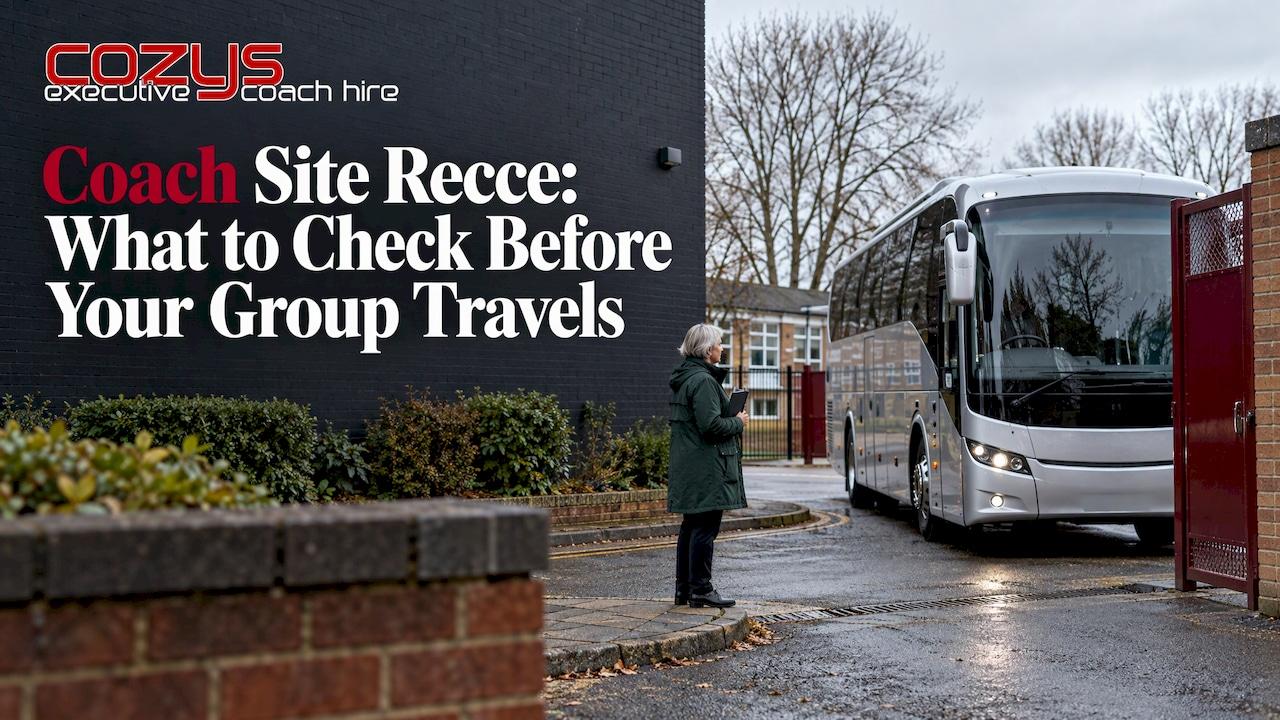
A coach site recce is a visit, made before the journey, to the places your coach will actually use: the pickup point, the venue drop-off, the turning space, the parking and the route between them. It turns a plan on paper into facts you can put in a risk assessment and hand to the driver. For schools, local authorities, corporate teams, tour operators and community groups, the recce is the cheapest way to find the problem that would otherwise surface with 50 passengers on board.
This guide sets out who should go, what to check at each location, how to cover wheelchair access, and what to record and sign off afterwards.
TL;DR
- A recce is a pre-visit by the group leader to spot hazards and learn the area and route first-hand. It feeds the risk assessment.
- Check four things at every location: can the coach reach it, stop legally, turn or exit safely, and can every passenger board and alight safely?
- Agree stops, timings, special needs and driver responsibilities with your coach provider before you travel, and confirm them again on the day.
- If anyone uses a wheelchair, confirm the vehicle's access and securing facilities in advance, not at the kerb.
- Record the findings, resolve each issue in the risk assessment, get it signed off and give the driver and contact person a copy.
Table of Contents
- What a coach site recce actually is
- When a recce is worth doing
- Before you go: the desktop recce and who should come
- Pickup and drop-off points
- Access, turning and parking at the venue
- Wheelchair users and accessible loading
- The route and timings
- The coach itself: what to confirm on the day
- What to record and how to close the issues
- Extra checks for school and recurring journeys
- A short recce checklist you can reuse
- Booking the coach once the recce is done
- Our view on the coach recce
- FAQ
- Sources
What a coach site recce actually is
Recce is short for reconnaissance. In group travel it means collecting accurate information about a place and route before anyone relies on it. One education provider describes a recce as the way to identify and document details of a venue to support risk management, programme design and group safety. The same team explains that desktop research alone gives only a two-dimensional map, and that the physical visit shows how access, routes and facilities connect on the ground, including for schools arriving by coach.
For a coach, the questions are practical ones. Is the entrance wide enough and high enough? Where does the vehicle stop, and where does it wait? Can passengers cross to the venue without walking behind a reversing vehicle? Which road does the driver take if the main route is closed?
The recce is a document as much as a visit. A school's educational visits policy describes the pre-visit as a way to identify potential hazards and gain first-hand knowledge of the area and route, with the findings feeding the risk assessment. Without a written outcome, the visit is a pleasant walk.
When a recce is worth doing
Not every journey needs one. A repeat trip to a venue you used last month with the same coach stop probably needs a quick check of the details, not a full visit. A recce earns its time in these cases:
- A venue, pickup point or route your group has never used.
- A large group, where a coach needs space to manoeuvre and passengers need room to queue safely.
- Passengers with mobility, medical or behavioural needs.
- Residential trips, trips abroad and anything where complexity is high. The same school policy says a pre-visit is usually required where there is a high complexity factor and the visit has not happened previously, and for adventurous, staff-led activities.
- Events with congestion, security cordons or restricted coach access, such as stadiums and conference centres. Our guide to booking stadium coach parking in London shows how a fee or a missed booking can follow from skipping this step.
If you cannot visit in person, a desktop review of maps, the venue's access notes and a call with the venue manager is a sensible first pass. It does not replace the visit when the location is new and the group is large or has additional needs.
Before you go: the desktop recce and who should come
Do the desktop work first so the visit answers specific questions. The Outdoor Education Group's research team starts with a desktop recce to collate information and assess viability before anyone travels. For a coach job, gather:
- The group size, the seat count you are likely to need and the vehicle length. Our coach capacity guide explains how a 16 to 85 seat range maps to group sizes.
- The proposed pickup and drop-off addresses, with maps and satellite views.
- The planned route, alternative routes and expected traffic at the time you will travel.
- Venue contact details, opening times, delivery or coach entry restrictions and any permit needs.
- A list of passengers with access, medical or supervision needs.
- Your risk assessment draft, so the visit can test it.
Who should take part
The visit leader is the person who will be responsible on the day, because they will make the decisions the findings support. Bring a second person where you can: a teacher or supervisor for a school trip, a destination manager for a corporate event, or a carer or access lead for a community group with disabled passengers. A second pair of eyes on the passenger approach and the toilets is useful, and a second view on whether the plan suits the group helps.
Involve your coach operator early. Guidance on hiring a coach says organisers should liaise with the provider over pickup and drop-off points, route and timings, planned stops, special needs, and driver and leadership responsibilities. The operator knows what a given vehicle can and cannot do at a location, so ask for their view on any stop you are unsure about before you finalise it.
Pickup and drop-off points
The point where passengers meet the coach is where most avoidable problems happen. Walk it at the same time of day as the real journey, because a quiet road at 11am can be a car park at 8am.
Check these points:
- Legal stopping. Can a coach stop here, and for how long? Look for restrictions, bus lane hours, loading bans and permit requirements. Where a stop is on private land or controlled by a venue or council, get permission in writing from whoever controls it.
- Approach and exit. Can the driver enter and leave without reversing across a pedestrian route? Is there space for the coach to wait without blocking others?
- Passenger approach. Walk it as a passenger would. Look at the waiting area, lighting, surfaces, crossings, shelter and access from nearby parking or public transport.
- Boarding position. Is there a level, firm area where people can queue away from traffic and board without stepping into the carriageway?
- Environment. Trees, overhead cables and low bridges matter for vehicle height and for the state of pavements. If a stop sits under a tree where birds roost, note it for the day, as droppings on surfaces and glass can make footing and visibility worse, and guidance on removing bird droppings safely is a practical reference for keeping vehicle surfaces clean.
Write a short record for each stop: full address, exact loading position, direction of travel, the contact who gave permission and any restrictions. Keep the driver's instructions and the passengers' instructions separate. The driver needs to know where to stop and which way to face, while passengers need to know where to wait and how to find it.
Access, turning and parking at the venue
At the destination, the same logic applies, with more variables. The Outdoor Education Group describes assessing vehicle access wherever it goes, making sure the coach has room to drop off students and turn around safely, and that there is space for loading equipment. It also plans around seasonal gate closures and emergency evacuation routes.
On the visit, look for:
- Entrance width and height, including gateposts, barriers and overhanging branches.
- Surface and gradient. Soft verges, gravel and steep slopes can leave a loaded coach stuck.
- Turning space. If the coach has to reverse a long way, ask where a banksman or marshal would stand and whether passengers will be kept clear.
- Drop-off versus parking. A coach may drop off at the front and then park elsewhere. Find the parking location, the walk back and the pickup point for the return.
- Luggage and equipment. Is there room to unload and to keep bags out of walkways?
- Emergency routes. Note where an emergency vehicle would enter, and where the group would assemble.
- Toilets, shelter and the nearest hospital. These are details that coordinators and group leaders need on the day, and a recce is where you find them.
For events in busy city locations, a venue's own transport desk may assign coach bays by booking. Ask about this during the desktop phase, because it can change where the coach is allowed to wait.
Wheelchair users and accessible loading
If any passenger uses a wheelchair, the recce changes from a general check into a specific one. Government guidance for school excursions says that where a group member uses a wheelchair, the leader should ensure the transport has appropriate access and securing facilities, and that portable ramps may be appropriate.
On site, test the whole journey from kerb to seat:
- Is the boarding area level and wide enough for a lift or ramp to be deployed?
- Is there a dropped kerb or a step-free route from the waiting area to the loading position?
- Is there space beside the vehicle for the lift to extend and for the passenger to turn?
- Is the destination entrance step-free, and are accessible toilets close to the drop-off?
- Can the driver and a helper reach the passenger without crossing a traffic lane?
Tell your operator the number of wheelchair users and the type of chair when you book, so the right vehicle is allocated. Our accessible transport service is set up for wheelchair users, and sharing your recce findings with us at the booking stage lets the vehicle and loading position be matched to the group.
The route and timings
A recce of the route is partly about driving conditions and partly about time. Guidance on hiring a coach names five key safety factors: the driver, the coach and equipment, the company, the route or itinerary with expected driving conditions, and the behaviour of the travelling group. The route is the one the visit leader can most easily test.
On the route, check:
- Roads with weight, width or height limits, tight junctions and low bridges.
- Roadworks or seasonal closures, and a back-up route if the main one is blocked.
- Where planned comfort stops will take place, and whether they have room for a coach. Plan stops rather than relying only on onboard toilets, as coach travel guidance for schools recommends.
- Journey time at the real time of day, with a buffer built in.
The same school guidance advises confirming pickup and drop-off locations and timings with the provider and identifying medical, accessibility or support needs so that seating and supervision can be planned. For tour operators, the route recce also tests whether a timetable is realistic for a full day. Our guide to coach support for tour operators covers what to agree with your operator beforehand, and our article on conference shuttle routes applies the same thinking to repeated loops between a hotel and a venue.
The coach itself: what to confirm on the day
The recce covers the places, but the same discipline applies to the vehicle when it arrives. Hertfordshire Grid for Learning's guidance says the visit leader should make a visual inspection of the interior and exterior of the coach and draw obvious defects to the driver's attention. It adds that on arrival the group leader should discuss mutual expectations with the driver and exchange contact details in case of emergency or changes at the venue.
Before departure, confirm:
- The agreed route, stops and timings.
- That the coach is clean, with clearly signed emergency exits and known emergency equipment locations.
- That leaders are positioned on the coach in a way that suits the age, behaviour and needs of the passengers.
- Where relevant, that the driver's CPC card is in order, a step the hiring guidance lists under checks before departure.
Drivers carry their own daily duty. Government guidance says drivers must check vehicle safety before setting off, with a walkaround covering lights, tyres, wheel fixings, bodywork, load and other equipment, and that defects are reported in writing. That is the operator's responsibility and not the organiser's, which is why choosing an operator with a clear compliance routine matters. Our coach booking playbook with DVSA checks sets out what to ask for before you confirm a booking.
What to record and how to close the issues
A recce is only as good as its paperwork. After the visit, write down what you found, what could go wrong and what you will do about it. The school policy quoted earlier is clear on the principle: issues identified by exploratory visits must be satisfactorily resolved within the risk assessment, agreed with the educational visits coordinator, signed off by the Headteacher and copied to staff involved. The same policy has a point of contact holding the itinerary, the coach company's contact details, the venue's address and contact details, and a copy of the risk assessment and emergency plan.
Corporate and community organisers do not need the same chain of approval, but the discipline carries over. A practical record includes:
| Item | What to write down |
|---|---|
| Location | Full address, exact stopping position, direction of travel |
| Permission | Who approved the stop, how, and any time or vehicle limits |
| Hazards | What you found, how likely and how severe, and the control you chose |
| Access | Step-free route, ramp or lift position, accessible toilets |
| Route | Main route, alternative, comfort stops, expected journey time |
| Contacts | Venue, operator, driver, on-the-day lead, emergency contact |
| Sign-off | Who approved the plan and who received a copy |
Give the driver a one-page summary with maps and notes. A well-run recce ends with every person involved knowing their part: coordinators know the nearest hospital, managers can describe the toilets and where coaches need to navigate, and group leaders know exactly where they are going, as the Outdoor Education Group's recce outputs show. Our guide to coach risk assessments shows how recce findings slot into the formal assessment.
Extra checks for school and recurring journeys
Schools and local authorities face two additional layers: children's safety rules and the repetition of the same journey every day.
For school trips, the long-standing HASPEV guidance (Health and Safety of Pupils on Educational Visits) expects the group leader to ensure the operator holds a PSV operator's licence, and that seat belts are fitted on coaches carrying children, as set out in the national guidance. A PSV licence is the licence required to operate passenger-carrying vehicles for hire.
For trips that include an overnight stay or travel abroad, the NSPCC-backed checklist used in sport calls for recorded drop-off and pickup times, journey times and stopping points, supervision, suitability and accessibility, driver checks and insurance. It also calls for a pre-event visit and risk assessment of accommodation.
For daily home-to-school routes, the recce becomes a stop-by-stop review that is repeated when a route changes. One school's published terms of carriage show what the routine looks like in practice: pupils at the stop five minutes before departure, a chaperone checking the bus list before leaving as a critical control measure, all passengers seated with seat belts fastened, and a target of 95% of journeys within one minute early to five minutes late, set out in its 2024/25 terms. A route recce is where you find out whether those targets are realistic for each stop.

On contract work, such as a local authority tender, the visit is also the moment to check that the stop locations suit the age and needs of the pupils using them. Our overview of contract coach services explains how multi-vehicle contracts are organised, and our schools and colleges service is built around this kind of work.
A short recce checklist you can reuse
Use this as a one-page template for corporate, tour and community journeys.
Before the visit
- Confirm group size, accessibility needs and the vehicle type with your operator.
- Collect addresses, maps, venue contacts and any coach-entry rules.
- Draft the risk assessment so the visit can test it.
At each stop and venue
- Legal stopping place and permission confirmed.
- Safe approach and exit for the coach.
- Turning space or a safe reversing plan.
- Level, protected boarding area with step-free access.
- Lighting, surfaces, shelter and crossings checked for the real time of day.
- Parking or waiting location for the coach between drop-off and pickup.
On the route
- Height, width and weight constraints checked.
- Alternative route noted.
- Comfort stops identified with space for a coach.
- Timings tested with a buffer.
After the visit
- Findings written up and each issue resolved in the risk assessment.
- Plan signed off by the person responsible.
- Summary sent to the operator and the on-the-day contact.
Corporate organisers who manage several movements in a day can pair this with our guide to event transport compliance checks.
Booking the coach once the recce is done
Once you know where the coach will stop, how many passengers need seats and who needs step-free boarding, you can brief an operator precisely. Cozy Travel provides minibus and coach hire from 16 to 85 seats, accessible transport for wheelchair users and home-to-school transport for local authorities and private schools. Send us the stop addresses, group size and access needs with your booking request through coach hire, group travel or corporate transport, and the vehicle can be matched to the plan you have already tested.
Schools and colleges can start from our schools page, and local authorities can look at the home-to-school service through our main site.
Our view on the coach recce
We have been a family-run transport operator for over four decades, and our view is simple: the best journeys are decided before the coach leaves the depot. A recce gives the organiser facts, and facts let us match the right vehicle to the group.
The size of the group sets the vehicle, and our fleet runs from 16 to 85 seats, so the exact stopping place and turning space on your recce notes matter. Passengers who use wheelchairs need the access and the loading position agreed in advance, which is why our accessible specialists work from those details.
Safety is where we put our own effort. We hold the highest 6-star BUSK safety rating, and we run the UK's first hybrid coach as part of our commitment to sustainable travel. Our work for school and corporate contracts, including partners such as Tesco and the RAF, rests on the same principle: plan the detail, then run it reliably.
If you bring us a clear recce record, you bring us the information that makes a booking straightforward.
Cozys
FAQ
Do I need a recce for every coach trip?
No. A first visit to a new venue, a large group, a residential trip or passengers with additional needs are the strongest reasons to visit in person. For a repeat journey on a known route, a quick review of your notes and a call to confirm the stop and timings is usually enough, with the risk assessment updated for anything that has changed.
Who should carry out the recce?
The visit leader who will be in charge on the day, ideally with a second person such as a supervisor, an access lead or a venue contact. Agree the stops, routes and timings with your coach operator as well, since they can advise on what a particular vehicle can do at a location.
What should I take with me on the visit?
Take the draft risk assessment, maps and addresses, a list of passenger needs, the operator's and venue's contact details, a camera or phone for photographs and a notepad or template for the record. Photographs of the stopping position, the entrance and the approach help you brief the driver afterwards.
What if the recce finds a problem I cannot fix?
Change the plan. Move the pickup point, choose another drop-off, adjust the timings or pick a different vehicle. Record the issue and the decision in the risk assessment and have it approved by the person responsible, so that the final plan matches what you actually found.
How does a recce differ for wheelchair users?
It focuses on the full route from kerb to seat: level ground, space for a lift or ramp, a step-free path to the venue and accessible toilets. Tell your operator the number of wheelchair users and the chair types when you book so the right vehicle and securing facilities are allocated.
Sources
- 081 Educational Visits (LOtC) policy
- Reconnaissance with the Outdoor Education Group
- Hiring a Coach guidance
- Selecting a coach operator, Hertfordshire Grid for Learning
- Making sure your vehicle is roadworthy, GOV.UK
- Health and Safety on Educational Excursions, Scottish Government
- Health and Safety of Pupils on Educational Visits
- Terms and Conditions of Carriage 2024/25
- Checklist for overnight trips and travel abroad
- Travel by coach, school guidance
Recommended
- Coach Risk Assessments: 8 Checks UK Organisers Need Before Booking
- Avoid Unlicensed Operators: 4 Legal Checks for UK Group Transport
- Confirm These 3 Coach Amenities Before Booking for UK Group Planners
- Cozy Travel Coach Booking Playbook for Organisers, with DVSA Checks
This article is produced as general information only and is not professional advise.