
Yes, onboard Wi-Fi delivers clear passenger, operational and commercial benefits when it is specified, segmented and monitored correctly. A bonded cellular connection, for example, keeps a passenger network live even when one carrier drops out on a weak corridor, and a case study from a UK rail operator recorded more than 300,000 users and over £40,000 in annual mobile-data savings after deployment. The business case depends entirely on how the network is designed.
TL;DR:
- Map every operating route and test the weakest corridor at peak occupancy; require multi network SIMs, pooled data terms, service targets, and live monitoring.
- Keep passenger access on a separate network, and prioritize ticketing, CCTV, and telemetry so crowded cabins cannot disrupt vehicle systems.
- Collect names or email addresses through captive portals only with clear consent and a stated purpose; session limits and content filters also protect service quality.
- A Chiltern Railways case study reported more than 99% availability and 175,000 validated contacts, but rail results are benchmarks, not coach guarantees.
Table of Contents
- How Wi-Fi improves passenger experience
- Operational benefits for transport providers
- Safety, security and passenger privacy considerations
- How coach Wi-Fi works: connectivity options and architecture
- Procurement and planning: route testing, SLAs and data sizing
- Implementation checklist and best practices for fleets
- Evidence and case studies that show measurable upside
- Publisher perspective: how this fits Cozy Travel's approach
- How Cozy Travel can help with connected coach hire
- FAQ
- Sources
How Wi-Fi improves passenger experience
Passengers use onboard connectivity for two distinct purposes: getting work done and filling travel time. Research into free rail Wi-Fi found that it supported laptop users working through a journey and acted as a reliable backup when mobile signals dropped, and that this combination had a measurable positive effect on overall satisfaction, according to research from the University of the West of England. The same research found that continuous, journey-long availability mattered more to passengers than advertised peak speed, which has direct implications for how operators should pitch the service.
- Productivity users want a stable connection for email and video calls, not maximum throughput.
- Entertainment and social users want enough bandwidth for messaging and light streaming, particularly on longer routes.
- Comfortable seating and accessible power points shape how much passengers actually use the network, regardless of signal quality.
We recommend marketing Wi-Fi as one part of the whole service package rather than a standalone headline feature, and setting passenger expectations around steady browsing and messaging rather than guaranteed high-definition streaming.
Operational benefits for transport providers
Onboard connectivity does more for the business than it does for the passenger seat. Once a router is on the vehicle, the same link can carry fleet telemetry, driver communications and service data back to a central dashboard, turning a passenger amenity into an operational tool.
- Real-time vehicle data and messaging reduce dispatch friction and support service-level reporting to clients.
- Captive-portal sign-ups generate validated contact records that feed directly into marketing and CRM systems.
- Passenger Wi-Fi can offload data that would otherwise run on operator mobile tariffs, reducing recurring costs.
- Proper segmentation lets CCTV, ticketing and telemetry run on the same vehicle without competing with passenger traffic.
A Chiltern Railways deployment illustrates the scale on offer: the case study reported more than 99% Wi-Fi availability and 175,000 new validated CRM contacts alongside the mobile-data savings already mentioned, built on a separate secure corporate network with content filtering and analytics running in parallel.
Safety, security and passenger privacy considerations
None of those operational gains are safe to pursue on a flat, unsegmented network. Passenger traffic needs its own VLAN, kept apart from the systems that actually run the vehicle and the business.
Network segmentation and quality-of-service rules protect telematics, ticketing and CCTV from being disrupted by a sudden surge of passenger devices, a separation that deployment guidance treats as a baseline requirement rather than an optional extra, as described in connected-bus architecture documentation. Where captive portals collect names, emails or usage data for marketing purposes, that collection needs clear consent language and a stated purpose; these benefits depend on consent and privacy-compliant practices rather than arriving automatically with the hardware, as supplier guidance on fleet connectivity benefits makes clear. Content filtering and sensible session limits round out the picture, keeping the passenger network stable for everyone rather than dominated by a handful of heavy users.

How coach Wi-Fi works: connectivity options and architecture
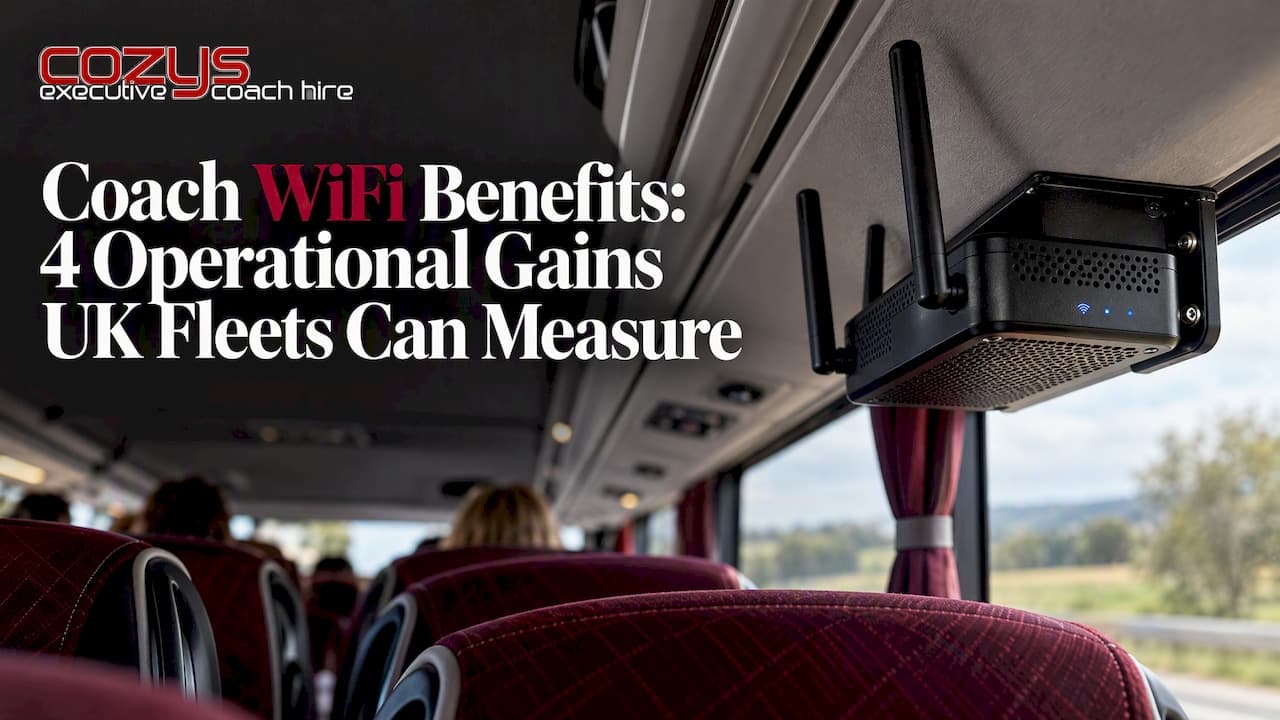
A typical system starts with a router mounted on the vehicle, connected to roof-mounted antennas that reach 4G or 5G networks, broadcasting a standard wireless network inside the cabin. More capable systems bond several cellular connections together so that if one carrier weakens on a given stretch of road, the others carry the load, with a cloud platform monitoring vehicle health and connectivity status across the fleet.

Viasat's Digital Bus architecture describes bonded multi-SIM cellular combined with satellite connectivity, reporting typical latency under 100 milliseconds for that product design, with up to four SIMs working together for coverage. For rural routes or long-haul journeys where cellular coverage is patchy, this hybrid cellular-and-satellite approach is the practical answer, trading a small amount of complexity for far fewer dead zones. Expected latency and per-passenger bandwidth vary meaningfully between products, so route mapping and permanent roaming SIM profiles, rather than a single fixed carrier, are what actually solve the coverage problem rather than headline connection speed.
Procurement and planning: route testing, SLAs and data sizing
Testing the actual route before specifying a system can help operators identify coverage problems early. Operator guidance is explicit that a single-carrier SIM can fail precisely where a route crosses a weak-coverage corridor, and that multi-network connectivity should be a procurement requirement rather than an afterthought, according to guidance on bus and coach fleet Wi-Fi.
- Define the business objective first: passenger satisfaction, digital inclusion or commercial engagement each change onboarding flow, data policy and network sizing.
- Map coverage along every route the vehicle actually runs, not just the depot-to-destination straight line.
- Test at peak occupancy and on the weakest corridor on the route, not just in ideal conditions.
- Specify pooled data allowances, per-device caps or unlimited SIM options against the chosen objective.
- Require SLA metrics and a live monitoring dashboard as part of the supplier contract.
- Agree a SIM provisioning lifecycle, including seasonal scaling for peak travel periods.
Pro Tip: Ask any shortlisted supplier to run a live test on your weakest route before signing, not just a coverage map.
Implementation checklist and best practices for fleets
A staged rollout catches problems while they are still cheap to fix. Running a focused pilot before a fleet-wide commitment can help reduce the risk of a costly rollout mistake.
- Pilot on routes that represent your weakest coverage, not your easiest one.
- Test with full passenger occupancy and a mix of device types, not a handful of staff laptops.
- Configure network segmentation so operational systems are prioritised ahead of passenger traffic.
- Set alerts for vehicles going offline or usage patterns that look abnormal.
- Plan SIM lifecycle and pooled billing in advance, including seasonal demand changes.
Our coach booking playbook covers the wider checks organisers should run alongside connectivity, including DVSA compliance.
Evidence and case studies that show measurable upside
The strongest published evidence on measurable upside still comes mainly from rail deployments, and operators should treat the figures as illustrative benchmarks rather than guarantees for every coach route. On the connectivity side, a 2026 industry report cites satellite-equipped coaches reaching 250 to 350 megabits per second to the vehicle on specified tariffs, with how much of that reaches each passenger depending on the product and how full the vehicle is. Research from the University of the West of England found that continuous connectivity supported passenger satisfaction, and that perceived reliability can matter more than advertised peak speed.
Publisher perspective: how this fits Cozy Travel's approach
We see connectivity as part of a wider reliability promise rather than a feature bolted onto a coach. Organisers booking school, corporate or accessible transport care more about a stable, well-run journey than a headline Wi-Fi speed, which is why we treat network design the same way we treat seating and access: specified for the actual route, not a generic claim. Operators planning a trial are welcome to discuss route-specific needs with us directly.
— Cozys
How Cozy Travel can help with connected coach hire
We run a fleet built for exactly the groups this guide is written for: schools, local authorities, corporates and community organisers who need transport that turns up, works and gets people where they need to be without surprises. Connectivity sits inside that promise rather than apart from it.

- Coach Hire covers single trips and ongoing contracts for groups of different sizes.
- Group Travel supports organisations coordinating larger parties across multiple pickup points.
- Our hybrid coach hire service offers a hybrid coach option for organisers prioritising sustainable travel.
If you are planning a route-specific trial or want to talk through connectivity requirements for an upcoming contract, get in touch through our Coach Hire page and we will talk you through what fits your route.
FAQ
Do you get free Wi-Fi on National Express coaches?
Coverage of free Wi-Fi varies by operator and route, so it is worth checking directly with the specific coach company you are booking before travelling. Some coach operators offer onboard Wi-Fi, though availability and quality differ between fleets and services.
How do I connect to coach bus Wi-Fi?
Most coach Wi-Fi networks appear in your device's wireless settings as a named network you can join directly, often followed by a captive portal page that asks you to accept terms before browsing. Some systems require an email address or a simple registration step, which also lets the operator capture a validated contact record.
How does bus Wi-Fi work?
An onboard router connects to 4G or 5G mobile networks through roof-mounted antennas, then broadcasts a standard wireless network inside the cabin for passengers to join. More advanced systems bond several cellular connections, and sometimes satellite links, together so coverage holds steady even where one network is weak, with typical latency under 100 milliseconds reported for one such hybrid architecture.
Is there free Wi-Fi on the bus?
Whether a given bus or coach service offers free Wi-Fi depends entirely on the operator and the vehicle, so there is no single answer across the industry. Where it is offered, research suggests passengers value having it available throughout the journey more than they value high peak speeds, according to UWE research on rail Wi-Fi.
Sources
- Viasat
- Uwe-repository
- Railway-news
- Travel-pursuit
- Onboard WiFi for Bus & Coach Fleets | Multi-Network SIM