
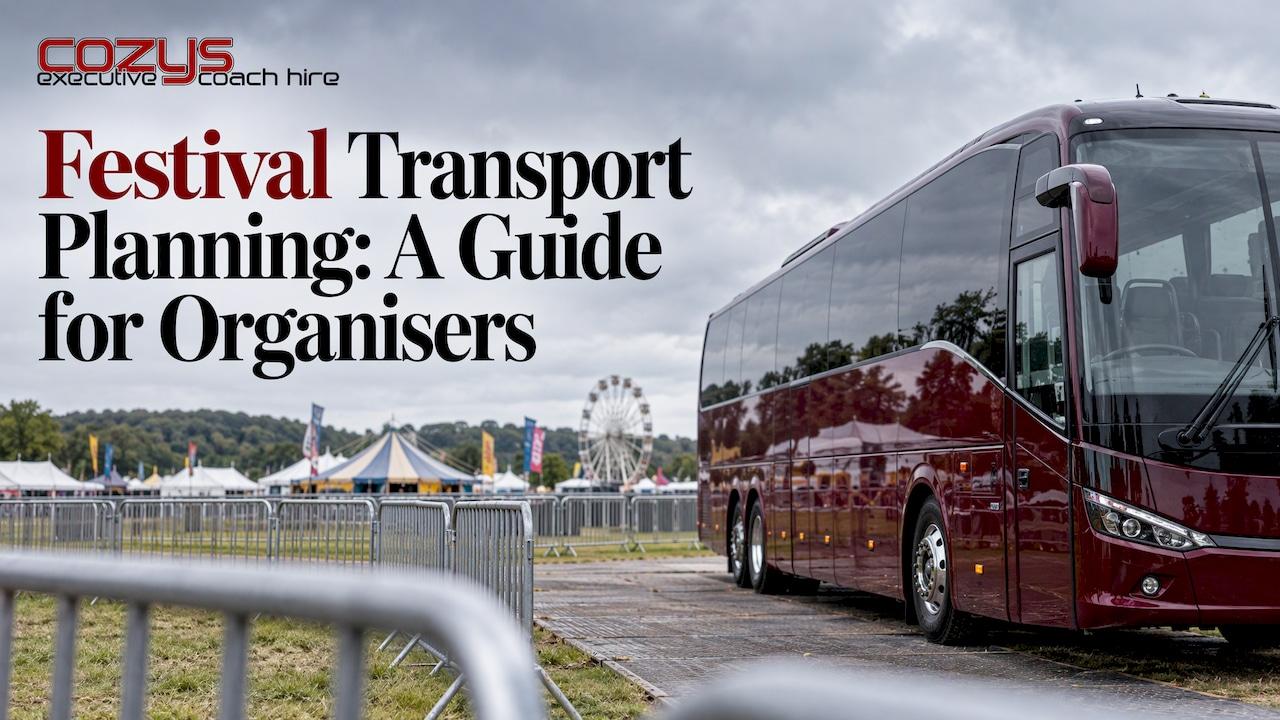
Festival transport planning is the work of getting every attendee, performer, contractor and emergency vehicle to the site and away again without blocking the roads or crowding the gates. Done well, it rests on three things: a documented plan your local highway authority will accept, scheduled group vehicles matched to arrival and departure peaks, and a fallback for when timings slip. Dedicated coaches and shuttles are the part that you control directly, and with a fleet of 16 to 85 seats, including the UK's first hybrid coach, Cozy Travel can supply the vehicle size each leg of the plan needs.
TL;DR
- Contact the local highway authority at the earliest opportunity: road closure applications can take up to 16 weeks, and a traffic management plan (TMP) is usually expected.
- Separate people and vehicles on site, give emergency vehicles their own entry and exit routes, and keep them clear at all times.
- Match coach and shuttle capacity to your peak arrival and departure windows, with fixed pick-up points and a marshalled loading area.
- Plan accessible travel from the start: step-free routes, accessible shuttles and wheelchair-accessible coaches.
- Write down what happens if the event overruns, ends early or is cancelled, and rehearse it with your stakeholders.
Table of Contents
- What your local authority will want to see
- The planning steps, in order
- Making the journey accessible
- Communicating the plan and preparing for disruption
- Our view on festival transport
- Booking coaches for your festival
- FAQ
- Sources
What your local authority will want to see
Before you choose a single vehicle, collect the information the authorities will ask for. Surrey County Council's TMP writing guidance asks for a concise, accurate document. It covers the event overview, the affected highway network and pedestrian crossing points, the phased set-up, the event and de-rig timetable, arrival modes, parking locations with capacities, access and egress routes, and overflow parks. It also covers on-road parking suspensions, accessible parking, road closures and times, emergency vehicle access and rendezvous points, and signed diversion routes.
A traffic management plan is simply the written description of how vehicles and pedestrians will move around your event. Other councils ask for the same core content. North Devon's 2025 event TMP briefing asks for ingress and egress routes, overflow parking, secure cycle parking, space for special buses and coaches, and a park and ride operation for larger events. Runnymede Borough Council's event management plan guidance lists access, egress, vehicle and pedestrian separation, signage, service vehicles, contractors' and artistes' vehicles, public transport, parking and road closures.
Three practical points follow from these documents:
- Start with the highway authority. Under the Traffic Management Act 2004 it manages the local road network, and North Devon's police guidance says organisers must consult it at the earliest opportunity if disruption is possible.
- Allow for lead times. Surrey notes that road closure applications can take up to 16 weeks and may carry a charge to the organiser.
- Check your diversions against your vehicles. Surrey says diversion routes must be checked for height, weight and width restrictions for every vehicle that will use them, which matters when the vehicle is a 12-metre coach.
Police resources are not a substitute for a traffic plan. The same North Devon guidance says TMPs should not rely on police for traffic control, as police deal only with spontaneous incidents.
The planning steps, in order
There is no single official four-step model for festivals, but the working sequence is consistent across the guidance above.
1. Establish demand and where people come from
Start from your ticket data: how many attendees, from which postcodes, arriving on which days. A festival with a camping population arriving across Wednesday to Friday has a very different pattern from a one-day event where most people arrive within three hours. Your demand profile decides how many vehicles you need, and which of them should be group vehicles.
Common sources of group demand are:
- Rail stations or town centres without a direct service to the site.
- Large cities with enough demand to fill a coach from a fixed point.
- Staff, volunteers, performers and crew, who arrive earlier and leave later than the audience.
- Organisations that book as a group: community groups, schools and colleges, corporate hospitality parties.
2. Assess the site and the roads around it
Walk the access routes with the site plan in hand. The Health and Safety Executive's event transport guidance tells organisers to assess the risks from vehicle movements on site, keep people and vehicles apart, use a traffic management system with one-way routes where possible, minimise reversing, and plan entry and exit for emergency vehicles. It also says work-vehicle tasks in public areas should be completed before the audience is admitted.
For coaches this translates into a few concrete questions. Where does the vehicle turn? Is there a drop-off point that does not need reversing? Can a coach reach the loading area on hardstanding or trackway in wet weather? Our guide to park and ride shuttles for events covers the details that most often cause a TMP to be sent back.
3. Choose pick-up points, capacity and timings
Pick-up points should be easy to find and big enough for a coach to stop without blocking traffic. Mode Shift's leisure action plan recommends public transport timetables aligned to event start and finish times, dedicated coaches, shuttles or buses with pre-arranged pick-up points, and seat reservations on longer-distance train or coach services.
Capacity is where many plans go wrong. A shuttle sized for the average hour is overwhelmed in the peak hour, and the queue then becomes a safety problem. Work from the peak:
| Question | Why it matters |
|---|---|
| How many people arrive in the busiest hour? | Sets the number of vehicles needed per cycle. |
| How long is the round trip, including loading? | Sets how many cycles each vehicle can run. |
| What seat count suits the route? | A 16-seat minibus suits crew and small parties; an 85-seat coach suits a high-volume trunk route. |
| Where do vehicles wait between runs? | Standing coaches need space away from public areas. |
If you are unsure how to match seat counts to groups, our coach capacity guide sets out the 16 to 85 seat range and a planning checklist. Where one coach serves several towns, multiple pick-up coach hire explains how to plan stops, route and timings.
Departures are harder than arrivals, because everyone leaves at once. Mode Shift advises that the last mile around a venue should have well-signed walking routes with travel times from bus stops and stations, and that vehicles in nearby parking should be held for a minimum time after the event so that attendees have time to leave the area. Build the departure schedule around that: staggered coach loading, a clear queue layout and a named marshal at each bay. Our event coach marshalling guide explains how to run the loading area.
Where the festival is in a town centre and some visitors will drive, point them to booked parking rather than leaving them to circle. Even a seaside concert town shows how a booking system helps, as with pre-booking event parking in Sopot, Poland, where reservation and easy entry and exit are the selling points.
4. Control crowds where transport meets the gate
The HSE's crowd management guidance says that where the number arriving may exceed safe venue capacity, you need arrangements to monitor and estimate arrivals and, depending on size, close liaison with the police and transport operators. Queues must not block emergency access routes. Practically, that means a coach drop-off that releases passengers at a rate the gates can absorb, and a holding area for vehicles that arrive early.
5. Plan emergency access separately
The HSE's Event Safety Guide says fire appliances should be able to reach all parts of the site and get within 50 metres of any structure. Emergency routes must stay clear at all times, with temporary trackways for wet ground and gated entrances and exits tall and wide enough for fire and ambulance vehicles. North Devon's police guidance adds that pre-defined, separate emergency entry and exit routes with rendezvous points belong on the site plan. Do not let a coach holding area or shuttle queue encroach on any of them.

Making the journey accessible
Accessible transport is a core part of the plan, not an add-on. Larger festivals publish their arrangements, and they show what attendees now expect:
- Glastonbury's 2025 easy-read access information describes an accessible car park, a wheelchair-accessible shuttle around the site, and an accessible shuttle from the festival coach station to the access arrivals tent.
- Download Festival's 2026 accessibility guide describes designated accessible routes and an internal accessible shuttle from the transport hub, where coaches drop passengers at the East Entrance.
- Boomtown's 2026 travel page lists a regular wheelchair-accessible shuttle from Winchester station, plus a coach service from over 50 UK locations in which essential companions can book two codes to travel together.
The pattern is the same in each case: an accessible link from the arrival point to the entrance, and companions travelling together. For your own plan, ask for wheelchair-accessible vehicles at the booking stage, publish the pick-up point details early, and make sure the step-free route from the coach bay to the gate is on the site plan. Our accessible specialists provide transport for wheelchair users, which is the starting point for the accessible legs of a festival plan.
Mode Shift also recommends well-lit, clear and accessible walking routes, and secure cycle and e-scooter parking with charging. Shifting some attendees to coaches also reduces the number of cars you must park, which eases the pressure on overflow fields.
Communicating the plan and preparing for disruption
A plan only works if attendees know it. The Rail Delivery Group's Planning for Special Events guidance suggests a public information campaign six weeks before the event. It also suggests a tabletop exercise with key stakeholders at least ten days before. Those are written with rail in mind, but the timeline suits coach and shuttle plans too. Send travel information with the ticket, publish pick-up points and times, and state clearly where the coach does and does not stop.
The same guidance asks organisers to consider events that overrun, end early or are cancelled at short notice, and to document a three-tier command and control structure with contingencies for stranded passengers, evacuation and crowd management. For coach operations, a short contingency table is enough:
| Scenario | What the plan should state |
|---|---|
| Headliner overruns | Whether coaches wait, and who authorises it. |
| Early finish | Where early arrivals queue, and how departures are brought forward. |
| Severe weather | Which loading areas are usable, and the alternative bay. |
| Road closure on the route | The approved diversion, checked for vehicle size. |
| Stranded passengers | The holding point and the onward options. |
The HSE notes that external public transport is generally outside health and safety law because road traffic law covers those risks. It still advises organisers to talk to the police, the local highways authority and transport providers about external traffic management, and to consult rail authorities about extra services. The Event Safety Guide stresses a team approach with duties agreed in writing at the planning stage: police coordinate response on and off site, the fire brigade leads on site fire response, and the ambulance service coordinates medical response.
Our guide to three compliance checks for event transport logistics is a useful companion at this stage, and matchday shuttle planning shows how the same peak-flow thinking works for stadium crowds.
Our view on festival transport
Most festival transport problems start long before the weekend. They start when the plan is written around the vehicles that happen to be available, rather than around the people who need to move.
We have run group travel for more than four decades as a family-run operator, and we see the same principle hold for schools, corporate teams and community groups: the journey works when the vehicle, the pick-up point and the timing have been matched to the group. A fleet from 16 to 85 seats lets a planner do that, with a minibus for crew and a full-size coach for the busiest route.
We also think the sustainable choice should be the easy one. Putting attendees onto a shared coach, including the UK's first hybrid coach in our fleet, reduces the number of cars arriving at the gate. Our 6-star BUSK safety rating, the highest available, is the standard we hold ourselves to when we are carrying large groups on unfamiliar site roads.
Early conversations help most. Tell us the site, the peaks and any accessibility needs, and the transport plan can be built around them.
Cozys
Booking coaches for your festival
If your plan needs scheduled shuttles, group coaches from towns and cities, or accessible vehicles, we can supply them. Coach Hire covers vehicles from 16 to 85 seats, and our Group Travel page is the place to start for organisations booking on behalf of their members. Corporate teams attending as hospitality guests can look at Corporate, and schools and colleges with student groups at Schools & Colleges.
Bring your site plan, expected peaks and any accessibility requirements to the first conversation, so the vehicles and timings can be matched to them.
FAQ
When should I start planning festival transport?
As soon as the site and dates are fixed. Road closure applications can take up to 16 weeks according to Surrey County Council, and your highway authority expects early consultation. Coach availability in festival season is also limited, so confirm vehicles once your demand estimate is firm.
What should a festival transport plan include?
It should cover the event overview, the affected roads, arrival modes, parking and overflow, access and egress routes, set-up and de-rig timings, accessible parking, emergency routes, road closures and diversions. Councils such as Surrey, North Devon and Runnymede publish checklists with the specific items they expect.
How do I make festival travel accessible?
Plan the whole journey: an accessible vehicle, a step-free route from the drop-off to the gate, and an accessible shuttle on site where the ground is uneven. Allow companions to travel together and publish the arrangements early. Wheelchair-accessible coach transport can be arranged through our accessible specialists.
Do I need police for traffic control?
No plan should rely on it. North Devon's police guidance says TMPs should not include police resources for traffic control, because police deal only with spontaneous incidents. Use approved traffic management providers and stewards, and agree duties with the emergency services in writing.
Sources
- Writing a traffic management plan, Surrey County Council
- Event Traffic Management Plans briefing, North Devon Council
- Guidance for Creating an Event Management Plan, Runnymede Borough Council
- Police guidance for event and protest organisers, North Devon
- Transport, HSE
- Put crowd controls in place, HSE
- The Event Safety Guide, HSE
- Leisure Action Plan, Mode Shift
- Planning for Special Events, Rail Delivery Group
- Glastonbury easy-read access information
- Download Festival 2026 accessibility guide
- Boomtown travel information
- Event parking booking in Sopot
Recommended
- Matchday Shuttle Planning: A Practical Guide for Organisers
- 3 compliance checks UK organisers must do for event transport logistics
- Avoid TMP rejections when contracting park and ride shuttles for events
- Event Coach Marshalling: A Planner's Guide for UK Organisers
This article is produced as general information only and is not professional advise.