
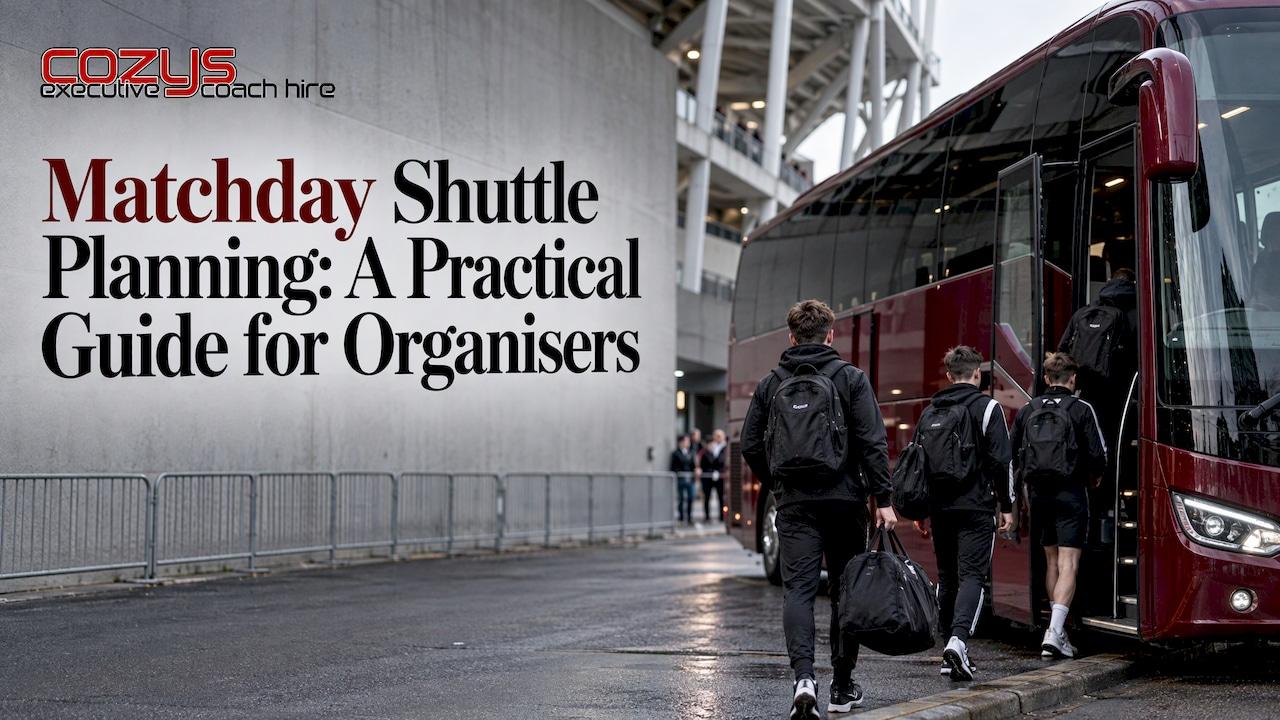
A matchday shuttle works when it links a station or park and ride site to the stadium on a fixed timetable, starts about two hours before kick-off and keeps running for 60 to 90 minutes after full-time. It also has to fit the road closures around the ground. Get those four things right (route, frequency, timings, accessibility) and most of the rest follows. This guide uses published arrangements from UK clubs to show what that looks like, and how supporter groups, clubs, corporate hospitality hosts and community organisations can plan their own.
TL;DR
- Link the shuttle to a rail station or park and ride site, not to a street address. Supporters already know how to reach those.
- Plan around the closure window: most clubs start shuttles about two hours before kick-off and run them up to 90 minutes after the final whistle.
- Size the fleet to the return peak, not the arrival peak. Everyone leaves at once, and roads are closed.
- Build accessible provision in from the start: step-free vehicles, wheelchair spaces and a booking route for those who need one.
- Publish the timetable, pickup point, fare and accessibility details in one place before the fixture.
Table of Contents
- Start with the matchday timeline
- Choosing routes, pickup points and drop-off locations
- How many vehicles, and how often
- Timings around kick-off, full-time and road closures
- Fares, booking and passenger information
- Accessibility and safety
- Keeping the service reliable on the day
- Our view on matchday shuttles
- Book a matchday shuttle with Cozy Travel
- A planning checklist
- FAQ
- Sources
Start with the matchday timeline
Every decision in a shuttle plan hangs off three times: when supporters arrive, when roads close and when the crowd leaves. Work backwards from kick-off and forwards from full-time.
Published club arrangements show a consistent pattern. West Ham United's access statement describes complimentary shuttle buses that run continuously from two hours before kick-off and for up to 90 minutes after full-time. Southampton's visiting supporters guide describes a shuttle that starts two hours before kick-off and runs every 10 to 15 minutes depending on traffic. Everton's travel hub goes earlier still, with shuttle services starting five hours before kick-off, which suits a ground where many fans arrive for the atmosphere or hospitality.

A useful planning rule: the further the pickup point is from the stadium and the larger the away or hospitality contingent, the earlier you start. A small supporter group using one coach can fix a single outbound and single return departure. A club or event organiser serving thousands needs a continuous loop.
Choosing routes, pickup points and drop-off locations
This is the part most plans get wrong, because it is decided by geography rather than by a formula. Four questions settle it.
Where do your supporters already arrive? Rail stations and park and ride sites are the natural origins. Bristol City's three matchday routes are built this way: one connects with Temple Meads railway station, Bristol Coach Station and most public bus routes, while the other two serve park and ride sites with free parking. Southampton runs from the central station and Town Quay, and drops fans at Britannia Road just outside the stadium.
Where can a vehicle legally and safely stop? The drop-off should be as close as the closure zone allows, but never inside it. Southampton's drop point sits just outside the ground, and Everton's accessible service stops at Boundary Street, around 175 metres from the stadium. Walk the final stretch before you publish it, at the time of day the match will be played.
Can the vehicles turn and queue without blocking the route? A shuttle needs a loading bay with room for several vehicles waiting, a clear turning circle and a place for marshals to stand. Check this at both ends. A pickup point that works for one coach may fail with six.
Do you need a second origin for overnight guests? Away supporters and hospitality guests often stay in town. For a central London fixture, a pickup outside boutique hotels in central London with good rail links can feed the same shuttle network, so guests do not need to find the station first. Keep the number of pickup points low, though. Each extra stop adds minutes to every loop.
For wider route design principles, our guide to designing shuttle routes for events applies equally to a stadium, and our guide to stadium coach parking in London covers where coaches can wait once passengers are dropped.
How many vehicles, and how often
The return journey sets the fleet size. Arrivals spread over two hours or more; departures compress into the 30 to 60 minutes after the final whistle. West Ham's numbers make the point: 11 buses run continuously before the match, but 18 operate after full-time.
| Club | Service pattern | Source detail |
|---|---|---|
| West Ham United | 11 buses before kick-off, 18 after full-time | Free, from two hours before kick-off |
| Southampton | Every 10 to 15 minutes, traffic permitting | Starts two hours before kick-off |
| Everton | Four services, two running every 10 minutes | Starts five hours before kick-off |
| Derby County (Morledge shuttle) | Every 20 minutes from 1 hour 20 minutes before kick-off | Single return 20 to 30 minutes after the whistle |
| Bristol City | Three routes, 1,100+ users per matchday | Off-peak services run too |
Sources: the West Ham access statement, the Southampton guide, Everton's bus page, Derby County's matchday travel page and Bristol City's shuttle announcement.
To size your own service:
- Estimate passengers per direction. Use ticket sales, hospitality lists or a booking count, not stadium capacity.
- Divide by seats per vehicle. Coach fleets for groups run from 16 to 85 seats, so mix sizes if demand is uneven.
- Time a full loop in match traffic, including loading, and divide it by your target headway.
- Add a reserve vehicle. A breakdown or a delayed return should not halve your frequency.
An important point on frequency: a smaller number of larger vehicles often loads faster than many minibuses, because each stop at the bay is shared among more passengers. Where the loading bay is tight, one high-capacity coach every ten minutes can beat three small vehicles competing for kerb space.
Timings around kick-off, full-time and road closures
The shuttle cannot run to a timetable that ignores the closures. Derby County's page describes a traffic exclusion zone around Pride Park from 90 minutes before kick-off until up to 60 minutes after the final whistle, with a dynamic risk assessment that can bring closures forward. Its Morledge shuttle therefore has a single return departure 20 to 30 minutes after the final whistle when directed by police. West Ham says its buses do not leave the stadium until road closures re-open, normally around 30 minutes after the final whistle.
The practical consequences:
- Tell passengers the return will not be instant. Publish "buses depart after road reopening" rather than a precise minute.
- Stage vehicles outside the zone so they are ready to enter as soon as police allow.
- Put the last outbound departure before the closures bite. Derby's last departure on the Morledge route is 20 minutes before kick-off.
- Agree the closure type with the traffic management team. The Wembley event parking plan distinguishes hard closures, which allow no vehicle access without agreement from the safety officer, and soft closures that let residents and businesses through. Whether your shuttle sits inside a soft closure, by accreditation, decides whether it can reach a drop-off at all.
If your event needs a temporary traffic management plan, our guide on avoiding TMP rejections when contracting park and ride shuttles sets out what authorities look for.
Fares, booking and passenger information
Decide early whether the shuttle is free, paid on the day or pre-booked. Clubs use all three. West Ham's is complimentary. Southampton accepts contactless payment. Derby County's Morledge shuttle fare is £3 for adults and £1.50 per child with an adult from the 2026/27 season. Bristol City held prices for a second year, with group tickets allowing return travel from £2.99 per person and £1 off-peak returns; under-fives and bus pass holders travel free.
For a group or corporate organiser, the equivalent is a single per-vehicle booking, so no one pays on the day. Whatever you choose, publish these in one place before the fixture:
- Pickup point, with a landmark and a map pin
- First and last departure times, in both directions
- Frequency, with the note that it depends on traffic
- Fare or booking reference
- Accessibility arrangements and how to request them
- A contact number staffed on the day
Supporters should not need to piece this together from several pages.
Accessibility and safety
A matchday shuttle that excludes wheelchair users is a failed shuttle, and the planning has to start with vehicles, not exceptions. Bristol City states that all of its shuttle buses are fully accessible. Derby County describes low floors, ramps, a wheelchair space with a backrest, priority seating and colour-contrasting handrails on its local services. Everton offers a separate accessible shuttle between Sandhills station and Boundary Street, booked by email or phone with requirements specified.
Two cautions to build into your information:
- Chair size and securing. West Ham notes that only wheelchairs meeting standard size and safety specifications can be accommodated, and that a chair which cannot be secured may need a transfer to a fixed seat. Ask passengers to state chair dimensions when booking.
- Number of spaces. Each coach has a limited number of wheelchair positions, set by its layout. Check this against your expected demand.
Our guides on accessible coach seating layouts, wheelchair accessible coach standards and wheelchair group transport options go through what to check before you book. For fans who find crowds and noise difficult, see our note on autism friendly travel.
Keeping the service reliable on the day
The weak point is almost always the return. Everton's travel page reports that operators saw good pre-match performance but ongoing challenges with return journeys, which led to adjusted lane closures to speed up shuttle movements. The lesson is to plan the return as its own operation.
- Marshals at both ends. One to hold the queue in an orderly line, one to direct vehicles.
- A single queue per route, with clear signage by destination.
- A control contact in touch with drivers and the stadium control room, as the Wembley plan describes for its traffic management contractor.
- A fallback. If the road reopening is delayed, tell passengers and keep vehicles staged rather than circling.
Shuttles also reduce pressure on everything else. Transport guidance from the Greater London Authority notes that park and ride, coaches and shuttle buses can reduce congestion near stadiums by dispersing fans quickly, and it cites a subsidised shuttle at Twickenham carrying fans to Richmond and Hounslow East stations. Getting people to a station with spare capacity, rather than the nearest one, is as much a part of the design as the vehicle itself.
Our view on matchday shuttles
We have run group transport for over four decades, and the pattern is consistent: shuttles fail on detail, not on intent. The vehicle is rarely the problem. The loading bay, the closure timings and the information given to passengers are.
Our approach is to plan from the return journey backwards, match the vehicle size to the bay and the crowd, and brief drivers on the closure plan before the day. Our fleet runs from 16 to 85 seats, so we can fit a small supporter group or a large event loop without over- or under-sizing.
We operate the UK's first hybrid coach, and we hold the highest 6-star BUSK safety rating, which matters when organisers must show a licensing authority or a school governing body that their transport is safe. We also run accessible transport for wheelchair users as a core service, so access is designed in from the first quote rather than added late.
Cozys
Book a matchday shuttle with Cozy Travel
If you are organising transport for a supporter group, a corporate hospitality party or a community club, we can supply the vehicles and the planning support. See our coach hire page for fleet details or group travel for bespoke group arrangements. Corporate hosts can look at our corporate transport service, and anyone needing step-free travel can go straight to our accessible specialists.
Send us the fixture, the numbers and the pickup point, and we will propose a vehicle mix and timetable. Our offers do not carry published prices, so quotes are based on your requirements.
A planning checklist
- Confirm the fixture, expected numbers and any hospitality or away allocation.
- Choose origins (stations, park and ride, hotels) and the drop-off just outside the closure zone.
- Get the closure times and type from the club, police or highway authority.
- Size the return peak and add a reserve vehicle.
- Specify accessible vehicles and a way to request wheelchair spaces.
- Publish the timetable, fare and contact details in one place.
- Brief drivers and marshals, and agree a staging area.
- After the match, record queue times and departure delays, and adjust for the next fixture.
FAQ
How early should a matchday shuttle start?
Most published services start around two hours before kick-off. Everton starts earlier, at five hours, and Derby County's Morledge shuttle starts 1 hour 20 minutes before. Choose a start time that matches when your passengers actually arrive.
How long should shuttles run after the final whistle?
Plan for up to 90 minutes, as West Ham does. Buses usually cannot leave until road closures reopen, around 30 minutes after the match at that ground, so passengers should expect a wait.
How many buses do I need?
Size for the return, when everyone leaves together. West Ham runs 11 buses before the match and 18 after it. For your own event, divide return passengers by seats per vehicle, test a full loop time in traffic and add a reserve.
Should a matchday shuttle be free?
Both models exist. West Ham's service is complimentary, while Derby County and Bristol City charge modest fares. For a private group, a single booking paid in advance avoids payment queues on the day.
Sources
- City matchday shuttle bus prices frozen for the 2025/26 season, Bristol City
- London Stadium Access Statement 2025/26, West Ham United
- Men's Visiting Supporters Guide 2024/25, Southampton FC
- Matchday Travel, Derby County
- Bus Travel, Everton Football Club
- Stadium Event Parking Management Plan, Wembley Stadium
- A Question of Sports Travel, London.gov.uk
- Parkwood Hotel, The Chapter Hotels
Recommended
- Conference Shuttle Routes: How to Design Them Well
- Avoid TMP rejections when contracting park and ride shuttles for events
- Corporate Shuttle Policy: What to Include and How to Write It
- 3 compliance checks UK organisers must do for event transport logistics
This article is produced as general information only and is not professional advise.