
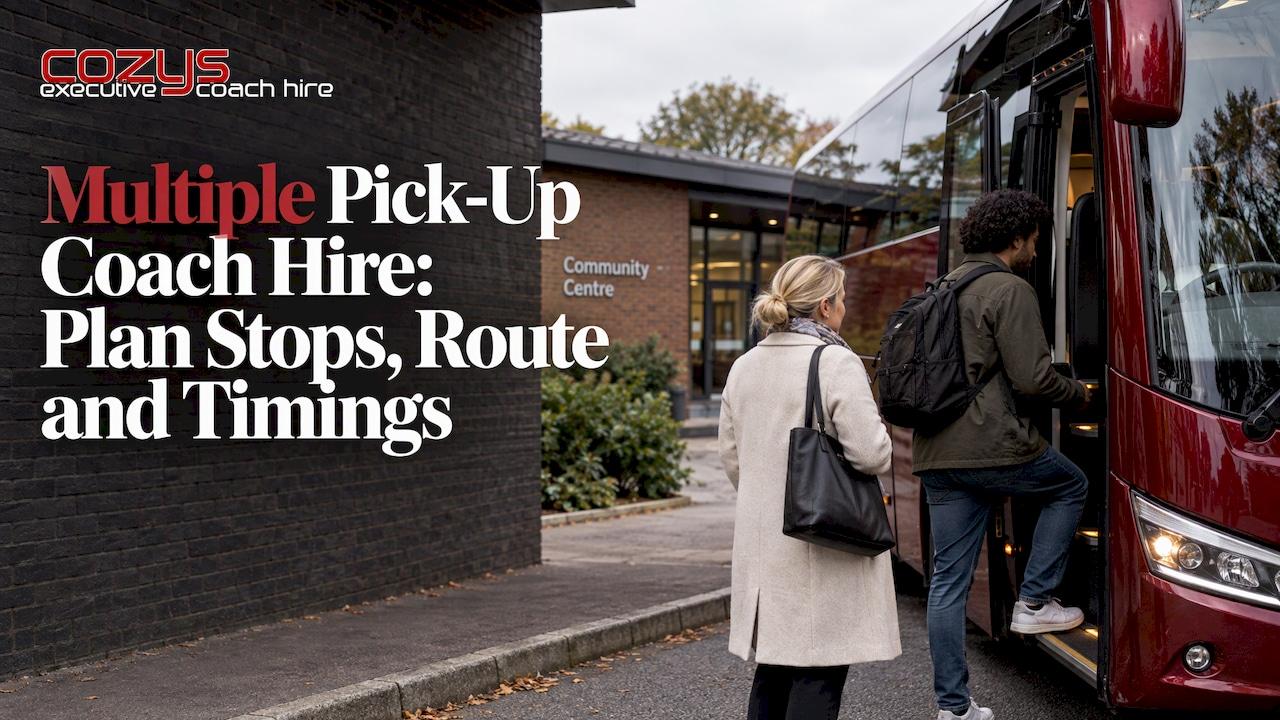
A multiple pick-up coach collects passengers from several agreed locations and carries them to one destination, or the reverse. It works when your group is spread across a town, a region or several sites, and it replaces a convoy of cars with one scheduled vehicle. It only runs well when each stop is checked in advance, the timings allow for boarding, and the vehicle is sized for the whole group. We are Cozy Travel, a family-run operator with over four decades of group transport behind us, and this guide sets out how organisers of school, corporate, community and tour groups plan it.
TL;DR
- A multiple pick-up coach serves several set stops on one route, so a dispersed group arrives together on one booking.
- Every stop needs a safe place to pull in, a clear landmark and an agreed time. Send each passenger the exact address, arrival time and a contact number.
- Build boarding time into the schedule and respect driver break rules: a 45-minute break after no more than 4.5 hours of driving.
- School and accessible runs add requirements: assessed stops, trained passenger assistants, correct wheelchair securement and checked staff.
- Cost is driven by vehicle size, total mileage, hours on duty and the number of stops, so give your operator the full route when you ask for a quote.
Table of Contents
- What a multiple pick-up coach journey involves
- When several stops beat a single meeting point
- How to plan the stops and route
- Choosing the right vehicle size
- What affects the cost
- School and accessible routes: extra requirements
- Our view on multi-stop coach planning
- Plan your multi-stop route with us
- FAQ
- Sources
What a multiple pick-up coach journey involves
One vehicle, one driver (or a pair for longer duties), a fixed sequence of stops and a single destination. Passengers join at the stop nearest to them, and the coach continues until it is full or the last stop is reached. The return leg usually reverses the order, or drops passengers at the same points.
Business Cloud notes that clear pick-up and drop-off locations are essential for coach hire, and that where passengers join from different areas, multiple pick-up points may be arranged depending on the route. The same article advises allowing extra travel time for busy periods, major events or long-distance journeys.
The arrangement is different from a point-to-point charter in one respect: the route is no longer a simple line. Each added stop adds distance, boarding time and a risk of delay, so the planning matters more than the vehicle.
When several stops beat a single meeting point
Multiple pick-ups earn their place in a few common situations:
- Corporate events and conferences. Staff based at different offices or hotels travel to one venue without each arranging parking. Our guide to conference shuttle routes covers loop and point-to-point designs in more detail.
- Private school and college runs. Pupils join from a series of villages or estates and arrive together before the first lesson.
- Community and social groups. Members from several neighbourhoods reach a day out, a match or a service without a long walk to a central stop.
- Tour operators. Guests join at several towns along the outbound road, which fills the vehicle and spares each guest a long journey to a single departure point.
- Residential trips. Families drop pupils at a school, where one coach departs, or the coach collects from more than one site. See residential school trip transport for the planning side.
If everyone already lives within a few minutes of one car park, a single meeting point is simpler. The more spread out the group, the more a multi-stop route pays back, particularly where it takes many cars off the road. Our piece on contract coach services shows how one vehicle can replace dozens of individual car journeys.
How to plan the stops and route
Planning follows a sequence. Work through it in order, because each step feeds the next.
1. Map where the passengers actually are
Start from a list of passenger postcodes, not from the stops you assume are convenient. Group them into clusters and choose one stop per cluster. Aim for as few stops as the group will accept: each additional stop costs time for every passenger already on board.
This is where operator experience helps. We plan routes for school and corporate contracts, and a route that looks neat on a map often needs adjusting once the vehicle length, turning room and local roads are taken into account.
2. Check every stop for safe stopping
A stop must give the coach room to pull in without blocking traffic, a landmark that passengers and driver both recognise, and ideally an off-road place for passengers to wait. Check parking restrictions at the times of day you will use it. Essex Coach Hire's guidance, summarised in the research on this topic, makes the same points: room to stop safely, clear landmarks, off-road waiting space and awareness of restrictions.

Lincolnshire County Council's school transport handbook sets a sound standard here. It says the vehicle should approach each pick-up and drop-off point carefully, and that passengers may board or alight only when the doors are open adjacent to the kerb. It also requires the supplier to complete a route assessment before operating. Treat that as the model for any group, not only council contracts.
Where a stop fails, move it. A stop 200 metres away with a proper lay-by is better than a convenient one on a bend.
3. Sequence the route and set a time at each stop
Order stops so the coach moves steadily towards the destination rather than doubling back. Then give each stop a time, with a realistic dwell: a few minutes for a small group, longer for a full stop with luggage or passengers who need help boarding.
Two timing rules are worth building in from the start:
- Driver breaks. GOV.UK's guidance on drivers' hours says that a break of at least 45 minutes must follow no more than 4.5 hours of driving, and it may be split into a 15-minute and a 30-minute period. A long collection route followed by a long motorway leg can reach that limit sooner than organisers expect, so the break has to be planned into the schedule, not squeezed in.
- Arrival buffers. For events, arrive well before the start. For schools, Transport for London's planning guidelines expect morning school journeys to reach the school at the requested time and afternoon vehicles not to depart before closing time. The principle holds for any contract: fix the arrival time first and work backwards.
4. Tell every passenger exactly where and when
Send each person their stop address, the time the coach will arrive and a contact number for the day. Ask them to be at the stop ahead of the time. A passenger who is five minutes late at the third stop of six can delay the rest of the route.
5. Agree what happens if the route changes or runs late
Decide in advance who calls whom. Lincolnshire's handbook states the route must not be varied without prior approval except in extreme circumstances, and that when a vehicle is running more than 20 minutes late, the council and the establishment served must be contacted. A private group can adopt the same discipline: one named contact on the organiser's side, one on the operator's, and a threshold at which the group is told.
6. Brief the return journey
A return that mirrors the outward route is easiest to understand. If the group is leaving a venue at different times, agree a single departure time and state it on every joining instruction.
Choosing the right vehicle size
Capacity decides how many stops you can serve in one run. Our fleet runs from 16 to 85 seats, so the choice covers a small committee group through to a full contingent. You can see the range on our coach fleet page.
Some practical points:
- Count passengers, not only seats. Add staff, group leaders and any carers who travel with passengers who need support.
- Allow for luggage on trips that involve overnight stays or equipment.
- If a route includes narrow roads or a tight village stop, a smaller vehicle may reach it where a full-size coach cannot. Splitting one large group into two smaller vehicles, each with its own set of stops, can also shorten journey times.
- Where group size is uncertain, plan to the confirmed number and discuss with the operator how late changes are handled.
Our hybrid coach, the first in the UK, is part of that fleet for groups that want to reduce the emissions of a regular route.
What affects the cost
There is no single price for a multi-stop coach, because the price is built from the route. The main drivers are:
- Vehicle size. Larger vehicles cost more to run, but cost less per head once the seats are filled.
- Total mileage. Collection legs count, not only the main journey. A route that starts and ends at different places adds positioning miles too.
- Hours on duty. The time a driver is on duty includes waiting at stops and breaks, not only time on the road.
- Number of stops and dwell time. More stops lengthen the duty.
- Day and time. School-run hours, weekends and peak event dates are busier.
- Contract length. A regular daily or weekly run is priced differently from a one-off hire.
The quickest way to an accurate quote is to hand the operator the full list of stops, times and passenger numbers at the start, not a destination alone. We publish no standard prices for our services, so a quote is built from your route.
School and accessible routes: extra requirements
Schools, colleges and councils face additional duties when a route has multiple pick-ups. Readers here usually want to know what a safe specification looks like.
Stops for pupils
Policy differs between authorities. Derbyshire County Council's school travel policy for 2027 to 2028 says children using a free school bus or public transport will normally be expected to walk up to a mile to a designated pick-up point, accompanied as necessary. Specialised transport pick-up points are used only where the child's needs have been assessed and the arrangement is deemed suitable. If you commission home-to-school transport, your own authority's policy sets where stops can be.
For independent schools arranging their own routes, our guide to private school transport options compares the models, and our Schools & Colleges service covers the day-to-day running.
Seat belts
An inquest into the 2023 M53 school coach crash, reported by The Mirror, heard that more than 50 pupils were on board and none was wearing a seat belt, although belts were fitted. Pupils under 14 are expected to wear them under driver supervision. On a multi-stop route, where passengers board at different points, the check that every belt is fastened has to be repeated after each stop, and a passenger assistant or group leader makes that practical.
Wheelchair users and passengers with additional needs
A stop that works for a walking passenger may not work for a wheelchair user. Transport for London's planning guidelines treat accessibility as a network requirement, not only a vehicle feature: a ramp can only be used where the kerb, the parking restrictions and the footway allow it. For a coach route, that means checking each stop for space to lower a lift or ramp and a firm, level surface.
The North Northamptonshire home-to-school specification published by The Access Group sets out securement requirements: wheelchairs secured forward-facing with tiedowns and occupant restraints, never carried sideways, and the vehicle not moving from the pick-up point until all passengers are confirmed on board and secured. The same specification requires a trained passenger assistant on special-needs routes or routes carrying only primary-age children, with training that includes first aid, epilepsy awareness, disability awareness and anaphylaxis handling. It also requires DBS checks, no older than three years, for all drivers and staff.

Use those as a checklist when you write or assess a tender. Our Accessible Specialists service is built for wheelchair users and groups with additional needs, and our guides to wheelchair accessible coach standards, wheelchair securement standards and SEND school trip transport go through the requirements in detail.
Our view on multi-stop coach planning
Most delays on a multiple pick-up route are decided before the coach leaves the depot. A stop chosen for convenience, a dwell time guessed too short, or a route handed over without its passenger numbers will all cost time later.
We have run group transport for over four decades, from home-to-school contracts for local authorities and private schools to corporate and community travel. That work has taught us to treat the route as part of the service, not an afterthought, and to plan around the people who will be using it, including wheelchair users.
Safety is where we put the most weight. We hold the highest 6-star BUSK safety rating, and organisations such as Tesco and the RAF rely on us. For an organiser, that means one accountable operator for the vehicle, the driver and the schedule.
Our advice is simple: bring us the full list of stops and timings early, and let us help turn it into a route that holds up on the day.
Cozys
Plan your multi-stop route with us
If your group is spread across several locations, our Coach Hire service covers vehicles from 16 to 85 seats, including the UK's first hybrid coach. For regular staff or client movements, see our Corporate service, and for wider community and social groups our Group Travel page.
Send us your stops, times and passenger numbers through the booking form on the relevant page and we will build the route around them.
FAQ
How many pick-up points can a coach have?
There is no fixed legal number, so the practical limit is time. Every stop adds distance and boarding time, and the driver must still take the required breaks. Most groups find that a small number of well-chosen stops works better than many, and your operator can advise once they see the route.
Do passengers need to be told the exact stop in advance?
Yes. Give each passenger the full address of their stop, the time the coach will arrive and a contact number for the day. Clear landmarks help the driver and passengers recognise the stop, and a joining instruction sent ahead reduces late arrivals that hold up everyone else.
What size of coach should I book for a multi-stop route?
Book for the confirmed number of passengers plus staff, carers and any luggage. Our fleet runs from 16 to 85 seats, so the vehicle can be matched to the group. If some stops are on narrow roads, a smaller vehicle, or two smaller ones, may suit the route better.
Can a multi-stop route include wheelchair users?
Yes, provided each stop has space and a firm surface for the ramp or lift, and the vehicle has the right securement equipment. Wheelchairs should be secured forward-facing with tiedowns and occupant restraints. Our Accessible Specialists service handles wheelchair transport for groups.
What decides the price of a coach with several pick-ups?
Vehicle size, total mileage including collection legs, hours on duty, the number of stops and the day of travel all affect it. A quote built from your complete route and passenger numbers will be more accurate than one based on the destination alone.
Sources
- Business Cloud: why coach hire is a smart choice for group travel
- Lincolnshire County Council: Driver and Passenger Assistant Handbook
- GOV.UK: drivers' hours and tachographs, buses and coaches
- Transport for London: bus service planning guidelines
- Derbyshire County Council: school travel policy 2027 to 2028
- The Mirror: M53 school bus crash inquest
- The Access Group: North Northamptonshire home to school service specification
Recommended
- Conference Shuttle Routes: How to Design Them Well
- Matchday Shuttle Planning: A Practical Guide for Organisers
- Backup Coach Provision: 3 Checks UK Planners Must Insist On
- Meet and Greet Pickup: How It Works for Groups by Coach
This article is produced as general information only and is not professional advise.