
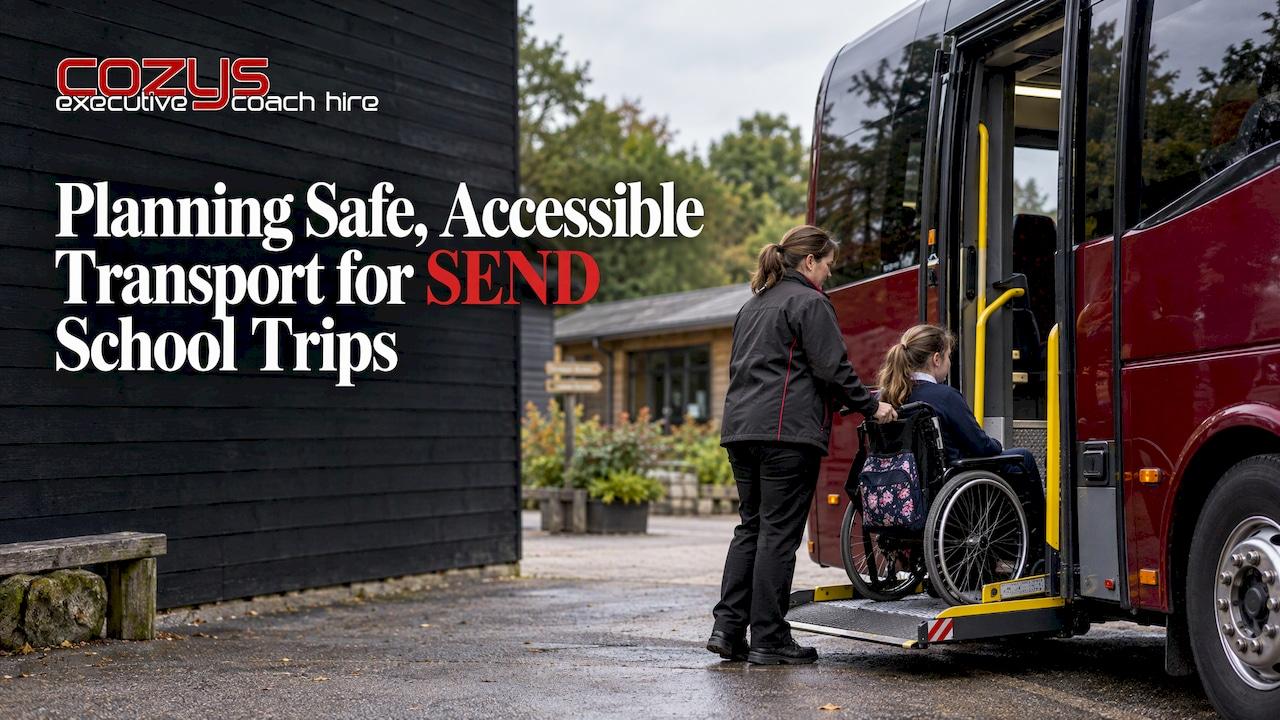
SEND school trip transport is the vehicle, the people and the planning that get pupils with special educational needs and disabilities to a visit and back safely, on the same terms as their classmates. It is a different job from daily home-to-school transport. The school, not the local authority, is usually the organiser, so the school writes the risk assessment, chooses the vehicle and decides who travels with each pupil. This guide sets out what to assess, what to check on the vehicle and the operator, and how to prepare pupils and families.
TL;DR
- Start with an individual assessment of each pupil's mobility, medical, communication and supervision needs. Build the transport plan from that, not from the nearest available coach.
- Check the vehicle for access, seating, seatbelts and wheelchair securement, and make sure staff are trained to use the equipment.
- Home-to-school travel assistance and trip transport are separate. Eligibility for one does not decide what a school must arrange for the other.
- Tell families the route, timings, boarding point and who is travelling with their child well before the day.
- Rules differ across England, Scotland, Wales and Northern Ireland, so follow your own authority's visits policy.
Table of Contents
- How trip transport differs from home-to-school transport
- What the law and local policy expect from the school
- Assess each pupil's needs before choosing a vehicle
- What the vehicle needs to provide
- Staffing, safeguarding and first aid on board
- Questions to put to a coach operator
- Planning the day with families and pupils
- How the school trip fits with daily SEND travel
- Perspective
- Plan your next trip with Cozy Travel
- FAQ
- Sources
How trip transport differs from home-to-school transport
Home-to-school transport is a statutory service run by the local authority for eligible children. In England, children who cannot reasonably be expected to walk to school because of SEND, disability or mobility difficulty are entitled to free transport regardless of distance, after an individual assessment, whether or not they have an EHC plan. The authority decides the form that assistance takes. Current GOV.UK guidance says it must suit individual needs, support wellbeing and enable a safe, timely arrival.
A school trip sits outside that arrangement. The school plans the excursion, so the school carries the duty to make it workable for every pupil. Excursion policies, such as Perth and Kinross Council's guidance, treat accessibility as part of ordinary visit planning: identify hazards, control risks, define responsibilities and consider reasonable adjustments for participants with additional support or medical needs.
The practical consequence is that a pupil who has a taxi with an escort every morning may need something quite different on a day trip. A coach carrying 50 pupils for two hours is a different environment from a five-minute taxi ride. The arrangement that works at 8am does not automatically transfer.
If you want the wider picture on eligibility, rights and appeals for daily travel, our guide to SEND transport guidance for the UK covers it.

What the law and local policy expect from the school
Two duties shape most decisions.
Reasonable adjustments. Under the Equality Act 2010, responsible bodies must make reasonable adjustments so that disabled participants are not placed at a substantial disadvantage. The same policies note that this does not require placing anyone at inappropriate risk, as set out in a school educational visits policy. In practice, the first question is what change would let the pupil take part safely, not whether the pupil can be accommodated at all.
An enhanced risk assessment. Devon County Council's guidance for schools says an Enhanced Risk Assessment should specify the pupil's physical or medical needs and consider transport, the destination, activities and stop-offs. It also says adventurous or overseas trips need approval from the local authority advisor, and that where an activity cannot be adapted, an alternative of equal educational value should be arranged for all pupils.
Your own authority's policy governs the detail. The UK framework is not identical: Wales, for example, has its own Learner Travel Measure, under which a learner unable to walk because of disability or learning difficulty must receive suitable travel arrangements even below the usual distance threshold. Scottish and Northern Irish schools should work from their own council or education authority procedures.
Assess each pupil's needs before choosing a vehicle
The vehicle comes last. Start with the pupil. A workable assessment covers five areas.
| Area | What to establish | Transport decision it drives |
|---|---|---|
| Mobility | Walks unaided, uses a walking aid, uses a manual or powered wheelchair, can manage steps | Lift or ramp, boarding time, seat position, securement |
| Medical | Medication, seizures, feeding or continence needs, allergies | First aid cover, medication storage, comfort-stop plan |
| Communication | Speech, signing, symbols, need for a familiar adult | Seating beside a known adult, visual schedule for the journey |
| Sensory and behavioural | Noise, crowding, changes to routine, travel anxiety | Seat choice, quieter boarding, preparation before the day |
| Supervision | Ratio of adults to pupils, one-to-one support, training | Number of staff on board, who sits where |
Devon's guidance also asks organisers to check venue and transport accessibility and to consider the number and training of supporting adults. Talk to parents and carers and, where appropriate, the pupil. They usually know what makes a journey go well and what has gone wrong before.
Write the assessment well ahead. Excursion guidance expects risk assessments to be completed well in advance and approved by an authorised person, covering transport, supervision, participant requirements, medical needs and emergency procedures. If your authority recommends recording visits on EVOLVE, do so: Devon notes that it reduces bureaucracy and provides a robust audit trail.
For a structured way to check the transport part, see our coach risk assessment checklist.
What the vehicle needs to provide
Devon's guidance is direct: check that the transport has suitable access, seating, seatbelts and wheelchair securement, and that staff are trained to secure wheelchairs or pupils. Use this as a pre-booking list.
- Boarding. Does the vehicle have a lift or ramp that suits the pupil's chair, and is there a trained person to operate it?
- Wheelchair spaces. How many are available, and are they positioned so that the pupil can sit with a friend or adult?
- Securement. Is the chair secured with the proper restraint system, and is the pupil wearing the correct belt?
- Seatbelts. Leicester City Council's guidance advises hiring from a reputable company and ensuring coaches have seatbelts, and school policies say the same: schools should insist on seatbelts on coaches used for visits.
- Luggage and equipment. Is there room for a spare chair battery, a standing frame, medication bags or a changing mat?
- Climate and noise. Can the vehicle be kept at a comfortable temperature, and can a pupil who finds noise difficult sit away from the loudest areas?
If a wheelchair is used as a vehicle seat, Devon's guidance says it should carry a DCC tag or be verified as safe and suitable. Check your own authority's equivalent. On seat fit, our note on three-point seatbelts explains what to confirm, and our wheelchair accessible coach standards guide covers the vehicle side in more depth.
Staffing, safeguarding and first aid on board
The adults on the coach matter as much as the vehicle. Decide before the day who is responsible for each pupil on the journey, who handles boarding, and who is the named contact for the driver.
- Ratios and training. Base the number of supporting adults on the assessment, not on a standard ratio. Consider whether any pupil needs a trained one-to-one.
- Safeguarding. Devon's guidance says adults attending should be DBS checked or supervised. Make sure the operator's driver and any passenger assistant are covered by the checks your policy requires.
- First aid. School policy expects a supervising adult able to administer first aid and suitable equipment on trips, per the educational visits policy. Agree where individual medication travels and who holds it.
- Private cars. Using a staff or parent car is not a shortcut. The same policy requires the headteacher's approval and a Private Car Form kept by the school. For a group including pupils with SEND, a professionally operated vehicle is usually the more manageable choice.
Questions to put to a coach operator
Your policy may require you to use an approved list. Devon, for example, tells schools to check its current approved bus and coach operators list. Whatever your authority's rules, ask the operator these questions in writing when you request a quote.
- Which vehicle will be used, and how does its access equipment suit our pupils' chairs?
- Do all seats have seatbelts, and which seats suit pupils who need extra support?
- Who is the driver, and how experienced are they with groups that include pupils with SEND?
- What is the plan if the vehicle breaks down or a pupil becomes unwell?
- Can the same driver and vehicle run the outbound and return legs, so pupils see a familiar face?
- What are the waiting and loading times at the venue?
Our coach booking playbook walks through the booking sequence and the DVSA checks organisers can make, and our guide to coach capacity from 16 to 85 seats helps you size the vehicle once wheelchair spaces and staff are counted.
Planning the day with families and pupils
The journey is where many trips succeed or fail for pupils who rely on routine. Plan these points with parents, carers and the pupils themselves.
Boarding and drop-off. Agree where the coach stops at school, which door pupils use and how long boarding will take. Pupils who use lifts or need medication before departure should board first or in a quieter window, so they are not waiting in a crowd.
Journey time. Share the expected duration and comfort-stop plan. A long journey may need a staged route with planned breaks, and the return leg should be timed so that families can meet pupils at the usual pick-up point.
Preparation. Show pupils the vehicle, a photo of it or a short visual schedule beforehand. Our article on autism friendly travel sets out how familiar routines and clear information reduce anxiety for families on group trips.
Communication with parents. Send one clear message with the departure time, route, who is travelling with their child, what to pack and an emergency contact. Our guide to parent communication in school transport has a practical structure you can adapt.
Monitoring on the day. Risk assessment does not end at departure. Local authority guidance asks staff to monitor risks throughout a visit and modify or curtail activities when circumstances change. On the coach, that might mean an extra stop or a changed seating plan.
How the school trip fits with daily SEND travel
GOV.UK guidance gives local authorities flexibility: they may use shared vehicles and reasonable pickup points, and single-occupancy vehicles are only necessary in specified circumstances. Contact notes that daily assistance may be a pass, dedicated bus, shared taxi or minibus, individual taxi, travel training or a mileage allowance with consent.
For trips, a school can often mirror what works day to day: the same escort, a similar seating position, a comparable boarding routine. Ask the family and the daily transport provider what already works, and carry it across where you can.
Perspective
We run group travel for schools, colleges and local authorities, and our fleet runs from 16 to 85 seats, so we see how often trip transport is decided too late. The vehicle is booked first and the access questions arrive a week before departure.
Our advice is to reverse the order. Settle who is travelling, which chairs and equipment come along and how many adults are needed, then choose the vehicle. A school that does this can give an operator a precise brief, and a precise brief gets a precise quote.
This is the work our team is set up for. We provide accessible transport for wheelchair users, home-to-school travel for local authorities and private schools, and a safety record that includes the highest 6-star BUSK rating. We have been a family-run operator for over four decades, and school and community groups are central to what we do.
Cozys
Plan your next trip with Cozy Travel
Cozy Travel offers coach and minibus hire for schools and colleges, accessible transport for wheelchair users, and group travel for community organisations. If your next excursion includes pupils with SEND, tell us the group size, the equipment and the supervision plan, and we will help match the vehicle to the group.
See our Schools & Colleges service, our accessible transport specialists or our general coach hire page to send a booking request. If you manage transport for a private school, our guide to private school transport options is a useful starting point.
FAQ
Who is responsible for arranging transport on a school trip for a pupil with SEND?
The school organising the trip is responsible for planning it, including transport. That means completing a risk assessment that covers the pupil's needs, choosing a suitable vehicle and arranging supervision. Local authority home-to-school travel assistance is a separate duty and does not usually cover excursions.
Does a pupil with an EHC plan automatically get free transport to a school trip?
No rule links an EHC plan to free trip transport. In England, daily travel assistance is based on an individual assessment of whether a child can reasonably walk to school, with or without an EHC plan. For trips, the school's own policy and the reasonable adjustments duty apply, so check your visits policy and ask your authority if unsure.
Do coaches on school trips need seatbelts?
Local authority and school policies in England advise that schools should insist on coaches with seatbelts for visits. Leicester City Council, for instance, advises hiring from a reputable company and confirming that seatbelts are fitted. Ask the operator to confirm this in writing when you book.
What if a pupil uses a wheelchair?
Check that the vehicle has suitable access and wheelchair securement, and that staff are trained to use it. Where the wheelchair is used as a vehicle seat, check whether your authority requires it to be tagged or verified. Tell the operator the chair type and any equipment when you request a quote.
Are the rules the same across the UK?
No. England, Scotland, Wales and Northern Ireland each have their own legal framework for learner travel and their own authority guidance on visits. Follow the policy of your own local authority or education authority.
Sources
- Delivering effective travel assistance to schools and colleges, GOV.UK
- School transport in England, Contact
- School trips: support for schools and settings, Devon County Council
- Trips and Excursions Policy, Perth and Kinross Council
- Educational Visits Policy 2025
- Offsite Visits and Adventurous Activities SMS, Leicester City Council
- Guidance for Off-Site Visits, London Borough of Hammersmith and Fulham
- Learner Travel statutory provision and operational guidance, Welsh Government
Recommended
- Wheelchair Group Transport Options for UK Organisations
- Parent Communication in School Transport: A Practical Guide
- SEND Transport Guidance for the UK: Rights, Eligibility and Appeals
- Wheelchair Accessible Coach Standards: A UK Buyer's Guide
This article is produced as general information only and is not professional advise.