
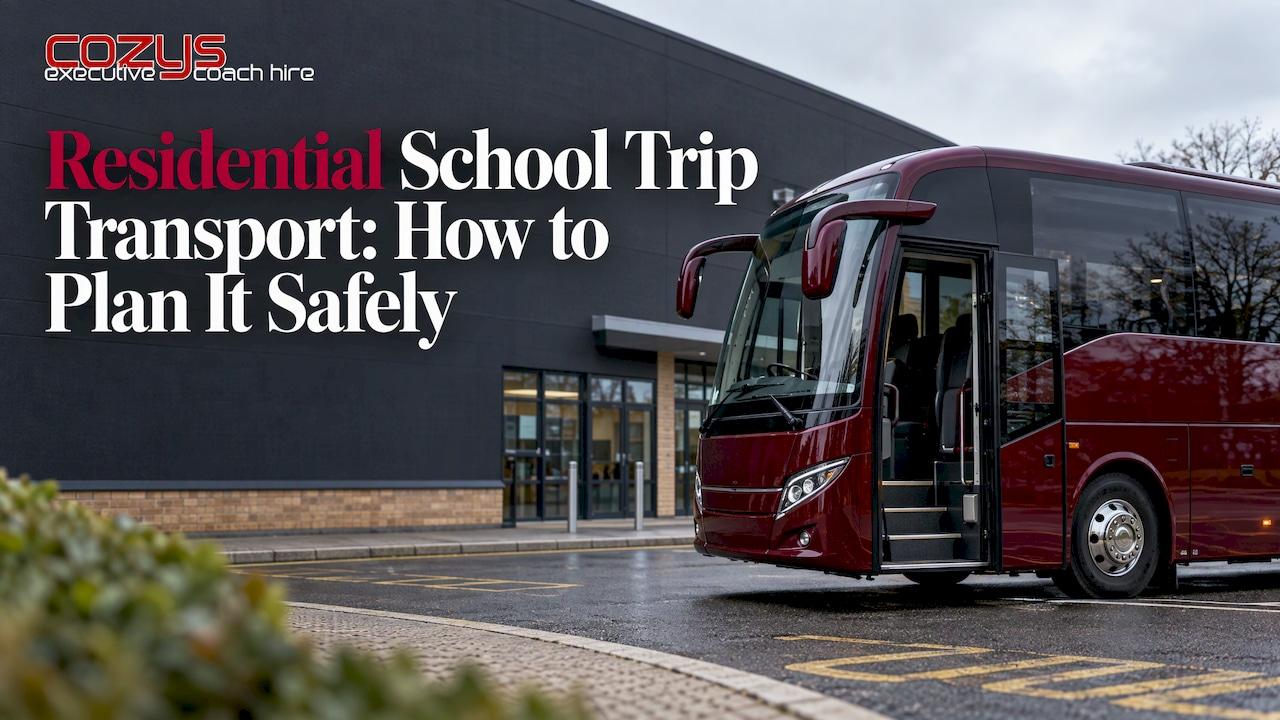
Residential school trip transport is best arranged as a written plan that covers the vehicle, the route, the operator, supervision and a contingency, agreed before the booking is confirmed. For most residential groups, a licensed coach with seat belts, booked early and matched to the exact passenger list, is the practical choice. This guide sets out what a trip leader, a school business manager or a local authority officer should settle, and in what order.
TL;DR
- Build the transport plan from an accurate list of pupils, staff, luggage and mobility needs, then choose the vehicle. Do not choose the vehicle first.
- The employer, usually the local authority or governing body, must be satisfied that hired coaches are suitable. In practice the headteacher usually carries out the checks.
- The visit leader stays responsible for pupils throughout the journey, including stops. The driver concentrates on driving.
- Identify accessibility needs at the planning stage, so that step-free or wheelchair-secured seating is confirmed with the operator in writing.
- Agree a breakdown and backup plan with the operator before departure, not on the hard shoulder.
Table of Contents
- Which transport suits a residential trip
- Build the journey plan first
- Checking the operator, the driver and the vehicle
- Supervision and safeguarding on the journey
- Making transport accessible for every pupil
- Overnight and long-distance journeys
- When the plan changes: breakdowns and delays
- What to tell pupils, parents and staff before departure
- Residential trip transport with Cozy Travel
- Our perspective
- Frequently asked questions
- Sources
Which transport suits a residential trip
A residential visit has features that a day trip lacks. Pupils travel with luggage, the journey is often long, and the group usually needs to arrive and depart together. General school travel guidance lists the usual options as walking, cycling, car, rail, minibus, coach or bus, ferry and air, and says the choice should reflect accessibility, environmental impact and the group's independence.
For most UK residential trips, the decision comes down to minibus, coach or rail:
| Option | Where it fits | Points to settle |
|---|---|---|
| Minibus | Small groups, such as a single class or a sports team, and sites with limited access | Driver entitlement, vehicle licensing and training if the school's own minibus is used |
| Coach | Year groups, whole-class trips and trips with substantial luggage | Seat count against passengers and staff, seat belts, luggage space, driver hours |
| Rail | City destinations with good station links | Reserved seating for the whole group, onward transfers, luggage handling |
If you are weighing coach against rail, our coach versus train checklist for organisers covers the questions to ask before you book. A coach keeps the group together door to door, and one driver and one vehicle mean fewer transfers to supervise.
Capacity needs thought as well. Staff, adult helpers and luggage all take space, so work from the real headcount rather than the number of pupils. Our coach capacity guide for group planners explains how seat counts from 16 to 85 relate to group size.
Build the journey plan first
The Department for Education's guidance on health and safety of pupils on educational visits expects the group leader to plan for passenger safety, driver competence and licensing, driving hours and fatigue, traffic, weather, journey distance, rest stops, insurance and contingencies for breakdowns and emergencies. Turn that into a one-page plan the operator can work from.
What the plan should contain
- An accurate passenger and staff list. Names, ages, and any medical, behaviour or mobility requirements.
- Destination access. Can a full-size coach reach the entrance, or is there a drop-off point nearby? Is the site's parking suited to the vehicle?
- Luggage. Residential trips carry bags, bedding and equipment. Tell the operator in advance, because it affects the vehicle and the loading time.
- Route and journey time. Include expected traffic and weather, and the rest stops you intend to make.
- Safe pick-up and drop-off points. Choose places where pupils can board and alight away from moving traffic, with enough adults to supervise.
- Driver hours and rest. Agree these with the operator in advance, particularly for long journeys.
- A contingency route and plan. What happens if the road closes or the vehicle cannot continue.
Reserve seats so that the group can travel together, and leave the written plan and emergency contacts with school management. Oxfordshire's guidance on transporting children and young people adds that staff on the journey should carry the passenger and adult list, emergency contacts, any relevant health or behaviour plans and a charged phone, as set out in the council's guidance.
If you book through a coach operator, our coach booking playbook for organisers walks through the booking sequence, including the DVSA checks you can ask about.
Checking the operator, the driver and the vehicle
Responsibility for hired transport does not pass to the operator. The DfE guidance says the employer, usually the local authority or governing body, should satisfy itself that all travel arrangements, including hired coaches and buses, are suitable for the visit. Headteachers commonly perform these checks.
A sensible pre-booking check covers:
- The operator. It should be reputable, appropriately licensed and insured. A guidance document on trips and residential visits published in October 2024 also advises using a reputable transport provider.
- The vehicle. It should suit the route, the group size, the seat-belt requirement and any accessibility needs.
- The driver. They should hold the correct entitlement, be competent, and work to an adequate hours-and-rest plan.
- School-owned or hired minibuses. Verify the applicable PSV or Section 19 requirements and driver training, as the DfE guidance advises.
Seat belts deserve a specific mention. The DfE guidance says seat belts must be available for pupils, that buses without them are normally unsuitable for long journeys, and that the driver is responsible for ensuring pupils have and use them. A residential journey is usually a long one, so confirm belts on every seat when you request the quote.
People working with children are a separate question. Our guide to coach driver DBS checks explains what to ask an operator about driver vetting, and our coach risk assessment checklist lists the eight checks organisers need before booking.
Supervision and safeguarding on the journey
The DfE guidance is clear on who is in charge. The group or visit leader remains responsible for pupils and discipline throughout travel, including stops and transitions, while the driver normally concentrates on driving rather than supervision. The guidance on trips and residential visits takes the same line: the leader keeps ultimate responsibility even when participants are temporarily in the care of a coach driver or other third party, and should withdraw the group if concerns are not resolved.
In practice, that means a supervision routine written into the plan:
- Risk-assess the supervision ratio for the journey, not just for the destination.
- Count at every transition. Do a headcount at boarding, at each stop and on leaving each stop, and again on arrival.
- Position staff deliberately. One adult near the door and one towards the back is a common arrangement, and the school's own risk assessment should decide.
- Check seat belts before the vehicle moves.
- Brief pupils on behaviour and what to do in an emergency before departure.
Supervision has to continue at motorway services and other rest stops, where the group is in a public space and pupils are most likely to drift. Allocate adults to specific groups of pupils before anyone leaves the coach.
Drivers should also be able to raise concerns. If the visit leader sees speeding, tiredness, aggressive driving or a poor attitude, the same guidance says to raise it promptly with the operator and to consider stopping the journey if it is not resolved. That is a useful reason to have a named contact at the operator's office on the day.
Making transport accessible for every pupil
Accessibility belongs in the first draft of the plan. The DfE guidance says to identify needs during planning and select a vehicle with suitable step-free or ramp access, a wheelchair space and approved securing facilities. Portable ramps should be considered only where appropriate and safe.

The law supports this. The Equality Act 2010 requires reasonable adjustments where a provision, criterion or practice, a physical feature or the lack of an auxiliary aid places a disabled person at substantial disadvantage, and information may need to be provided in an accessible format. The Act also provides that failing to comply with these requirements is discrimination. For a school, the practical lesson is to ask about wheelchair capacity and securing equipment at the time of the enquiry, not the week before travel.
A short accessibility checklist for the operator:
- How many wheelchair positions does the vehicle have, and how are the chairs secured?
- Is access by lift or ramp, and is the equipment tested and in working order?
- Where will the pupil's wheelchair, spare equipment and medical supplies be carried?
- How will the pupil's seat be arranged so they travel with their friends and their support staff?
- Is the destination drop-off point step-free?
Our accessible transport service is built around these questions, and we are happy to talk through the requirements of a specific group.
Overnight and long-distance journeys
Some residential trips involve travelling at night or very early in the morning to save a night's accommodation or to reach a distant destination. Driver hours and rest become the central issue, and the group leader should agree them with the operator in advance. Our guide to overnight coach travel sets out how UK groups can approach this and what rules apply.
For children, the journey should also be suitable for their age. The October 2024 trips guidance asks organisers to consider the age suitability, length and complexity of the journey, along with weather and the needs of participants with limited mobility. A shorter daytime journey with a planned stop is often easier to supervise than a long overnight one.
When the plan changes: breakdowns and delays
Even well-run coaches break down, and roads close. The DfE guidance advises using the contingency plan, keeping pupils under direct supervision and communicating with the school, the operator and emergency contacts. After a breakdown or accident, pupils should stay in the vehicle unless the location is dangerous. If it is, move them in an orderly way to a safe place and wait for authorised alternative transport, reassessing whether the revised plan remains safe.
A local authority's school transport code of conduct adds two points: pupils in the vehicle should not be left unattended, and they must not leave with an unauthorised adult. The school and parents or carers should be notified, as stated in Perth and Kinross Council's code.
Before departure, ask the operator:
- How quickly can a replacement vehicle reach the group, and from where?
- Who at the operator's office will answer the phone on the day, and at what hours?
- Will the replacement have the same seat count, seat belts and accessibility equipment?
Our guides to the breakdown contingency plan and backup coach provision go through what to put in writing.
What to tell pupils, parents and staff before departure
Good information reduces problems on the day. The trips guidance suggests giving parents written information on the activities and learning objectives, the venue, domestic and sleeping arrangements, medical provision and first aid, supervision, travel, insurance and conduct expectations. Pupils should be briefed on the code of conduct.
For the coach itself, a short pupil briefing covers the essentials: arrive on time, stay seated with seat belts fastened, keep aisles clear, avoid distracting the driver and follow staff instructions when crossing roads. These points are set out in general school travel guidance. Give staff a one-page version with the headcount routine, the emergency contacts and the operator's office number.
Residential trip transport with Cozy Travel
We are a family-run operator and have provided group transport for over four decades. Our fleet runs from 16 to 85 seats, and we hold the highest 6-star BUSK safety rating. For schools, we provide coach hire for trips and residentials and arrange school and college transport to suit the group.
If your group includes wheelchair users, tell us at the first enquiry so that we can match the vehicle to the need. If your school or trust wants a lower-emission option, ask about our hybrid coach, which we describe as the UK's first. Send us your passenger numbers, destination and dates through the site and we will build the plan around them.
Our perspective
Schools usually come to us with a date and a destination. The better question to start with is who is travelling, because the answer decides the vehicle, the seat count, the loading time and the supervision plan.
We have run group transport for over four decades, and the residential trips that go smoothly share one habit: the school tells the operator everything early. Luggage volume, a pupil who needs a wheelchair space, a second pick-up point, a preferred rest stop. Each one is easy to plan for in October and difficult to fix in the car park on departure morning.
Our fleet of 16 to 85 seats exists so that the vehicle fits the group and not the other way round. A 6-star BUSK safety rating is something we are proud of, and we regard it as a baseline for school work rather than a selling point. We also believe schools should expect an operator to discuss driver hours, breakdown cover and accessibility without being asked.
Our advice is simple: write the plan down, agree it with the operator, and keep the visit leader's responsibilities clear from the first headcount to the last.
Cozys
Frequently asked questions
Who is responsible for pupils on a hired coach?
The visit leader remains responsible for pupils and discipline throughout the journey, including stops. The driver's job is to drive safely. The employer, usually the local authority or governing body, must also be satisfied that the hired transport is suitable, and the headteacher usually carries out the checks.
Do school coaches need seat belts?
The DfE guidance says seat belts must be available for pupils, and that vehicles without them are normally unsuitable for long journeys. Residential trips are usually long, so confirm belts on every seat when you request a quote. Pupils should be briefed to keep them fastened, and the driver is responsible for ensuring they are used.
How early should we book residential trip transport?
Book as soon as the dates and the destination are fixed, and send the operator your passenger and luggage details. Early booking makes it easier to reserve the right seat count and any accessibility equipment. We do not publish a fixed lead time, so contact us with your dates and we will advise.
What should happen if the coach breaks down?
Follow the contingency plan. Keep pupils supervised, and keep them in the vehicle unless the location is dangerous. If it is, move them in an orderly way to a safe place. Notify the school, the operator and parents or carers, and wait for authorised replacement transport.
How do we arrange transport for a pupil who uses a wheelchair?
Raise it in the first enquiry. Ask for a vehicle with ramp or lift access, a wheelchair space and approved securing facilities, and confirm the arrangements in writing. The Equality Act 2010 requires reasonable adjustments where a disabled person would otherwise be at substantial disadvantage.
Sources
- Health and Safety of Pupils on Educational Visits, Department for Education
- Transporting Children and Young People, Oxfordshire County Council
- Guidance on Trips and Residential Visits, October 2024
- Equality Act 2010, adjustments for disabled persons
- Equality Act 2010, section 21
- School Transport Operator, Driver and Escort Code of Conduct, Perth and Kinross Council
- Travel: General, Beyond The Gates
Recommended
- Private School Transport Options: A Guide for UK Schools
- Avoid Unlicensed Operators: 4 Legal Checks for UK Group Transport
- Parent Communication in School Transport: A Practical Guide
This article is produced as general information only and is not professional advise.