
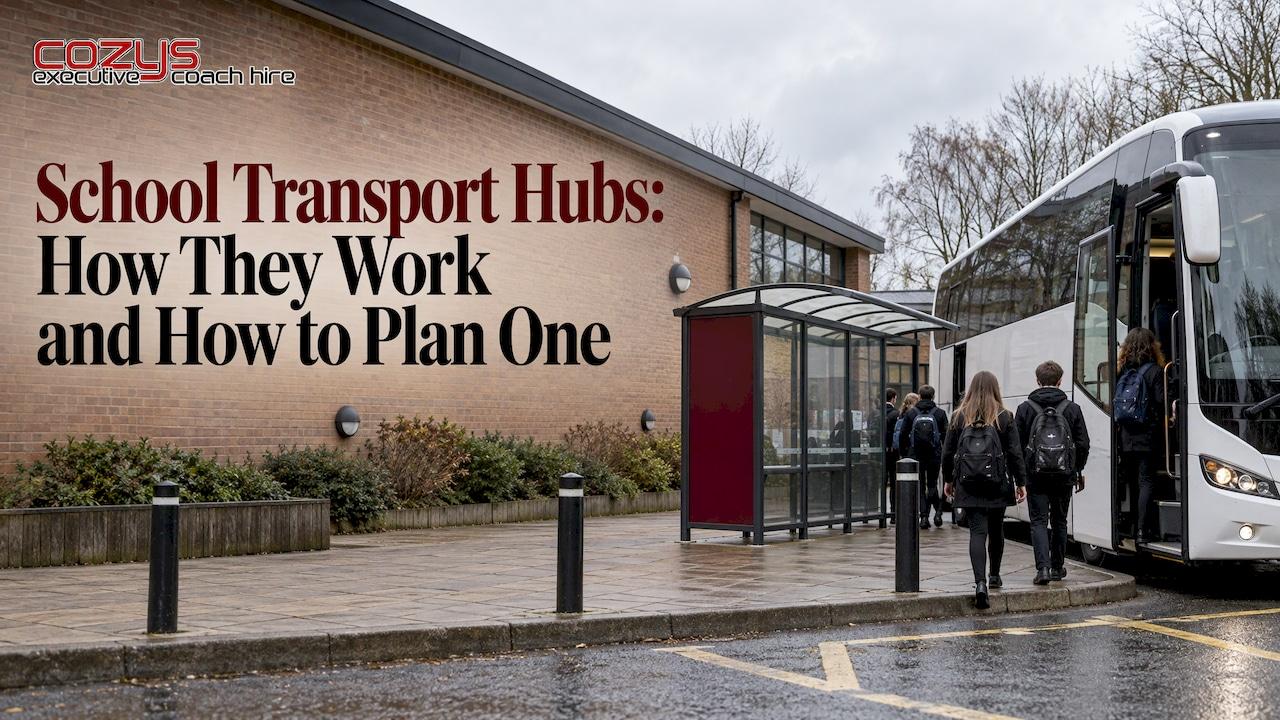
A school transport hub is a safe, designated place near a school or in a community where pupils are picked up and dropped off, and where different ways of travelling meet: buses, coaches, minibuses, walking and cycling. It works when the vehicles that serve it are reliable, accessible and matched to the pupils who use them. For local authorities and schools, the hub is the place on the map, and the operator is what makes it function every morning and afternoon. At Cozy Travel we run home-to-school transport for local authorities and private schools with vehicles from 16 to 85 seats, so this guide covers both the hub and the service that runs through it.
TL;DR
- A school transport hub is a safe pick-up and drop-off location that links home-to-school services with walking, cycling and public transport. It is a narrower, school-focused version of a mobility hub.
- Government guidance says a hub should be close to homes, for example within 800 metres or a 10-minute walk, with step-free access, lighting, clear signage and agreed management arrangements.
- Plan from a needs assessment and an infrastructure audit, and keep within the DfE's best-practice maximum journey times of 45 minutes for primary and 75 minutes for secondary pupils.
- Measure the result: councils report gains in walking and cycling and fewer car journeys where school-gate schemes are monitored.
- Vehicle size, accessibility and contingency cover decide whether a hub works day to day.
Table of Contents
- What a school transport hub is
- What a hub can bring together
- Planning a hub: the order that works
- Where coaches and minibuses fit
- Schemes already operating in the UK
- How to tell whether a hub is working
- Our view as a school transport operator
- Talk to us about school transport
- FAQ
- Sources
What a school transport hub is
The phrase has no single legal definition in the UK, so it helps to start from the two ideas it combines.
The first is the mobility hub. GOV.UK's sustainable placemaking guidance for mobility hubs describes a place that brings together active travel, shared transport and public transport with amenities. It differs from a conventional interchange because it also integrates non-transport components, such as community facilities, so that people travel less and rely more on their neighbourhood.
The second is the home-to-school pick-up point. Essex County Council's September 2024 guide to mobility hubs and integrated transport halts describes Community Hubs in rural areas that include safe pick-up and drop-off locations where parents can put children onto school services, alongside micro-mobility and storage for first and last mile links, and village hall facilities such as toilets and shelter.
A school transport hub sits where these two meet. It is a mobility hub whose first job is the school commute. That distinction matters for planning: a general hub is judged on many journey types, while a school hub is judged on whether children arrive safely, on time and without stress, and whether the vehicles can load and leave without blocking the street.
Who needs to think about hubs
- Local authorities that must assess travel needs and arrange transport for eligible pupils.
- Private schools and colleges that run their own coach or minibus networks and want to cut congestion at the gate.
- Community organisations that want accessible travel for children and young people with additional needs.
- Corporate and tour clients who share a site with a school, or whose coaches use the same roads at the same hours.
What a hub can bring together
The more journey types a hub connects, the more it should offer in the way of facilities. GOV.UK's mobility hub guidance says the more transport interchanges a hub enables, the greater the range of other components it should provide. It also says a hub should be reasonably close to people's homes, for example within 800 metres or a 10-minute walk.
For a school hub, the practical components are:
- A defined pick-up and drop-off bay for coaches and minibuses, separate from private cars where space allows.
- Safe walking, wheeling and cycling routes to the hub, with crossings and step-free access.
- Shelter, seating and lighting for pupils waiting, particularly in the dark winter months.
- Cycle or scooter storage for pupils who combine active travel with a coach or bus.
- Clear signage and wayfinding, so drivers, escorts, parents and pupils know where each service stops.
- Space for passenger assistance, including wheelchair access to vehicles and room to deploy a lift.
The travel arrangements a hub can connect are broader than the school bus. Warrington's 2026 to 2027 policy, summarised in the research for this guide, lists independent travel training, bus and rail passes, walking buses, cycle allowances, personal transport budgets, dedicated school bus places and shared or individual minibuses and taxis. A hub is the physical point where several of these can meet.
Other countries treat the same idea as part of public transport planning. Denmark's mix of trains, buses, metro and ferries shows how connecting modes at one stop shortens the final leg of a journey, which is the same logic a school hub applies to the walk from a coach stop to the classroom.
Planning a hub: the order that works
The Department for Education's home-to-school travel guidance, published through Haringey Council, sets out what local authorities must do under Section 508A of the Education Act: assess travel needs, audit sustainable travel infrastructure, publish a strategy, and consider special educational needs, disability and safety issues such as bullying on school buses. A hub plan should follow the same sequence.
1. Assess the need
List where pupils live, which schools they attend, and which of them are eligible for assistance. Include pupils with SEN or disabilities from the start, because their needs set the vehicle specification and the pick-up arrangements. Newer GOV.UK travel assistance guidance for local authorities, published in October 2026, says assistance must suit the child's needs, support wellbeing, enable safe and on-time arrival, and build independence.
At this step, a transport operator can describe what vehicles and staffing a pupil group needs. We provide accessible transport for wheelchair users, and our guide to wheelchair accessible coach standards sets out what to specify.
2. Audit the infrastructure
The DfE guidance asks authorities to audit bus and public transport routes, footpaths, cycle ways, crossings, 20mph zones, travel training and park and stride or park and ride schemes. For a hub, add the practical questions about the site itself: where can a 49-seat or 70-seat coach turn, how long does it need to stand, and is the kerb suitable for a lift?

3. Choose the location
Buckinghamshire's mobility hubs guidance says hubs should be in an open, accessible location, with priority for walking, wheeling and cycling, safe direct pedestrian and cycle connections, maximised natural surveillance, adequate lighting, step-free access, clear wayfinding and low-maintenance infrastructure. Those criteria suit a school hub directly. A hub tucked behind a building or reached across an unlit car park fails them, whatever its capacity.
4. Set journey times and pick-up rules
The DfE guidance gives best-practice maximum journey times of 45 minutes each way for primary-age pupils and 75 minutes for secondary-age pupils. It warns against several public transport changes that make a journey unreasonably long. It also says authorities may use pick-up points at their discretion, provided the arrangements are safe and reasonably stress-free.
That last phrase is the test for a hub. A pick-up point that adds a long walk in the dark, or a wait with no shelter, does not meet it, however neat it looks on a plan.
5. Agree who runs it
Buckinghamshire's parking standards for new developments require mobility hubs to have agreed operational and management arrangements, covering continuity of service, network integration, safe and inclusive use, and the ability to adapt to changing demand. For a school hub, name who maintains the shelter, who manages the bays at peak times, and who decides what happens when a vehicle is late or off the road. Our guide to home-to-school contingency cover covers the last point.
6. Phase it and measure it
Buckinghamshire's draft guidance phases hub components to Travel Plan milestones. Minimum facilities must be operating before baseline surveys at six months after occupation or at 50% occupation, whichever comes first. Schools and councils outside new developments can borrow the principle: open a working minimum first, then build up.
Where coaches and minibuses fit
An open hub gives pupils somewhere safe to wait. It does not carry them. The service that does is a coach or minibus contract, and the details of that contract decide whether the hub earns its place.
| Hub question | What the vehicle side must answer |
|---|---|
| How many pupils use this stop? | Vehicle size, from a 16-seat minibus to an 85-seat coach, so one vehicle replaces several smaller ones |
| Can every pupil board? | Wheelchair-accessible vehicles and trained crew where needed |
| Does the stop work at peak times? | Staggered arrival slots, so vehicles do not queue on the road |
| What if a vehicle fails? | A contingency plan agreed before term starts |
| Does it support active travel? | Routes that let pupils walk or cycle to the hub, then ride |
The GOV.UK travel assistance guidance notes that larger buses and coaches bring economies of scale on routes that are similar, and that many children can walk to a safe pick-up point near home. A hub is what makes both statements work together: children walk a short, safe distance, and one larger vehicle serves the stop.
Costs are the reason authorities look at this. Argyll and Bute Council's August 2025 school and public transport review, a Scottish example, reports home-to-school bus services for pupils within a two-mile walking distance costing over £1,440,000 a year in tender costs, with taxi hires alone above £400,000 a year, a quarter of the total. Its options include minibuses serving larger areas and routing pupils onto larger bus services. The same review found that better route coverage, better connections between buses, ferries and rail, and better waiting facilities were the leading accessibility improvements respondents wanted. Consolidating pick-ups at well-designed points answers all three.
If you tender for this work, our guide to school transport tenders in the UK explains how operators are assessed, which helps councils write a specification that fits a hub.
Schemes already operating in the UK
School Streets are the best-documented neighbour of the school transport hub, because they also redesign the school gate and must deal with school vehicles.
- Southampton has 20 permanent School Streets, operating from 08:00 to 09:30 and 14:15 to 15:45. Roads are closed to motor vehicles except walking, wheeling, cycling and buses on bus routes. Council-contracted school transport may pick up or drop off pupils within a School Street or serve the affected school, and the operator's vehicle number plate is added to the permitted list. The operator is responsible for keeping that list up to date.
- Peterborough monitors its School Streets and reports an 18% increase in walking and cycling and fewer car journeys at all participating schools.
- Birmingham's Car Free School Streets began in September 2019, and its second phase added six new schools. The scheme closes the road outside the school to most vehicles at drop-off and pick-up, alongside Modeshift STARS travel plans.
- Wiltshire is running an 18-month trial at four primary schools under Experimental Traffic Regulation Orders, with ANPR enforcement and permits for pre-arranged school transport. Two other schools were dropped from the trial over access concerns for carers and deliveries.
The lesson for hub planning is practical. Wherever the road is restricted, school transport needs a permit, a registered plate and a clear stopping point. An operator that handles permit administration, keeps vehicle details current and briefs drivers on the rules is part of the scheme's reliability.
How to tell whether a hub is working
Set measures before opening, not after. Useful ones draw on what the schemes above report:
- Mode share: the proportion of pupils walking, cycling, using the coach or arriving by car, against a baseline survey.
- Journey times: actual door-to-door times against the 45 and 75 minute best-practice limits.
- Punctuality: arrivals before the first bell, and the number of missed or late services.
- Safety and conduct: incidents at the stop, on the vehicle and on the approach route.
- Access: how many pupils with additional needs can use the hub independently or with their planned support.
- Neighbourhood effect: congestion, parked vehicles and resident complaints near the stop.
Oxfordshire's April 2026 report and Peterborough's data both show why this matters: school-gate schemes are judged on measurable changes in active travel and car use, not on opinion. Buckinghamshire's baseline survey requirement builds the same discipline into hub delivery.
Our view as a school transport operator
A hub is only as good as the vehicle that arrives at it. We have provided specialised group travel for over four decades, and school contracts are where reliability shows most clearly: the same pupils, the same stop, every day, in every kind of weather.
Our fleet runs from 16 to 85 seats, so a council or school can match the vehicle to the demand at each hub rather than overserving a quiet stop or overloading a busy one. We include accessible transport for wheelchair users, because a hub that some pupils cannot board is not a hub for the community it serves. We also operate the UK's first hybrid coach, which fits the sustainable travel aims that hub guidance sets out.
We hold the highest 6-star BUSK safety rating, and we work with local authorities and private schools on home-to-school transport. Our advice is to involve the operator at the audit stage, before the location and bay layout are fixed. The questions of turning space, kerb height, loading time and timing are far cheaper to settle on paper than after the shelter is built.
Cozys
Talk to us about school transport
If you are a local authority, a private school or a college looking at home-to-school transport, our Schools & Colleges service covers coach and minibus transport for pupils, and our accessible specialists provide transport for wheelchair users. For council contracts, see our home-to-school transport offer.
Private schools weighing their options can start with our guide to private school transport options. Good communication with families is part of a working hub too, and our guide to parent communication in school transport covers what to tell them and when.
FAQ
Are there school buses in the UK?
Yes. Local authorities arrange home-to-school transport for eligible pupils, using contracted coaches, buses and minibuses, and many independent schools run their own networks. Whether a pupil is eligible depends on the local authority's policy and national guidance. The authority's website sets out its own rules.
What is a mobility hub in the UK?
It is a place that brings together active travel, shared transport and public transport with amenities, as GOV.UK's May 2026 sustainable placemaking guidance describes. It differs from a standard interchange because it also includes non-transport components such as community facilities. A school transport hub is the school-commute version of the same idea.
How far should a hub be from pupils' homes?
GOV.UK's mobility hub guidance gives a reasonable distance of within 800 metres or a 10-minute walk. For children, the DfE guidance adds that any pick-up point must be safe and reasonably stress-free, so route lighting, crossings and supervision matter as much as distance.
What is the longest journey a pupil should have?
The DfE's best-practice maximum is 45 minutes each way for primary-age pupils and 75 minutes for secondary-age pupils. The guidance warns against combining several public transport changes if that makes the journey unreasonably long. Check your own authority's policy for any local variations.
Can contracted school vehicles use a School Street?
Often yes, with a permit. Southampton's guidance, for example, allows council-contracted school transport to serve the affected school, with the operator's vehicle plate added to the permitted list. Each council sets its own rules, so confirm the permit process with the authority.
Sources
- Mobility Hubs and Integrated Transport Halts, Essex Design Guide
- Delivering quality: mobility hubs, GOV.UK
- Home to School Travel and Transport Guidance, Department for Education
- Delivering effective travel assistance to schools and colleges, GOV.UK
- Mobility Hubs Guidance for new developments, Buckinghamshire
- Parking Standards for New Developments, Buckinghamshire
- School and Public Transport Review, Argyll and Bute Council
- School Streets Permits and Access Guidance, Southampton City Council
- School Streets Schemes, Peterborough City Council
- Car Free School Streets Phase 2 evaluation, Birmingham City Council
- Public transport in Denmark, Rejs i Danmark
Recommended
- SEND School Trip Transport: Plan Safe, Accessible Journeys
- Private School Transport Options: A Guide for UK Schools
- Residential School Trip Transport: How to Plan It Safely
- Parent Communication in School Transport: A Practical Guide
This article is produced as general information only and is not professional advise.