
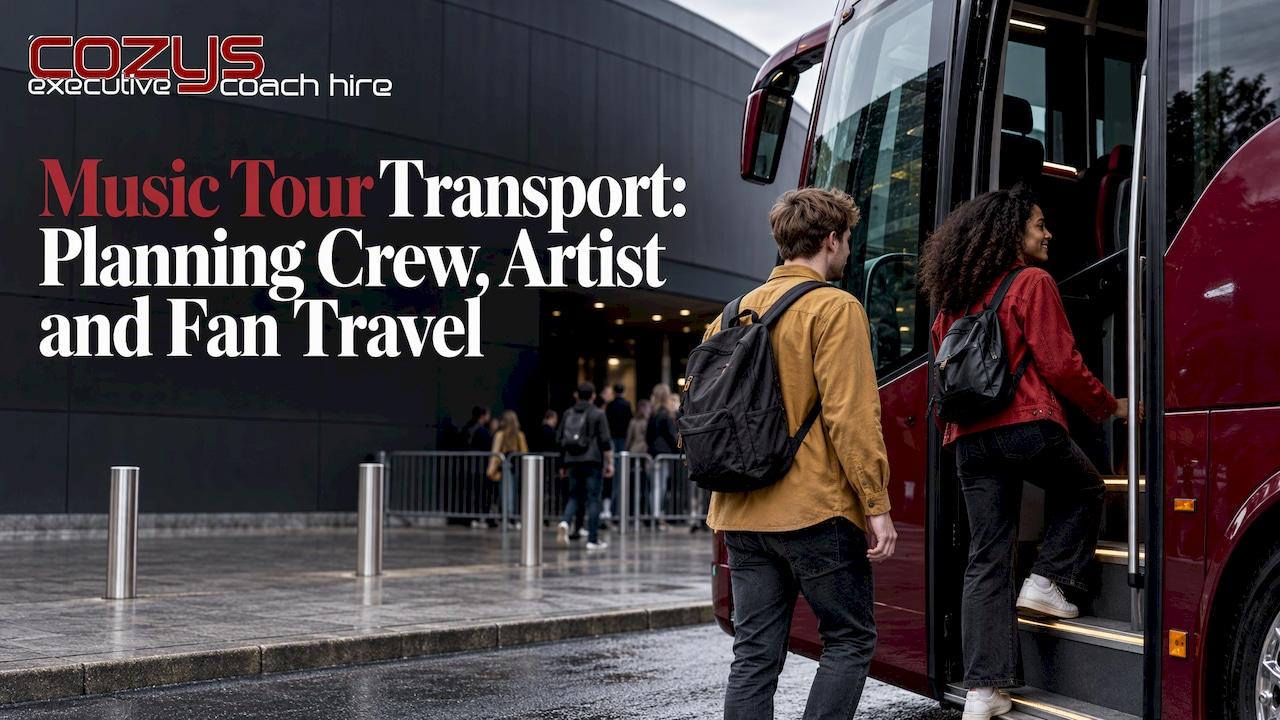
Music tour transport is three separate jobs: moving the equipment, moving the band and crew overnight, and moving everyone else by day, from crew shuttles and hospitality groups to fans travelling to a venue. The first two are specialist services, mostly trucks, splitter vans and sleeper buses. The third is group coach work, where a licensed operator with a modern fleet, a strong safety record and accessible vehicles keeps a tour on schedule. We are a family-run coach and minibus operator, and this guide shows where coaches fit into a UK tour, and what to check before you book one.
TL;DR
- A tour has three transport layers: gear (trucks and trailers), the touring party overnight (splitter vans, sleeper buses), and daytime group movements (minibuses and coaches, 16 to 85 seats).
- Drivers' hours and rest rules apply to every driver on the tour, so build the schedule around them, not around the set list.
- A written touring risk assessment should exist before the first date, and it must cover vehicles, rest, and travel to and from venues.
- Lower-emission options already exist at tour level, from electric trucks to hybrid coaches for group legs.
- For crew shuttles, VIP groups, fan travel and accessible journeys, book a licensed coach operator early and give it the full run sheet.
Table of Contents
- The three layers of music tour transport
- Which vehicle for which job
- Planning transport around drivers' hours
- Overnight versus day travel by coach
- Risk assessment: the document that protects the tour
- Accessible travel for crew, guests and audiences
- Getting the group to the venue
- Lower-emission touring is now practical
- A step-by-step process for booking group transport on a tour
- Where we fit
- Book coach travel for your tour group
- FAQ
- Sources
The three layers of music tour transport
It helps to separate the tour into layers, because each one is bought from a different kind of supplier and fails in a different way.
1. Equipment haulage. Stage sets, backline, lighting and merchandise travel by truck, often with dedicated trailers for each type of load. At the top end the scale is huge: the BBC reported that Beyoncé's 2016 Formation tour needed seven Boeing 747 freighters and more than 70 trucks to move her stage set and other gear. Most UK tours are far smaller, but the principle is the same: freight is planned with production managers, separately from people.
For European legs, haulage firms use an ATA Carnet, a customs document listing every item a band tours with, so trailers do not have to be unloaded and checked at every border.
2. The touring party overnight. Bands and crew who play night after night usually travel in splitter vans or sleeper buses, often called nightliners. A sleeper bus is a converted coach with bunks and a living area, and the driver drives overnight while the party sleeps. Splitter buses are commonly built on van chassis, most often the Mercedes-Benz Sprinter, which suits smaller bands and crews.

3. Daytime and event group movement. This is everything else: getting a crew from hotel to venue, a record label or sponsor's guests to a show, a choir or youth orchestra to a regional date, a tour party to an airport, or fans to a venue with poor rail links. This layer is plain group transport, and it is where a coach operator earns its place on a tour.
Which vehicle for which job
| Need | Typical vehicle | What decides the choice |
|---|---|---|
| Staging, backline, merchandise | Trucks and trailers | Load size, venue loading access, border paperwork |
| Small band with a small crew, overnight | Splitter van | Party size, luggage and instruments carried on board |
| Larger party, consecutive nights, long distances | Sleeper bus | Bunks, driver rest, distance between dates |
| Crew or guests, same-day travel | Minibus or coach, 16 to 85 seats | Headcount, luggage, timings, accessibility |
| Fans, supporters or a youth ensemble | Coach, often with a pick-up plan | Pick-up points, venue drop-off and parking |
| Wheelchair users in the party or audience | Wheelchair-accessible coach or minibus | Lift or ramp, securing points, journey length |
If your party is more than around 16 people travelling by day, a coach is usually the more economical and simpler answer than a convoy of cars or vans. Our fleet runs from 16 to 85 seats, so the same operator can cover a ten-piece crew shuttle one week and a full coach of supporters the next. Our coach hire and group travel pages set out how bookings work.
Planning transport around drivers' hours
Every vehicle on a tour has a driver, and every driver is regulated. Following the UK's departure from the EU, national journeys within the UK are governed by the assimilated drivers' hours and tachograph rules, with GB domestic rules applying to some exempt vehicles. Journeys that go partly abroad bring in the rules of the countries visited as well. A tachograph is the device that records a driver's driving time, breaks and rest.
The practical effect is the same whichever rule applies: there is a limit on driving per day, a break is needed after a set period at the wheel, and daily and weekly rest must be taken. Our guide to drivers' hours rules for UK fleets covers the 2026 changes in detail.
Where tours go wrong is the load-out. A show that overruns by an hour, followed by a long drive and an early load-in, can leave a driver without legal rest. Three habits prevent it:
- Give the operator the real finish time and the real load-out time, not the advertised curfew.
- Agree where the vehicle waits and where the driver rests during show day.
- Allow a buffer for traffic on the return leg, because a late arrival is also a driver's hours problem.
This is one reason a booking for a group coach is worth making early. We plan driver allocation from your itinerary, so rest periods are built into the day rather than found at the last minute.
Overnight versus day travel by coach
Sleeper buses are designed for tours that play on consecutive nights. For a one-off event, a short run of dates or a group travelling out and back on the same day, a standard coach is the simpler fit, and it can carry far more people. When a group needs to travel through the night to save on hotels, our guide to overnight coach travel and the rules sets out how it is planned.
A tour manager's real question is therefore not "coach or sleeper bus?" but "which parts of this itinerary are overnight and which are daytime?" Often the answer is both, with a sleeper bus or van for the core party and coaches for the groups around it.

Risk assessment: the document that protects the tour
The Musicians' Union advises that an employer should complete a touring risk assessment well before a tour begins. It should cover travel and rest arrangements, the mechanical standard and comfort of vehicles, food and refreshment, toilet and washing facilities, manual handling and the risk of deep vein thrombosis (DVT) from long periods of inactivity. It also asks for secure transport to and from airports, stations and workplaces.
For a coach booking inside that assessment, the questions that matter are:
- Is the operator licensed for the work, and can it show it?
- What is the operator's safety record and how is it independently rated?
- Are the vehicles modern, regularly inspected and suited to the number of passengers and bags?
- Is there a plan for breaks, so passengers are not sitting for hours without a stop?
- Is there a contingency if a vehicle is delayed or a driver reaches their limit?
Our guides on avoiding unlicensed operators and coach risk assessments cover the legal checks and the eight points a UK organiser should confirm before booking. We hold the highest 6-star BUSK safety rating, and our reliability has been proven in work for organisations including Tesco and the RAF.
Accessible travel for crew, guests and audiences
Music tours increasingly include community groups, supporters' clubs, school choirs and corporate hospitality parties, and some of those travellers use wheelchairs. Accessible transport needs to be planned from the start, because it affects vehicle choice, boarding time and the schedule. Securing a wheelchair, allowing time at each stop and agreeing the drop-off point close to the venue entrance all take longer than a standard boarding.
We provide accessible transport for wheelchair users, and we have experience with school and community groups, which is useful when a tour includes a young ensemble or a charity group. Our guide to SEND school trip transport explains how those journeys are planned, and the same thinking applies to any group with access needs travelling to a concert.
Getting the group to the venue
The last mile is where a lot of event transport planning breaks down. Coaches need a drop-off point, a legal place to wait and somewhere to park for the evening. At large venues, parking and traffic management are controlled by the venue or the local authority, and rules vary from site to site. Our guide to event transport logistics lists three compliance checks UK organisers should complete, and for stadium shows in the capital our note on coach parking in London shows how to book a space and avoid a Wembley fee.
If fans travel in by coach or shuttle, the organiser may also need a traffic management plan. Our guide to park and ride shuttles for events explains what avoids a rejection.
Lower-emission touring is now practical
The live music industry has set itself targets. A University of Manchester roadmap, Super-Low Carbon Live Music, proposes reducing surface travel emissions to zero by 2035. It recommends phasing out fossil-fuel vehicles in hired fleets, starting where electric alternatives already exist, and building low-emission travel into the tour from its conception.
There is proof that this can be done on the road. The Sam Fender People Watching Tour was the first live music tour to use 100% electric heavy goods vehicles: four eActros 600 trucks covered 934 miles across England, Scotland and Ireland, saving 840 kg CO2e. At Massive Attack's 2024 Bristol show, all performers travelled by train, ferry or coach, cutting artist travel emissions by 72%, and electric shuttle buses took more than 2,000 fans to Bristol train stations.
Those examples show two things. Freight can be decarbonised on its own track, and passenger movement is where coaches help most, because one full coach replaces many cars. We operate the UK's first hybrid coach, and our hybrid coach hire page and our guide to hybrid coach benefits for group transport planners explain what that means for a group's footprint. For a corporate sponsor or a venue with its own sustainability reporting, a lower-emission group leg is something that can be written into the tour plan.
A step-by-step process for booking group transport on a tour
- List every movement. Write down each journey that involves people: crew shuttles, guest groups, airport runs, fan transport and any accessible travel. Mark which are overnight and which are daytime.
- Count heads and luggage. Headcount decides whether you need a minibus or a coach, and luggage decides what fits in the hold. Include instruments or merchandise only if they are small enough to travel safely with passengers.
- Set the real timings. Use doors, curfew and load-out times, then add margin. Give them to the operator in full.
- Check licensing and safety. Ask for the operator licence details and safety rating, and put them in the risk assessment.
- Plan the venue arrival. Agree drop-off, waiting and parking, and check any local rules.
- Confirm access needs early. Wheelchair spaces and boarding equipment need to be allocated at booking.
- Book as soon as dates are fixed. Coaches for popular dates and weekends are in demand, and a longer lead time gives you more choice of vehicle.
At step 4 in particular, we make the process easier for you: our safety rating and fleet details are stated up front, so they can be dropped into your documentation without chasing.
Where we fit
We see music tour transport as a planning problem first and a vehicle problem second. The gear, the overnight party and the daytime groups each need their own answer, and the daytime groups are where a coach operator with a long record is most useful.
We have been providing group travel for over four decades, with a fleet from 16 to 85 seats, the highest 6-star BUSK safety rating and the UK's first hybrid coach. For a corporate client, a tour operator or a community organisation moving a group to a concert, that combination means a vehicle sized to the group, a driver scheduled within the rules and a lower-emission option when sustainability matters.
Our advice is to bring us in as soon as the dates are fixed. The earlier we see the run sheet, the better we can match the vehicle, the driver hours and the venue access to it.
Cozys
Book coach travel for your tour group
If your tour involves a crew shuttle, a guest group, a supporters' coach or accessible travel to a show, we can supply the vehicle and driver. We cover minibuses and coaches from 16 to 85 seats, including wheelchair-accessible transport and a hybrid coach for lower-emission journeys. Send us your dates, pick-up points, headcount and venue details through our coach hire page, or see our corporate service if the booking comes from a company.
Our coaches also serve schools, colleges and local authorities, so youth ensembles and school choirs travelling to performances can use our schools and colleges service.
FAQ
Do bands still use tour buses?
Yes. In Europe, splitter buses and sleeper coaches carry most professional touring acts. A tour bus is a converted coach with bunks, a lounge and often a small kitchenette and toilet, though UK tour buses do not have showers, so crews use venue facilities.
What vehicle does a small band or crew need?
A small party travelling overnight typically uses a splitter van, built on a van chassis. For daytime group movements of 16 or more people, a minibus or coach is usually the simplest option, and we supply both from 16 to 85 seats.
Are there drivers' hours rules for tour drivers?
Yes. Within the UK, national journeys follow assimilated drivers' hours and tachograph rules, and journeys abroad also fall under the rules of the countries visited. Share your real timings with the operator so rest periods are planned into the schedule.
Can a tour include wheelchair-accessible transport?
Yes, as long as it is arranged at the booking stage. Tell us how many wheelchair users are travelling and the venue drop-off point, and we will allocate suitable vehicles through our accessible transport service.
Sources
- What it takes to get Beyonce on a world tour, BBC News
- ATA Carnet case study, Business West
- Splitter tour bus, Wikipedia
- Drivers' hours and tachographs: buses and coaches, GOV.UK
- Risk assessment for touring musicians, Musicians' Union
- Super-Low Carbon Live Music, University of Manchester
- Sam Fender all-electric UK and Ireland tour, Mercedes-Benz Trucks UK
- How Ecotricity helped stage the world's greenest gig
Recommended
- 3 compliance checks UK organisers must do for event transport logistics
- Avoid Unlicensed Operators: 4 Legal Checks for UK Group Transport
- London Organisers: Book Stadium Coach Parking, Avoid £120 Wembley Fee
- Matchday Shuttle Planning: A Practical Guide for Organisers
This article is produced as general information only and is not professional advise.