
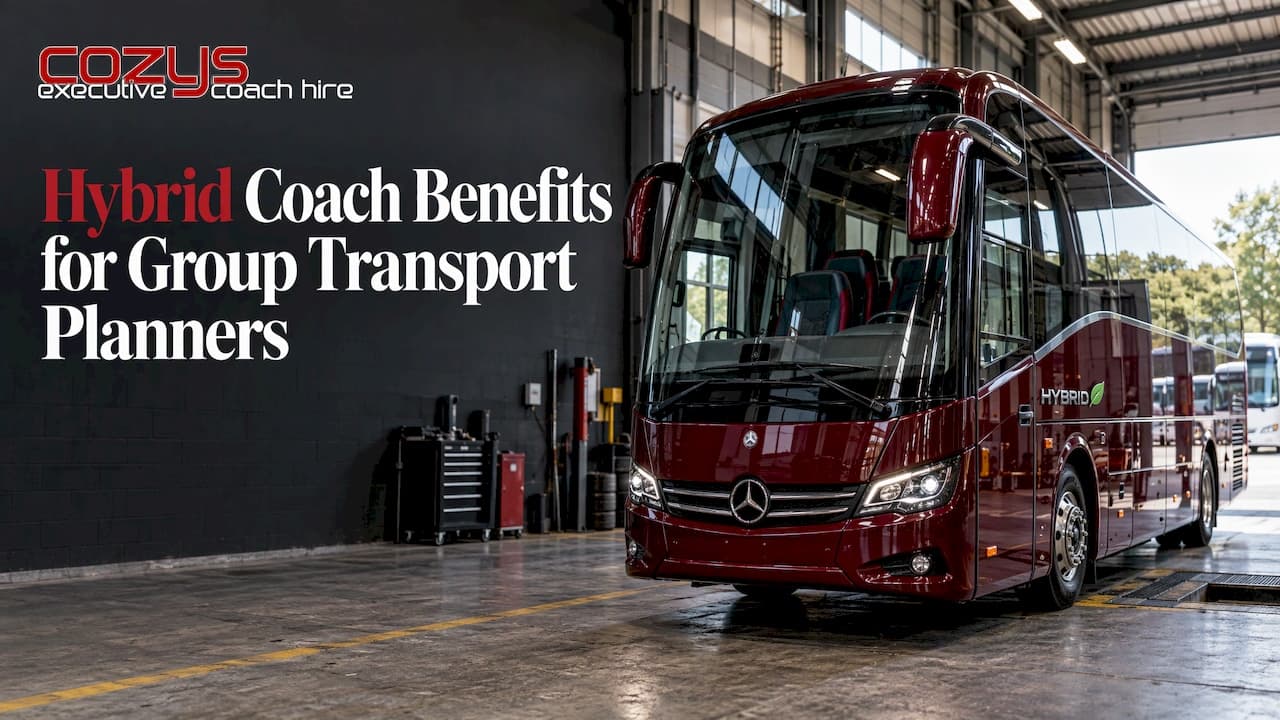
A hybrid coach pairs a combustion engine with an electric motor and battery. For a group booking, that means lower fuel use and emissions than a comparable diesel coach, a quieter and smoother ride, and the option to run on electric power in sensitive urban areas. The size of the saving depends on the vehicle, the route and how the coach is driven, so the figures below are ranges from published testing, not promises for any single journey.
This guide is written for the people who commission group travel: school and local authority transport officers, corporate travel managers, tour operators and community organisers. It covers how hybrid coaches work, what the evidence says, how they perform on urban and long-distance routes, and which accessibility features you should confirm for passengers with mobility needs.
TL;DR
- Hybrid buses and coaches are quieter, cleaner and more fuel efficient than standard diesel, and drivers report smoother rides.
- Government monitoring of diesel hybrid buses found efficiency gains of 15% to 37% over non-hybrid diesel buses, with proportional cuts in greenhouse gas emissions.
- Plug-in hybrid coaches can run electrically in zero-emission zones and switch to the engine for long distances.
- Accessibility is a separate question from powertrain: confirm wheelchair spaces, restraints and ramps or lifts before you book.
- Cozys operates the UK's first hybrid coach and holds the maximum 6-star BUSK safety rating.
Table of Contents
- How a hybrid coach works
- Fuel and emissions benefits
- Quieter, smoother journeys
- Urban and long-distance performance
- Hybrid coach benefits at a glance
- Accessibility features on a coach
- What UK accessibility rules apply
- What planners should ask before booking
- Our perspective on hybrid coaches
- Plan hybrid coaches with Cozys
- Where coaches fit in a wider sustainable travel plan
- Frequently asked questions
- Sources
How a hybrid coach works
A hybrid coach combines an internal combustion engine, usually diesel, with an electric motor, a generator and a battery pack. Transport Canada's technical review of hybrid buses describes two main layouts:
- Series hybrid: the engine drives a generator that produces electricity for the motor. The wheels are driven by the motor alone.
- Parallel hybrid: the engine and the motor can each drive the wheels, or work together.
The battery captures energy that a conventional coach would lose as heat when braking, and the electric motor supports the engine when it is working hardest, such as pulling away from a stop. A plug-in hybrid adds a larger battery that can be charged from the grid, which allows a stretch of fully electric running.
For a group organiser, the layout matters less than what it delivers: how much fuel the coach uses, how it behaves in town, and how it rides. The sections below take those in turn.
Fuel and emissions benefits
The strongest evidence for hybrids concerns fuel and emissions. A few figures from official and manufacturer sources give a realistic range:
- The Department for Transport's Low Emission Bus Scheme monitoring programme reports that diesel hybrid buses showed 15% to 37% higher efficiency than non-hybrid diesel buses, with proportional reductions in greenhouse gas emissions.
- Scania states that its plug-in hybrid technology can achieve fuel and emissions savings of up to 40% in typical mixed coach traffic.
- Volvo Buses estimates in a paper on full hybrid technology that a full hybrid bus can cut annual CO2 emissions by 20 to 50 tonnes, depending on mileage and operating conditions, and that running on biofuels such as B100 can lift the greenhouse gas reduction to around 60% compared with diesel.
These numbers describe hybrid vehicles in general. They come from different vehicle types, duty cycles and years, so they should not be added together or applied to a specific booking. What they show consistently is direction: a hybrid uses less fuel for the same work, and less fuel means lower emissions per passenger-kilometre.
Why this matters for reporting
Many organisations now report the carbon footprint of staff, pupil and visitor travel. Fuel use is the main input when emissions are calculated with DEFRA conversion factors, so a lower-consumption vehicle supports a lower reported figure. A coach already carries many people in one vehicle, which is the starting advantage; a hybrid powertrain improves on that. If your organisation needs emissions data for a contract or tender, ask your operator what information it can supply for the vehicle assigned to your journey.
Fuel choice interacts with powertrain choice. For a wider view of the options fleets compare, see our guide to coach fuel types and how depot costs vary.
Quieter, smoother journeys
Passenger comfort is the benefit group leaders notice first. Transport for London's hybrid buses report found hybrid buses quieter than diesel buses, with almost all models giving a smoother ride. Some drivers also said they felt more relaxed on long shifts.
That has practical value for particular groups:
- School journeys: lower cabin noise makes it easier for escorts to speak to pupils and for pupils to settle, particularly on early home-to-school runs.
- Corporate transfers: a quieter cabin suits teams who want to work or hold a conversation on the way to an event or site visit.
- Community and social groups: older passengers and those sensitive to vibration or noise often find a smoother ride less tiring.
- Residential areas: quieter operation at pick-up points is more considerate to neighbours at early or late hours.
The Transport Canada review also notes reduced fuel consumption, noise and brake wear as advantages of hybrid buses, because regenerative braking shares the work that friction brakes would otherwise do.
Urban and long-distance performance
Coaches rarely do one kind of journey. A school contract may be all town driving; a corporate event may mix a city centre drop-off with a motorway leg. Hybrids are designed to handle both.
According to Scania, its plug-in hybrid coach can run electrically in zero-emission zones and use its combustion engine for long-distance travel. Geofencing can switch the vehicle into electric mode automatically within defined areas. Scania quotes up to 80 km of electric range on a single charge, with four drive modes to suit different journey needs. Volvo Buses makes a similar point for full hybrids: connectivity and geofencing can prioritise electric driving in noise- and emission-sensitive areas.
In practice, this means a coach can serve a low-emission or noise-sensitive destination without the range limits of a fully electric vehicle on the motorway section. For planners, the questions to ask are simple:
- Does the route pass through a low-emission zone or a sensitive area such as a hospital, school gate or town centre?
- How long is the longest leg between stops?
- Will the coach be charged between jobs, if it is a plug-in model?
Route-specific range and charging information comes from the operator, so raise it at the quote stage.
Hybrid coach benefits at a glance
| Benefit | What the evidence says | What it means for your group |
|---|---|---|
| Fuel efficiency | 15% to 37% higher efficiency than non-hybrid diesel buses in UK monitoring | Lower fuel use for the same journey |
| Emissions | Proportional reductions in greenhouse gases; up to 60% with B100 biofuel in full hybrids (Volvo Buses) | Supports travel carbon reporting |
| Noise | Quieter than diesel buses (TfL) | More comfortable cabin and quieter pick-ups |
| Ride quality | Smoother ride in almost all models tested (TfL) | Less tiring for long or early journeys |
| Urban flexibility | Electric running in defined zones (Scania, Volvo Buses) | Suits low-emission and noise-sensitive areas |
| Brake wear | Reduced brake wear (Transport Canada) | Less wear on a component that matters for safety |
Accessibility features on a coach
A hybrid powertrain says nothing about whether a coach works for a wheelchair user. Many readers searching for hybrid coaches are also checking what a vehicle offers passengers with mobility needs, so the two should be assessed together.
GOV.UK's guidance on features and help for disabled people on buses and coaches explains that coaches can have wheelchair spaces with restraint systems, plus ramps or lifts to help passengers board. The same guidance gives the standard wheelchair dimensions used in UK accessibility regulations: 70cm wide, 120cm long and 1.35m high.
When you book for a group that includes wheelchair users, confirm the following in writing:
- Number of wheelchair spaces on the specific vehicle, and whether the seating plan changes when they are in use.
- Boarding equipment: ramp or lift, and whether the driver is trained to operate it.
- Restraints: how each wheelchair is secured, and how passengers are secured alongside it.
- Space for the wheelchair dimensions above, including powered chairs, which are often larger than a standard manual chair.
- Luggage and equipment space for walking aids, spare batteries and similar items.
- Pick-up and drop-off points that have level, safe access for the ramp or lift.
Our guides go deeper on each of these. Accessible coach seating layouts explains what organisers should check on the plan, and wheelchair securement standards covers how restraint systems are assessed. For a wider look at what is available, read our overview of wheelchair group transport options.
What UK accessibility rules apply
UK accessibility law for coaches is set out in the Public Service Vehicles Accessibility Regulations 2000. GOV.UK explains that new coaches have needed wheelchair access since 1 January 2005, and coaches have needed to be fully accessible since 1 January 2020.
Two scope points are worth knowing. The accessibility requirements do not apply to vehicles carrying 22 or fewer passengers, or to private or hired services that do not run to a timetable. So a minibus or a private hire may fall outside the regulations, yet your passengers' needs remain the same. That is why it is sensible to ask for the accessibility specification of the exact vehicle, whatever its legal category. Our PSVAR requirements guide sets out what operators need to meet.

Accessible travel also extends beyond the vehicle. The Confederation of Passenger Transport's route map to zero-emission coaches includes a commitment to ensure local emergency services know how to safely recover passengers from a zero-emission coach after an accident. As coach technology changes, safety procedures change with it, which is another reason to choose an operator with a documented safety record.
What planners should ask before booking
A hybrid brings real advantages, and an informed buyer gets the most from them by asking the right questions of the operator.
Maintenance and records
A diesel hybrid combines the maintenance requirements of diesel and electric systems, as the Low Emission Bus Scheme monitoring report notes. That makes the operator's servicing discipline part of the value you are buying. Ask how inspections are scheduled, who services the high-voltage components and how records are kept. Our guide to coach maintenance records and intervals that withstand DVSA audits lists what good looks like.
Powertrain sizing and the route
Academic work on optimal powertrain sizing for series hybrid coaches shows that engineers have to balance the high torque needed for hill climbing against efficiency at long-distance cruising. For a booking, that translates into telling your operator about gradients, motorway share and stop frequency so that the vehicle chosen suits the work.
Capacity and amenities
The right vehicle is first a matter of seats. Our coach capacity guide explains how to match group size to a 16 to 85 seat vehicle. Then confirm the comforts your group expects: three coach amenities to check before booking and the operational gains of coach WiFi are good starting points.
Safety record
Powertrain is one factor; operator safety is another. Ask for evidence of independent safety assessment. Cozys holds the highest 6-star BUSK safety rating.
Our perspective on hybrid coaches
We have run group transport for over four decades, and our view is that the best vehicle for a contract is the one that fits the journey, the passengers and the organisation's own targets. For many of our clients, that now includes a hybrid.
We introduced the UK's first hybrid coach because our school, corporate and community customers were asking for lower-emission travel without losing the reliability they depend on. Our fleet runs from 16 to 85 seats, so a hybrid is one part of a mix that lets us match the vehicle to the booking rather than the booking to the vehicle.
We also treat comfort and accessibility as part of sustainability. A coach that is quieter and smoother, and that can carry wheelchair users safely, serves more of the people a contract is meant for. That is why we plan accessible journeys with the same care as the powertrain.
Reliability remains the measure by which a transport partner is judged. Our 6-star BUSK safety rating and our long-standing work with organisations such as Tesco and the RAF reflect how we approach it: consistent maintenance, trained drivers and clear communication before the day.
Cozys
Plan hybrid coaches with Cozys
If you are comparing options for a school contract, a staff event or a community outing, we can advise on the vehicle that suits your group. Our coach hire service covers 16 to 85 seats, including the UK's first hybrid coach, and you can see the vehicles on our fleet page.
Other routes in depend on your organisation:
- Local authorities and private schools: our home-to-school transport and Schools & Colleges services.
- Corporate travel managers: our Corporate service.
- Groups with wheelchair users: our Accessible Specialists team.
- Community and social groups: our Group Travel service.
Prices depend on the vehicle, mileage and date, so request a quote with your route and passenger details.
Where coaches fit in a wider sustainable travel plan
Organisations that report on travel emissions usually look at the whole journey, not just the coach leg. A coach cuts the number of vehicles on the road for a group, and a hybrid reduces the fuel each of those journeys uses. At the destination, walking and cycling can cover the last stretch; the principles are discussed in this piece on sustainable mobility using bikes and eBikes. Combined with accessible vehicles where needed, this gives a travel plan that is lower in emissions and open to more people.
Frequently asked questions
Are hybrid coaches quieter than diesel coaches?
Research on hybrid buses by Transport for London found them quieter than diesel buses, with almost all models giving a smoother ride. Noise depends on the vehicle and how it is driven, so the experience on a given coach will vary. Electric running in towns gives the biggest noise reduction.
How much fuel can a hybrid coach save?
UK government monitoring of diesel hybrid buses found efficiency gains of 15% to 37% over non-hybrid diesel buses. Scania states that its plug-in hybrid can save up to 40% in typical mixed coach traffic. Actual savings depend on mileage, route and operating conditions.
Can a hybrid coach carry wheelchair users?
Powertrain and accessibility are separate features, so confirm the specification of the exact vehicle. Coaches can be fitted with wheelchair spaces, restraint systems and ramps or lifts, as GOV.UK describes. Tell your operator about every wheelchair, including powered chairs, when you request a quote.
Do hybrid coaches work for long-distance journeys?
Yes. Plug-in hybrid designs such as Scania's use the combustion engine for long distances and can run electrically in zero-emission zones, switching automatically through geofencing. This lets one vehicle cover both a city centre and a motorway leg.
Sources
- Hybrid Buses, Transport Canada (2009)
- Hybrid buses report, Transport for London (2009)
- Low Emission Bus Scheme monitoring programme, Department for Transport (2022)
- Inside Scania's plug-in hybrid powertrain (2026)
- Why full hybrid buses are the next-best alternative, Volvo Buses (2021)
- Optimal Powertrain Sizing of Series Hybrid Coach, MDPI (2022)
- Buses and coaches: features and help for disabled people, GOV.UK
- Bus and coach accessibility and the Public Service Vehicle Accessibility Regulations 2000, GOV.UK
- Coach Route Map to Destination Zero, CPT
- Sustainable mobility using bikes and eBikes
Recommended
- Hybrid Coach Hire — Greener Journeys — Sustainable Coach Travel — Bedfordshire & Hertfordshire
- 16–85 Seats: Coach Capacity Rules and Checklist for Group Planners
- Confirm These 3 Coach Amenities Before Booking for UK Group Planners
- Sustainable Group Travel: Procurement Ready KPIs for UK Organisers
This article is produced as general information only and is not professional advise.