
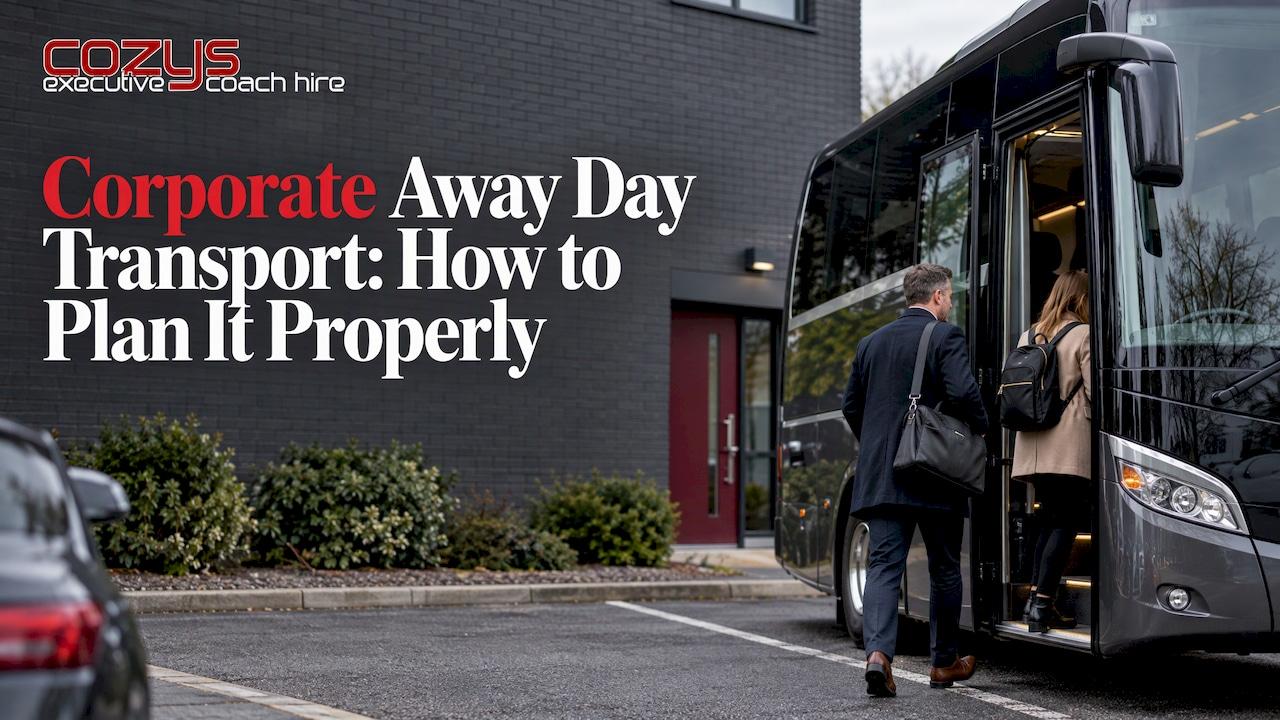
The safest, simplest way to move a team to an away day is a licensed coach or minibus, booked for the whole day, with one pick-up point, one return time and an operator whose licence, drivers and accessibility provision you have checked. Cars and public transport split a group, add arrival risk and make the day start late. A single vehicle keeps everyone together, and a family-run operator such as Cozy Travel can supply vehicles from 16 to 85 seats, so the size of your group decides the vehicle, not the other way round.
This guide is for the person who has been handed the logistics: an office manager, HR lead, events coordinator or travel manager. It covers choosing the vehicle, the legal checks that matter, the timings to plan, what to confirm with the operator, what drives the cost and how to cut the emissions of the journey.
TL;DR
- Choose by headcount and route: a minibus suits small teams, a coach suits larger groups and keeps everyone on one vehicle.
- Any vehicle with more than eight passenger seats hired out needs a PSV operator licence, so ask for it before you book.
- Confirm accessibility, luggage, pick-up points and the return time in writing, not on the day.
- Cost depends on vehicle size, mileage, waiting time and day of travel, so ask for a quote against a fixed itinerary.
- Measure the journey: a full coach usually beats a convoy of cars, and hybrid vehicles cut it further.
Table of Contents
- Coach, minibus or something else?
- The legal checks that protect you
- Accessibility: plan it before you book
- Pick-up points, journey times and the return trip
- What to confirm with the operator
- What affects the cost
- Lowering the emissions of the journey
- Our view: the vehicle is the easy part
- Booking corporate away day transport with Cozy Travel
- FAQ
- Sources
Coach, minibus or something else?
Start with the number of people who will actually travel, including anyone who needs step-free access, then work through three questions: how many seats, how far, and how much time the group has.
| Group size | Typical vehicle | Best for |
|---|---|---|
| Up to about 16 | Minibus | Leadership teams, small departments, short regional trips |
| 17 to 50 | Midi or standard coach | Department away days, workshops, site visits |
| 50 to 85 | Large coach, or two vehicles | Whole-company events, conferences, outings with partners |
Cozy Travel's fleet runs from 16 to 85 seats, which covers that whole range from one operator. That matters in practice: when a headcount moves from 38 to 47 a fortnight before the day, you want to change the vehicle, not the plan.
It also helps to be clear about what the alternatives do to your day:
- Staff driving themselves. Arrival times scatter, parking at the venue becomes your problem, and anyone planning to drink at an evening event has to be left out or provided with another way home.
- Public transport. It works for city venues with good rail links, but a group of 30 changing at a station will rarely arrive together, and luggage, equipment or a team member with limited mobility make it harder.
- Several minibuses. Fine for 20 to 30 people, but each vehicle needs its own driver, its own timing and its own pick-up, so the coordination rises quickly.
A single coach has one departure time, one driver to brief and one contact number. For most away days with more than 16 people it is the option that leaves you with the fewest things to manage.
The legal checks that protect you
You are not responsible for the vehicle, but you are responsible for choosing who carries your colleagues. Four checks do most of the work. Our guide to avoiding unlicensed operators goes into more depth on each.
1. The operator licence
Under the Public Passenger Vehicles Act 1981, a vehicle built or adapted to carry more than eight passengers and used for hire or reward needs a PSV operator's licence issued by the traffic commissioner. Vehicles with eight or fewer passenger seats can be hired out under a private hire vehicle licence instead, as set out in the Senior Traffic Commissioner's statutory document on PSV operations. In plain terms: if a company is quoting you for a 16-seat minibus or a 49-seat coach and cannot give you its PSV licence details, do not book.
Privately run minibuses with no payment from passengers, in cash or in kind, fall outside the PSV licence rules, according to the BVRLA guide to driving a minibus. That is the situation of a charity or a company minibus used by its own staff. A hired vehicle with a driver is a different case.

2. The driver
Professional bus and coach drivers generally need a Driver Certificate of Professional Competence (Driver CPC), which involves 35 hours of periodic training every five years, according to the Department for Transport's licensing framework. The same framework notes that a 2024 amendment introduced National Driver CPC changes for drivers working solely within the UK, including 3.5-hour courses. DVLA guidance for passenger-carrying vehicle drivers says drivers must carry the relevant Driver Qualification Card or National Driver Qualification Card.
For you, the practical question is simple: will the driver hold a valid qualification card, and is it the operator's own driver rather than someone found on the morning?

3. The vehicle
DVLA guidance says passenger-carrying-vehicle drivers should carry out daily walkaround checks. The BVRLA guide adds that operators must ensure roadworthiness, record daily checks, repair safety-related defects before use and avoid overloading. You are not expected to inspect the vehicle yourself. You are entitled to ask how the operator records these checks.
Condition also shows in the small things a team notices on the day: a clean, fresh interior, working seat belts and air conditioning that actually works. If some of your group will make the first or last leg in a car, advice on removing mould from car interiors is a reminder that interior upkeep is part of arriving in a fit state.
4. The safety record
Ask for evidence of an independent safety standard. Cozy Travel holds the highest 6-star BUSK safety rating, and has worked on contracts with organisations including Tesco and the RAF over four decades as a family-run operator. Our coach risk assessment checklist lists eight checks organisers need before booking.
Accessibility: plan it before you book
If anyone in the team uses a wheelchair or has limited mobility, accessibility is the first filter on the vehicle, not an afterthought on the final email.
The Equality Act 2010 places an anticipatory duty on service providers to make reasonable adjustments, and the explanatory notes to the Act explain that transport duties apply differently depending on the type of vehicle. Separately, the Public Service Vehicles Accessibility Regulations 2000 set technical requirements for specified buses and coaches, covering wheelchair spaces, ramps or lifts, restraints, entrances, gangways, communication devices and lighting. The legislation states that the in-use requirements were phased in by 2015 for certain buses and 2020 for coaches.
For an organiser, that means three questions to settle early:
- How many people need a wheelchair space, and do they travel in their own chair?
- Is the vehicle fitted with a lift or ramp, and does the driver know how to operate it?
- Is the venue itself step-free from the drop-off point?
Cozy Travel runs accessible transport for wheelchair users as a specialist service, so the question is part of the booking, not an extra. Our guide to wheelchair accessible coach standards explains what to look for, and the Accessible Specialists page describes the service.
Pick-up points, journey times and the return trip
Most away day problems are timing problems. The vehicle was fine, but the team was not where it should have been when it arrived.
Pick-up points
Pick one location that most people can reach easily, and add a second only if a large part of the team works elsewhere. Check three things about each point: whether a coach can legally and safely stop there, whether there is somewhere for people to wait out of the weather, and whether anyone arriving by car can park for the day.
Office car parks are often the best choice because everyone knows them, but check turning space. A 49-seat coach cannot always manoeuvre where a minibus can. If you are unsure, ask the operator to confirm access before you announce the plan. Our guide to conference shuttle routes shows how to lay out stops when more than one is needed.
Journey time
Work backwards from the start of the first session, not forwards from the departure. A reasonable pattern is:
- Fix the venue start time, for example 10:00.
- Add the driving time from the operator's estimate, then a buffer for rush-hour traffic if you leave before 09:00.
- Add 15 minutes for loading, a headcount and late arrivals.
- Set the departure time, and tell the team it is 10 minutes earlier than the real one.
A late arrival at the pick-up point delays everyone, so the departure time you circulate matters more than the one you hold privately.
Venue access
Ask the venue where coaches set down, whether the drop-off point is close to the entrance, and where the vehicle waits if it stays on site. Some venues limit coach parking or charge for it, and a driver has statutory limits on working hours, so the vehicle cannot simply wait indefinitely. Agree this in advance.
The return
The return trip is where plans most often slip. If the day ends with a meal or a drinks reception, set a fixed departure time and tell the team when the vehicle leaves, not that it will leave "around six". Agree with the operator what happens if the event overruns: whether waiting time is charged and from what point. Name one person on your side as the contact for the driver, with a mobile number both parties have.
What to confirm with the operator
A short written confirmation prevents most disputes. Ask for the following before you pay a deposit:
- Operator licence details and the name of the company that will actually run the vehicle.
- Vehicle type and seat count, including how many seats are usable once luggage or equipment is stowed.
- Accessibility provision, with wheelchair spaces and lift or ramp fitted.
- Pick-up and drop-off addresses and times, written out in full, with the return time.
- What the price includes: mileage, driver's time, waiting time, tolls and parking.
- Overrun terms: the hourly rate or the rule that applies after the agreed finish.
- Cancellation and change terms, including what happens if numbers drop or rise.
- A contact number for the driver and for the operator's office on the day.
- Emissions information if your company reports on travel emissions.
The full process, from first enquiry to the final check, is set out in our coach booking playbook for organisers. If your company runs regular staff travel, a written corporate shuttle policy saves you repeating these decisions every time.
What affects the cost
Operators quote against a specific itinerary, so there is no single price for an away day. The same five factors drive almost every quote:
- Vehicle size. A larger vehicle costs more to run, though per head a full coach is often the cheapest way to move a big group.
- Distance and driving time. Mileage, and the time the driver spends on the road, form the core of the price.
- Waiting time. A vehicle that stays at the venue all day costs more than one that drops off and returns for the evening.
- Day and season. Fridays, December and school holiday weeks are busier and can cost more.
- Extras. Accessibility equipment, tolls, parking and early or late starts may be added.
To compare quotes properly, send each operator the same brief: group size, addresses, times and whether the vehicle waits. Quotes based on different assumptions cannot be compared by price alone. Cozy Travel does not publish fixed prices, so a quote is built from your itinerary, which suits an away day where every route is different.
Lowering the emissions of the journey
Transport is often the largest single source of emissions from a corporate away day, and it is the one you control most directly through the booking.
A green travel and transport guide for events recommends dedicated coaches and shuttle buses, rail and public transport, car sharing, walking and cycling where possible, and measuring travel modes and distances. VisitBritain's event sustainability checklist recommends measuring at least 80% of event transport and staff travel when calculating emissions, and choosing venues with strong public-transport access. The same checklist suggests assessing each road journey for fuel economy and duration, choosing the shortest fuel-economic route and using Euro 6-compliant or equivalent vehicles where applicable.
For an organiser, a workable approach is:
- Record how each person would otherwise travel and the distance.
- Replace as many individual car journeys as possible with one shared vehicle.
- Ask the operator for the vehicle's emissions standard.
- Use the same method each year so figures can be compared.
Cozy Travel operates the UK's first hybrid coach, and the hybrid coach hire page explains how to book it. Our guides to hybrid coach benefits for transport planners and to calculating and reporting coach travel carbon savings show how to turn that choice into a figure your company can report.
Our view: the vehicle is the easy part
Most organisers worry about the destination and leave the journey to the last week. In our experience of group transport, the opposite order works better: fix the transport first, because the pick-up time, the vehicle size and the return time decide how the rest of the day runs.
We are a family-run operator and have provided specialised group travel for over four decades. A fleet from 16 to 85 seats means we can match the vehicle to the group rather than the group to the vehicle, and the highest 6-star BUSK safety rating is the standard we hold ourselves to on every booking.
We would encourage every organiser to treat accessibility, licensing and emissions as part of the same decision as price. They are easier to settle at the enquiry stage than on the morning of the event.
Cozys
Booking corporate away day transport with Cozy Travel
Cozy Travel provides corporate group transport and coach hire with vehicles from 16 to 85 seats, accessible transport for wheelchair users and the UK's first hybrid coach. Send us the date, group size, pick-up point and venue, and we will quote against your itinerary.
For an overview of the planning side before you enquire, read our guide to corporate offsite transport.
FAQ
How far ahead should I book away day transport?
Book as soon as the date and venue are fixed, and confirm the final numbers closer to the day. Busy periods such as December and school holiday weeks fill first. Early booking also gives you time to settle accessibility and licence questions.
Do I need a licensed operator for a minibus?
If the vehicle carries more than eight passengers and is hired out for payment, the operator needs a PSV operator licence from the traffic commissioner. Ask for the licence details when you request the quote, so you know the company running the vehicle is the one you are paying.
Is a coach or a minibus better for a corporate away day?
A minibus suits groups of up to about 16 on shorter trips. A coach suits larger groups and keeps everyone on one vehicle. With vehicles from 16 to 85 seats, Cozy Travel can supply either, so you can choose by headcount and route.
What should I do if a team member uses a wheelchair?
Tell the operator at the first enquiry, with the number of wheelchair spaces needed. The vehicle must have the right lift or ramp and restraints, and the venue's drop-off point should be step-free. Our accessible transport service is designed for exactly this.
Can I measure the emissions of the away day travel?
Yes. Record the distance and mode for each traveller, then compare it with the shared vehicle's journey. VisitBritain recommends measuring at least 80% of event transport, and our carbon savings guide shows the calculation step by step.
Sources
- Senior Traffic Commissioner, Statutory Document No. 13: PSV Operations
- BVRLA Guide to Driving a Minibus in the UK and Abroad
- Department for Transport, Commercial and Transport Operator Licensing Framework
- DVLA, Guidance for drivers: Passenger carrying vehicles
- Equality Act 2010, Explanatory Notes
- Public Service Vehicles Accessibility Regulations 2000
- Green Travel & Transport Guide for Events
- VisitBritain, Event Sustainability Checklists
Recommended
- Corporate Offsite Transport: How to Plan It Properly
- Conference Shuttle Routes: How to Design Them Well
- 3 compliance checks UK organisers must do for event transport logistics
- Coach Breakdown Contingency Plan: What to Put in It
This article is produced as general information only and is not professional advise.