
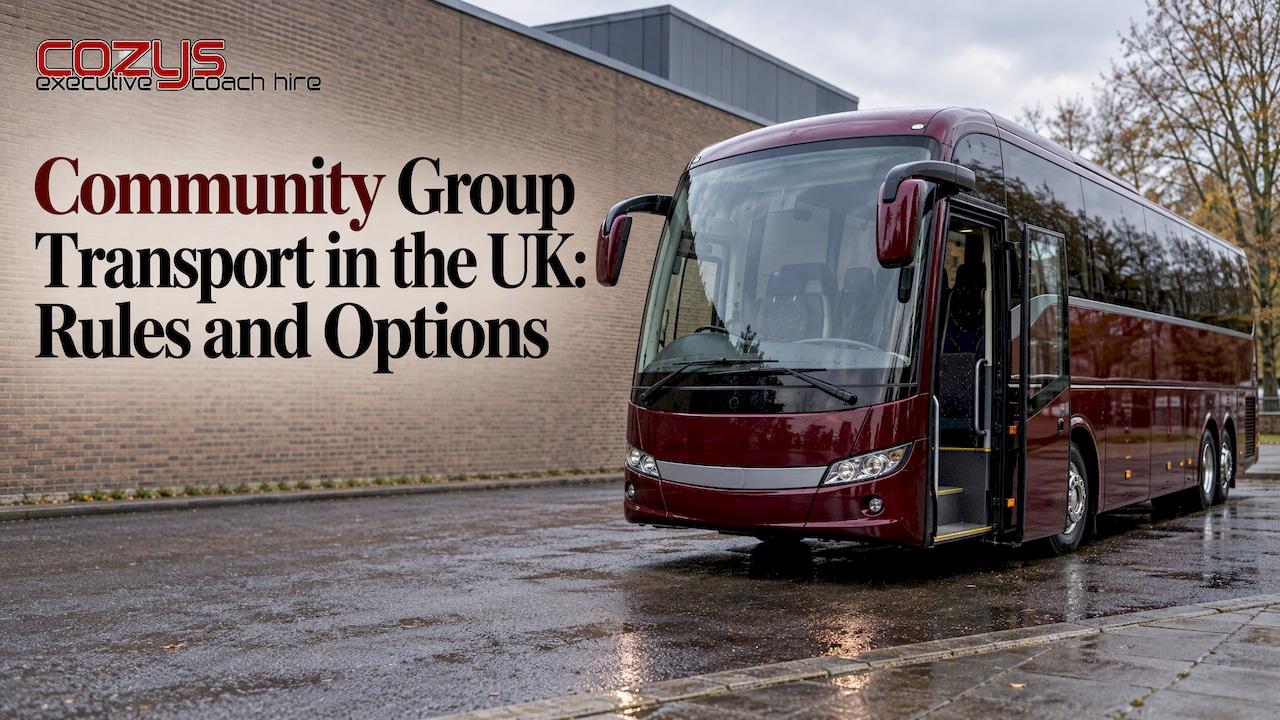
Community group transport in the UK means moving the members of a club, charity, school, care group or local organisation together, in a minibus or coach, with a driver and a vehicle that meet the legal and accessibility rules for the people on board. Groups can run their own minibus under a permit, or hire a licensed operator. For most organisations, hiring a family-run operator with a published safety rating, accessible vehicles and decades of contract experience removes the permit, driver-hours and compliance work from the organiser's desk. That is the work we do at Cozys: coach hire from 16 to 85 seats, including wheelchair-accessible vehicles.
TL;DR
- Community transport covers everything from volunteer car schemes to group hire, community buses and home-to-school contracts, and each service type suits a different need.
- Charging passengers normally requires an operator licence; not-for-profit bodies may use Section 19 or Section 22 permits instead, with limits on who can travel.
- Vehicles with more than 22 seats must meet accessibility regulations; wheelchair users need forward-facing, correctly restrained spaces and a ramp or lift.
- For children and vulnerable passengers, check DBS-checked drivers, seatbelts, risk assessments and an independent safety accreditation.
- A licensed coach operator takes the permit, driver and vehicle compliance off your hands.
Table of Contents
- What community group transport covers
- Permits and licences: what the rules say
- Accessibility: planning for wheelchair users
- Safety and safeguarding checks before you book
- Choosing the right vehicle and service
- Hire the group transport that fits
- Our perspective
- FAQ
- Sources
What community group transport covers
The Community Transport Association (CTA) describes community transport as transport run by the community for the community. Its services range from voluntary car schemes and dial-a-ride to community buses, school and hospital transport, wheels to work and group hire. Most are door-to-door and respond to demand.
Scale is real. North Northamptonshire's 2024 Bus Service Improvement Plan reports that community transport operators provide about 70,000 journeys a year under Section 19 permits and volunteer driver schemes, around 1,000 of them for wheelchair users, mainly for shopping and medical trips.
For an organiser, the practical question is which service fits. The CTA toolkit stresses that not every type suits every situation: a lunch club needing a weekly door-to-door run is different from a charity taking sixty members to a day trip, or a local authority needing a daily school route.
| Need | Typical service |
|---|---|
| Weekly outing for 10 to 16 people | Minibus with driver |
| Day trip or event for 17 to 85 people | Coach hire |
| Wheelchair users in the party | Accessible minibus or coach with ramp or lift |
| Daily pupil journeys | Home-to-school contract |
| Staff or customer travel | Corporate group transport |
Permits and licences: what the rules say
The CTA's Essential Obligations Guide, published via a council, states that an organisation accepting any payment for passenger transport needs a PSV operator licence or a private hire licence. Not-for-profit bodies can instead use a Section 19 or Section 22 permit under the Transport Act 1985. The most common is a standard Section 19 permit for minibuses with 9 to 16 passenger seats.
The Senior Traffic Commissioner's Statutory Document 13 adds the limits that catch groups out:
- A Section 19 permit may be standard (up to 16 passengers) or large bus (17 or more).
- It may carry only the organisation's members or the people it exists to help, not the general public.
- A Section 22 community bus permit covers local services under 15 miles that can carry the public.
- Permits last a maximum of five years.
The Traffic Commissioners' 2024-25 annual report says they are revising guidance for permit holders with the DfT and the CTA, so check the current guidance before applying or renewing. Our step-by-step guide to a Section 19 permit for community groups covers the application route.
Who can drive the minibus
GOV.UK explains that for a minibus not used for hire or reward, a driver may use a car licence if conditions are met: no trailer, a maximum authorised mass up to 3,500kg (4,250kg for electric or hydrogen vehicles), and Group 2 medical standards if over 70. Calderdale Council's guidance, citing the 1999 driving licence regulations, adds that volunteers must be 21 or over, hold a category B licence for at least two years and receive only out-of-pocket expenses. It recommends annual licence checks with records kept.
These conditions are why many groups find a volunteer-run vehicle stretches their trustees. A hired coach arrives with a professional, licensed driver, so none of these conditions fall on your volunteers.

Accessibility: planning for wheelchair users
DfT guidance on demand responsive transport sets out that public service vehicles designed for more than 22 passengers should meet the PSV Accessibility Regulations. These include a wheelchair space and a boarding ramp or lift. Smaller vehicles should provide equivalent accessibility, with enough wheelchair-accessible vehicles for users to travel with the same freedom as others.
Surrey County Council's 2026 specification requires wheelchair passengers to be carried forward-facing, with compliant tail-lifts or ramps, lifting equipment tested annually under LOLER and PUWER, and correct restraints fixed to floor tracking. These are sensible benchmarks for any organiser.

When you book, state the number of wheelchair users, the type of chair and any need for a passenger assistant. Our guides to wheelchair accessible coach standards and wheelchair group transport options set out the questions to ask. Our Accessible Specialists service is built around this kind of journey.
For school groups with special educational needs, see SEND school trip transport.
Safety and safeguarding checks before you book
The Department for Education's home-to-school guidance requires DBS safeguarding checks for drivers and escorts who have contact with children, up-to-date driver and escort training, and seatbelts on coaches and minibuses carrying groups of children aged 3 to 15 on organised trips. The same guidance points to independent accreditation such as the BUSK Benchmark, which audits operators on legal and safety compliance.
North Yorkshire Council's April 2025 supplier guidance asks for:
- A route risk assessment before the service starts, reviewed regularly.
- A driving risk assessment.
- Written incident and emergency procedures kept in the vehicle.
- Incident reporting to the council.
- Supervision of passengers, including children and wheelchair users, during any breakdown.
Cozys holds the highest 6-star BUSK safety rating. Our guides on coach driver DBS checks, coach risk assessments and avoiding unlicensed operators walk through each check in practice.
Choosing the right vehicle and service
Start with numbers and needs, not price. Count passengers, wheelchair users and escorts; map the route, stopping points and journey time; then match the vehicle. Our fleet runs from 16 to 85 seats, so a group can move from a minibus to a full coach without changing operator. We also run the UK's first hybrid coach for groups who want a lower-emission journey.
Different organisers have different priorities:
- Local authorities need dependable daily contracts, DBS-checked staff and documented risk assessments. See our home-to-school transport.
- Private schools need trip and daily transport with safeguarding built in. See Schools & Colleges and our guide to private school transport options.
- Corporate clients need punctual staff and event movements. See Corporate and our note on event transport compliance.
- Community organisations and social groups need flexible, accessible outings. See Group Travel.
For trips with overnight stays, our guide to residential school trip transport covers the planning.
Hire the group transport that fits
We are a family-run operator with over four decades of group travel experience. Our work includes contracts for organisations such as Tesco and the RAF, accessible transport for wheelchair users and home-to-school routes for local authorities and private schools. Tell us the group size, date, route and access needs through our Group Travel page and we will advise on the right vehicle.
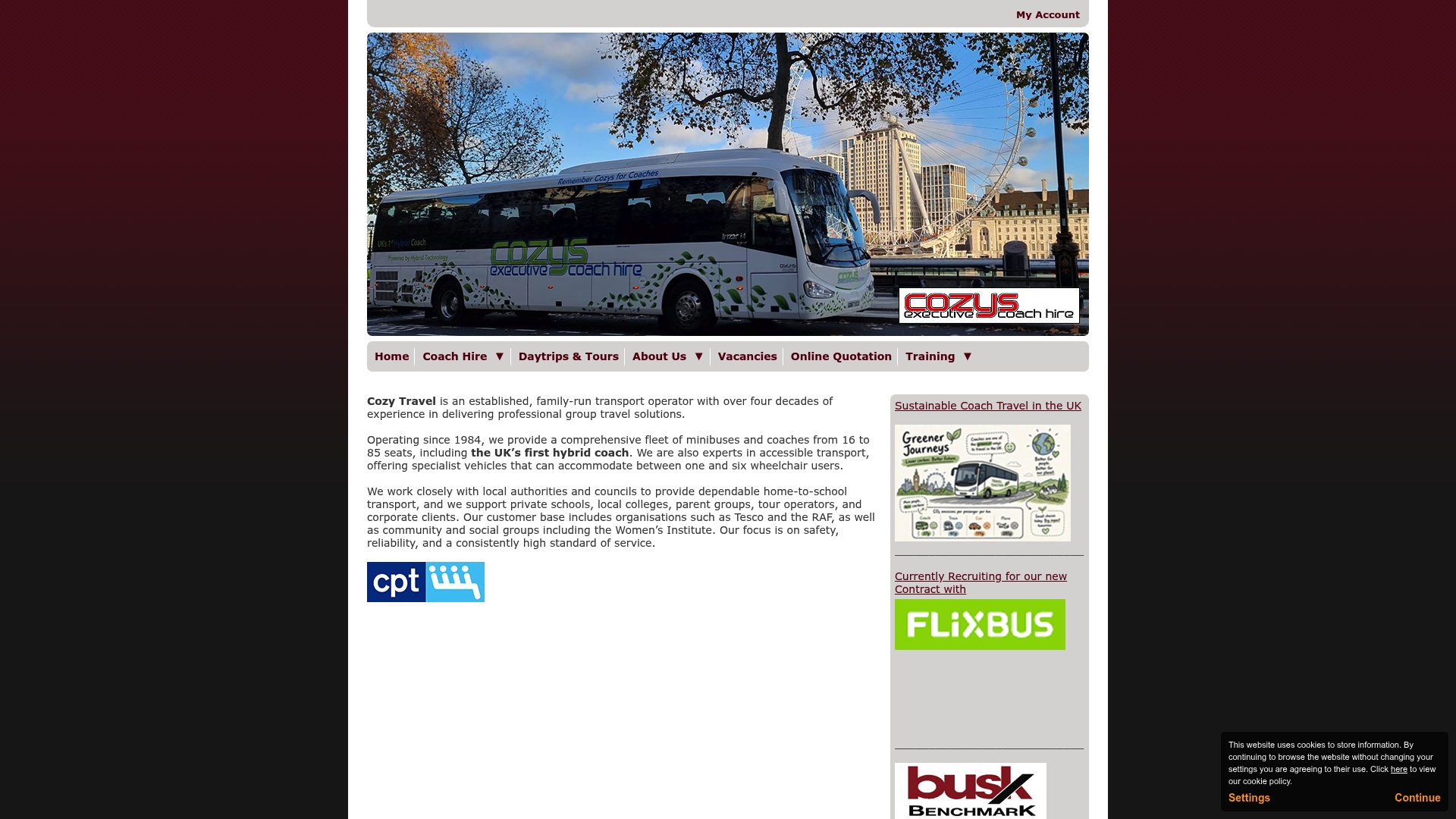
Based near Hertfordshire and Bedfordshire, we also serve local groups from Luton, Hitchin, Letchworth and Baldock and Huntingdon.
Our perspective
Community groups carry a real responsibility for the people they move. A permit, a driver's licence check, a wheelchair restraint and a risk assessment are each small tasks, but together they take trustees and volunteers away from the work their group exists to do.
Our view is that the safest place for those tasks is with an operator that does them every day. We have run group travel for over forty years, and the highest 6-star BUSK rating is the independent measure of how we handle legal and safety compliance. Our accessible vehicles and our hybrid coach mean a group does not have to trade inclusion or sustainability against reliability.
When a group tells us who is travelling and where, we build the journey around them.
Cozys
FAQ
Do community groups need a licence to run group transport?
If you accept any payment for carrying passengers, you normally need a PSV operator licence or a private hire licence. Not-for-profit bodies may use a Section 19 or Section 22 permit instead, with limits on who can travel. Hiring a licensed operator avoids the application altogether.
Can a Section 19 permit carry the general public?
No. A Section 19 permit allows only the organisation's members or the people it exists to help. Section 22 community bus permits cover local services of under 15 miles that can carry the public.
What should a wheelchair-accessible group journey include?
Larger vehicles of more than 22 seats should meet PSV accessibility rules, with a wheelchair space and a ramp or lift. Wheelchairs should travel forward-facing with correct restraints. Tell the operator about every wheelchair user and any assistant at the time of booking.
What checks matter most for children's groups?
DBS-checked drivers and escorts, seatbelts, written risk assessments and emergency procedures in the vehicle. An independent accreditation such as the BUSK Benchmark shows an operator's compliance has been audited.
Sources
- North Northamptonshire Bus Service Improvement Plan 2024
- Community Transport Association: What is Community Transport?
- CTA toolkit: Setting Up a Community Transport Service
- CTA Essential Obligations Guide
- Senior Traffic Commissioner Statutory Document 13
- Traffic Commissioners Annual Report 2024-25
- GOV.UK: Driving a minibus
- Calderdale Council minibus guidance
- GOV.UK: Demand responsive transport
- Surrey County Council 2026 transport specification
- DfE home-to-school travel and transport statutory guidance
- North Yorkshire Council best practice guidance for transport suppliers, April 2025
Recommended
- Wheelchair Group Transport Options for UK Organisations
- Avoid Unlicensed Operators: 4 Legal Checks for UK Group Transport
- 6 Steps to a Successful Section 19 Permit for UK Community Groups
- Care Home Outing Transport: How to Plan Safe, Accessible Trips
This article is produced as general information only and is not professional advise.